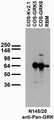
Anti-Pan-GRK (N145/20)
Our mouse Pan-GRK monoclonal antibody from NeuroMab is produced in-house from clone N145/20. It detects human, mouse, and rat Pan-GRK and is purified by Protein A chromatography. Works in WB, ICC, ELISA.
Human, Mouse, Rat
ELISA, ICC, WB
Mouse
SKU: 75-179
Ships: 1-2 business days
Product Details
Pan-GRK
G protein-coupled receptor (GPCR) kinases (GRKs), are important regulators of GPCR function and mediate receptor desensitization, internalization, and signaling. Several non-GPCR proteins also serve as GRK substrates, and GRKs have been shown to have kinase-independent functions through regulation of receptors and effectors. These proteins are members of the G protein-coupled receptor kinase subfamily of the Ser/Thr protein kinase family. GRKs phosphorylate activated forms of G protein-coupled receptors to regulate their signaling.
Purified by Protein A chromatography
1 mg/mL
Monoclonal
N145/20
IgG1
ELISA, ICC, WB
Mouse
Grk5 Gprk5 Grk6 Gprk6
70 kDa
Fusion protein amino acids 381-590 (C-terminus) of mouse GRK5 (accession number Q8VEB1) produced recombinantly in E. Coli
Mouse
Human, Mouse, Rat
AB_2232788
Aliquot and store at ≤ -20°C for long term storage. For short term storage, store at 2-8°C. For maximum recovery of product, centrifuge the vial prior to removing the cap.
Liquid
Produced by in vitro bioreactor culture of hybridoma line followed by Protein A affinity chromatography. Purified mAbs are >90% specific antibody.
10 mM Tris, 50 mM Sodium Chloride, 0.065% Sodium Azide pH 7.107
Unconjugated
Cross-reacts with GRK6
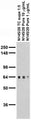
Each new lot of antibody is quality control tested by western blot on rat whole brain lysate and confirmed to stain the expected molecular weight band.
These antibodies are to be used as research laboratory reagents and are not for use as diagnostic or therapeutic reagents in humans.
United States
24 months from date of receipt
Gprk5; G protein-coupled receptor kinase 5; g protein-coupled receptor kinase GRK5; EC 2.7.11.16; G protein-coupled receptor kinase GRK5 G protein-coupled receptor kinase 6; G protein-coupled receptor kinase GRK6
Q8VEB1
UniProt Summary: Serine/threonine kinase that phosphorylates preferentially the activated forms of a variety of G-protein-coupled receptors (GPCRs). Such receptor phosphorylation initiates beta-arrestin-mediated receptor desensitization, internalization, and signaling events leading to their down-regulation. Phosphorylates a variety of GPCRs, including adrenergic receptors, muscarinic acetylcholine receptors (more specifically Gi-coupled M2/M4 subtypes), dopamine receptors and opioid receptors. In addition to GPCRs, also phosphorylates various substrates: Hsc70-interacting protein/ST13, TP53/p53, HDAC5, and arrestin-1/ARRB1. Phosphorylation of ARRB1 by GRK5 inhibits G-protein independent MAPK1/MAPK3 signaling downstream of 5HT4-receptors. Phosphorylation of HDAC5, a repressor of myocyte enhancer factor 2 (MEF2) leading to nuclear export of HDAC5 and allowing MEF2-mediated transcription. Phosphorylation of TP53/p53, a crucial tumor suppressor, inhibits TP53/p53-mediated apoptosis. Phosphorylation of ST13 regulates internalization of the chemokine receptor. Phosphorylates rhodopsin (RHO) (in vitro) and a non G-protein-coupled receptor, LRP6 during Wnt signaling (in vitro).
14773
Shipped on ice packs