Anti-Caspase-3 (p17 subunit) Antibody (31A1067)
Our Caspase-3 (p17 subunit) primary antibody from PhosphoSolutions is mouse monoclonal. It detects human, mouse, and rat Caspase-3 (p17 subunit) and is Protein G purified. It is great for use in WB, IHC.
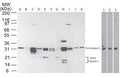
Western blot analysis of Caspase-3 in multiple human tissues using CM4911 at 1:100. The tissues shown are A) brain, B) heart, C) intestine, D) kidney, E) liver, F) lung, G) muscle, H) stomach, I) spleen, J) ovary, and K) testis. Lanes 1, 2 and 3 demonstrate the species crossreactivity of the antibody in human, mouse and rat heart lysate, respectively.
Click on image to zoom

SKU: CM4911
Ships: 1-2 business days
Product Details
Caspase-3 (p17 subunit)
The caspases are a group of cysteine enzymes, which cleave proteins in response to intrinsic and extrinsic pathways that cause apoptotic cell death. The caspases can be grouped into two subgroups based on their roles in apoptosis. Initiator caspases (caspases 2, 8, 9, and 10) are activated through the apoptosis-signaling pathways and activate the effector caspases (caspases 3, 6, and 7) which carry out apoptosis. Caspase cascades are initiated through assembly of multiprotein complexes that trigger activation of the initiator caspases, which are then released and are able to activate the downstream effector caspases.
Protein G Purified
Monoclonal
31A1067
IgG1
ELISA, IHC, WB
Mouse
CASP3
32
Clone 31A1067 was developed against full-length recombinant human Caspase-3. The antibody recognizes an epitope in the large domain subunit (p17) of Caspase-3, and it will recognize pro Caspase-3 and the p17 cleavage fragment.
Human
Human, Mouse, Rat
Storage at -20°C is recommended, as aliquots may be taken without freeze/thawing due to presence of 50% glycerol. Stable for at least 1 year at -20°C.
Liquid
PBS + 1 mg/ml BSA, 0.05% NaN3 and 50% glycerol
WB: 1:250
Unconjugated
The antibody detects pro Caspase-3 at 32 kDa* and the large subunit of the cleaved form of Caspase-3 at 14-21 kDa. The antibody can be used for western blot, immunohistochemistry and immuno-electron microscopy.
Western blots performed on each lot.
For research use only. Not intended for therapeutic or diagnostic use. Use of all products is subject to our terms and conditions, which can be viewed on our website.
United States
After date of receipt, stable for at least 1 year at -20°C.
CPP32; Yama; SCA-1; caspase-3; CASP-3; CPP-32; PARP cleavage protease; SREBP cleavage activity 1; apopain; caspase 3; apoptosis-related cysteine peptidase; apoptosis-related cysteine protease; cysteine protease CPP32; procaspase3; protein Yama; CASP3
P42574
UniProt Summary: Thiol protease that acts as a major effector caspase involved in the execution phase of apoptosis. Following cleavage and activation by initiator caspases (CASP8, CASP9 and/or CASP10), mediates execution of apoptosis by catalyzing cleavage of many proteins. At the onset of apoptosis, it proteolytically cleaves poly(ADP-ribose) polymerase PARP1 at a '216-Asp-|-Gly-217' bond. Cleaves and activates sterol regulatory element binding proteins (SREBPs) between the basic helix-loop-helix leucine zipper domain and the membrane attachment domain. Cleaves and activates caspase-6, -7 and -9 (CASP6, CASP7 and CASP9, respectively). Cleaves and inactivates interleukin-18 (IL18). Involved in the cleavage of huntingtin. Triggers cell adhesion in sympathetic neurons through RET cleavage. Cleaves DSG2 in response to apoptosis resulting in a loss of full length DSG2 at desmosome cell junctions and subsequent loss of cell-cell adhesion. Also cleaves JUP in response to apoptosis. Cleaves and inhibits serine/threonine-protein kinase AKT1 in response to oxidative stress. Acts as an inhibitor of type I interferon production during virus-induced apoptosis by mediating cleavage of antiviral proteins CGAS, IRF3 and MAVS, thereby preventing cytokine overproduction. Also involved in pyroptosis by mediating cleavage and activation of gasdermin-E (GSDME). Cleaves XRCC4 and phospholipid scramblase proteins XKR4, XKR8 and XKR9, leading to promote phosphatidylserine exposure on apoptotic cell surface. Cleaves BIRC6 following inhibition of BIRC6-caspase binding by DIABLO/SMAC.
836
Blue Ice