
Anti-Caspase-6 (C-terminal region) Antibody (M378)
Our Caspase-6 (C-terminal region) primary antibody from PhosphoSolutions is mouse monoclonal. It detects human Caspase-6 (C-terminal region) and is Protein A purified. It is great for use in WB.
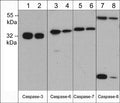
Western blot analysis of Caspase expression in human Jurkat cells. The blot was probed with anti-Caspase-3 at 1:500 (lane 1) and 1:1000 (lane 2), anti-Caspase-6 at 1:250 (lane 3) and 1:500 (lane 4), anti-Caspase-7 at 1:500 (lane 5) and 1:1000 (lane 6), as well as anti-Caspase-8 at 1:250 (lane 7) and 1:500 (lane 8).
Click on image to zoom

SKU: CM3781
Ships: 1-2 business days
Product Details
Caspase-6 (C-terminal region)
The caspases are a group of cysteine enzymes, which cleave proteins in response to intrinsic and extrinsic pathways that cause apoptotic cell death. The caspases can be grouped into two subgroups based on their roles in apoptosis. Initiator caspases (caspases 2, 8, 9, and 10) are activated through the apoptosis-signaling pathways and activate the effector caspases (caspases 3, 6, and 7) which carry out apoptosis. Caspase cascades are initiated through assembly of multiprotein complexes that trigger activation of the initiator caspases, which are then released and are able to activate the downstream effector caspases.
Protein A Purified
Monoclonal
M378
IgG1
ELISA, WB
Mouse
CASP6
34
Clone (M378) was generated from a peptide containing amino acid residues in the C-terminal region of human Caspase-6.
Human
Human
Storage at -20°C is recommended, as aliquots may be taken without freeze/thawing due to presence of 50% glycerol. Stable for at least 1 year at -20°C.
Liquid
PBS + 1 mg/ml BSA, 0.05% NaN3 and 50% glycerol
WB: 1:250
Unconjugated
The antibody detects a 34 kDa* protein corresponding to the molecular weight of Caspase-6 on SDS-PAGE immunoblots of human Jurkat, K562, and A431 cells.
Western blots performed on each lot.
For research use only. Not intended for therapeutic or diagnostic use. Use of all products is subject to our terms and conditions, which can be viewed on our website.
United States
After date of receipt, stable for at least 1 year at -20°C.
MCH2; Caspase-6; apoptotic protease MCH-2; caspase 6; apoptosis-related cysteine peptidase; apoptosis-related cysteine protease; CASP-6; Mch-2; p18 p11
P55212
UniProt Summary: Cysteine protease that plays essential roles in programmed cell death, axonal degeneration, development and innate immunity. Acts as a non-canonical executioner caspase during apoptosis: localizes in the nucleus and cleaves the nuclear structural protein NUMA1 and lamin A/LMNA thereby inducing nuclear shrinkage and fragmentation. Lamin-A/LMNA cleavage is required for chromatin condensation and nuclear disassembly during apoptotic execution. Acts as a regulator of liver damage by promoting hepatocyte apoptosis: in absence of phosphorylation by AMP-activated protein kinase (AMPK), catalyzes cleavage of BID, leading to cytochrome c release, thereby participating in nonalcoholic steatohepatitis. Cleaves PARK7/DJ-1 in cells undergoing apoptosis. Involved in intrinsic apoptosis by mediating cleavage of RIPK1. Furthermore, cleaves many transcription factors such as NF-kappa-B and cAMP response element-binding protein/CREBBP. Cleaves phospholipid scramblase proteins XKR4 and XKR9. In addition to apoptosis, involved in different forms of programmed cell death. Plays an essential role in defense against viruses by acting as a central mediator of the ZBP1-mediated pyroptosis, apoptosis, and necroptosis (PANoptosis), independently of its cysteine protease activity. PANoptosis is a unique inflammatory programmed cell death, which provides a molecular scaffold that allows the interactions and activation of machinery required for inflammasome/pyroptosis, apoptosis and necroptosis. Mechanistically, interacts with RIPK3 and enhances the interaction between RIPK3 and ZBP1, leading to ZBP1-mediated inflammasome activation and cell death. Plays an essential role in axon degeneration during axon pruning which is the remodeling of axons during neurogenesis but not apoptosis. Regulates B-cell programs both during early development and after antigen stimulation.
839
Blue Ice

