
Anti-MMACHC Antibody (N230/21)
Our mouse MMACHC monoclonal antibody from NeuroMab is produced in-house from clone N230/21. It detects human and mouse MMACHC and is purified by Protein A chromatography. Works in WB, ICC, ELISA.
Human, Mouse
ELISA, ICC, WB
Mouse
SKU: 75-239
Ships: 1-2 business days
Product Details
MMACHC
Metabolism of Cobalamin Associated C is encoded by the gene MMACHC. MMACHC is a member of the MMACHC family. MMACHC may have a role in the binding and intracellular trafficking of of cobalamin. MMACHC is widely expressed with higher levels in the liver, spleen, lymph nodes, thymus, and bone marrow. Diseases associated with MMACHC include Methylmalonic Aciduria and Homocystinuria, Cblc Type and Methylmalonic Acidemia with Homocystinuria.
Purified by Protein A chromatography
1 mg/mL
Monoclonal
N230/21
IgG1
ELISA, ICC, WB
Mouse
MMACHC
32 kDa
Fusion protein amino acids 1-282 (full-length) of human MMACHC (accession number Q9Y4U1) produced recombinantly in E. Coli
Human
Human, Mouse
AB_10673577
Aliquot and store at ≤ -20°C for long term storage. For short term storage, store at 2-8°C. For maximum recovery of product, centrifuge the vial prior to removing the cap.
Liquid
Produced by in vitro bioreactor culture of hybridoma line followed by Protein A affinity chromatography. Purified mAbs are >90% specific antibody.
10 mM Tris, 50 mM Sodium Chloride, 0.065% Sodium Azide pH 7.125
Unconjugated
No cross-reactivity reported
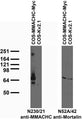
Each new lot of antibody is quality control tested on cells overexpressing target protein and confirmed to give the expected staining pattern.
These antibodies are to be used as research laboratory reagents and are not for use as diagnostic or therapeutic reagents in humans.
United States
24 months from date of receipt
cblC; Methylmalonic aciduria and homocystinuria type C protein; cyanocobalamin reductase (cyanide-eliminating; EC 1.16.1.-; Cyanocobalamin reductase; cyanide-eliminating
Q9Y4U1
UniProt Summary: Cobalamin (vitamin B12) cytosolic chaperone that catalyzes the reductive decyanation of cyanocob(III)alamin (cyanocobalamin, CNCbl) to yield cob(II)alamin and cyanide, using FAD or FMN as cofactors and NADPH as cosubstrate. Cyanocobalamin constitutes the inactive form of vitamin B12 introduced from the diet, and is converted into the active cofactors methylcobalamin (MeCbl) involved in methionine biosynthesis, and 5'-deoxyadenosylcobalamin (AdoCbl) involved in the TCA cycle. Forms a complex with the lysosomal transporter ABCD4 and its chaperone LMBRD1, to transport cobalamin across the lysosomal membrane into the cytosol. The processing of cobalamin in the cytosol occurs in a multiprotein complex composed of at least MMACHC, MMADHC, MTRR (methionine synthase reductase) and MTR (methionine synthase) which may contribute to shuttle safely and efficiently cobalamin towards MTR in order to produce methionine. Also acts as a glutathione transferase by catalyzing the dealkylation of the alkylcob(III)alamins MeCbl and AdoCbl, using the thiolate of glutathione for nucleophilic displacement to generate cob(I)alamin and the corresponding glutathione thioether. The conversion of incoming MeCbl or AdoCbl into a common intermediate cob(I)alamin is necessary to meet the cellular needs for both cofactors. Cysteine and homocysteine cannot substitute for glutathione in this reaction.
25974
Shipped on ice packs

