
Anti-Flrt3 Antibody (N353/13)
Our mouse Flrt3 monoclonal antibody from NeuroMab is produced in-house from clone N353/13. It detects mouse Flrt3 and is purified by Protein A chromatography. Works in ICC, ELISA.
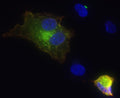
SKU: 75-328
Ships: 1-2 business days
Product Details
Flrt3
Fibronectin Leucine Rich Transmembrane Protein 3 is encoded by the gene FLRT3. FLRT3 is a member of the fibronectin leucine rich transmembrane (FLRT) family. FLRT3 functions in cell-cell adhesion, cell migration, and axon guidance, exerting an attractive or repulsive role depending on its interaction partners. FLRT3 is expressed in adult brain, embryonic rostral thalamus neurons, and the neonate eye. Diseases associated with FLRT3 included Hypogonadotropic Hypogonadism 21 With or Without Anosmia, Kallmann Syndrome, and Hypogonadotropic Hypogonadism 7 With or Without Anosmia.
Purified by Protein A chromatography
1 mg/mL
Monoclonal
N353/13
IgG1
ELISA, ICC
Mouse
Flrt3 Kiaa1469
73 kDa
Fusion protein amino acids 29-526 (extracellular domain) of mouse Flrt3 (accession number Q8BGT1) produced recombinantly in E. Coli
Mouse
Mouse
AB_2315833
Aliquot and store at ≤ -20°C for long term storage. For short term storage, store at 2-8°C. For maximum recovery of product, centrifuge the vial prior to removing the cap.
Liquid
Produced by in vitro bioreactor culture of hybridoma line followed by Protein A affinity chromatography and conjugation of purified mAb. Purified mAbs are >90% specific antibody.
10 mM Tris, 50 mM Sodium Chloride, 0.065% Sodium Azide pH 7.125
Unconjugated
No cross-reactivity against Flrt1 or Flrt2
Each new lot of antibody is quality control tested on cells overexpressing target protein and confirmed to give the expected staining pattern.
These antibodies are to be used as research laboratory reagents and are not for use as diagnostic or therapeutic reagents in humans.
United States
24 months from date of receipt
5530600M07Rik; Leucine-rich repeat transmembrane protein FLRT3; mKIAA1469; Fibronectin leucine rich transmembrane protein 3
Q8BGT1
UniProt Summary: Functions in cell-cell adhesion, cell migration and axon guidance, exerting an attractive or repulsive role depending on its interaction partners. Plays a role in the spatial organization of brain neurons. Plays a role in vascular development in the retina. Plays a role in cell-cell adhesion via its interaction with ADGRL3 and probably also other latrophilins that are expressed at the surface of adjacent cells. Interaction with the intracellular domain of ROBO1 mediates axon attraction towards cells expressing NTN1. Mediates axon growth cone collapse and plays a repulsive role in neuron guidance via its interaction with UNC5B, and possibly also other UNC-5 family members. Promotes neurite outgrowth (in vitro). Mediates cell-cell contacts that promote an increase both in neurite number and in neurite length. Plays a role in the regulation of the density of glutamaergic synapses. Plays a role in fibroblast growth factor-mediated signaling cascades. Required for normal morphogenesis during embryonic development, but not for normal embryonic patterning. Required for normal ventral closure, headfold fusion and definitive endoderm migration during embryonic development. Required for the formation of a normal basement membrane and the maintenance of a normal anterior visceral endoderm during embryonic development.
71436
Shipped on ice packs

