Our Anti-CaM Kinase II (Thr286) rabbit polyclonal phosphospecific primary antibody from PhosphoSolutions is produced in-house. It detects human, mouse, rabbit, and rat CaM Kinase II (Thr286) and is antigen affinity purified from pooled serum. It is great for use in WB, IHC.
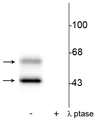
Western blot of rat brain lysate showing specific immunolabeling of the ~50 kDa α- and the ~60 kDa β-CaM Kinase II phosphorylated at Thr286 in the first lane (-). Phosphospecificity is shown in the second lane (+) where the immunolabeling is completely eliminated by blot treatment with lambda phosphatase (λ-Ptase, 1200 units for 30 minutes).
Ca2+/calmodulin-dependent protein kinase II (CaM Kinase II) is a multi-functional calcium and calmodulin-dependent protein kinase that mediates cellular responses to a wide variety of intercellular signals (Kennedy, 1998; Schulman and Hanson, 1993). CaM Kinase II has been shown to regulate diverse cellular functions including synaptic plasticity, neurotransmitter synthesis and release, gene expression, ion channel function, carbohydrate metabolism, cytoskeletal function, and Ca2+-homeostasis (Gleason et al., 2003; Soderling, 2000; Hudmon and Schulman, 2002). Phosphorylation of Thr-286 on the kinase produces an autonomously active form of CaM Kinase II (Meng et al., 2003; Picciotto et al., 1993). Autophosphorylation of Thr-305 inhibits the activity CaM Kinase II. Phosphorylation at this site appears to reduce the association of CaM Kinase II with the PSD and reduce LTP and learning (Elgersma et al., 2002).
Antigen Affinity Purified from Pooled Serum
Polyclonal
IgG
ELISA, ICC, IHC, WB
Rabbit
CAMK2A/B
50/60 kDa
Synthetic phospho-peptide corresponding to amino acid residues surrounding Thr286 of rat CaMKII, conjugated to keyhole limpet hemocyanin (KLH).
Rat
Human, Mouse, Rabbit, Rat
Zebrafish
AB_2492051
Storage at -20°C is recommended, as aliquots may be taken without freeze/thawing due to presence of 50% glycerol. Stable for at least 1 year at -20°C.
Liquid
Prepared from pooled rabbit serum by affinity purification via sequential chromatography on phospho and non-phosphopeptide affinity columns.
10 mM HEPES (pH 7.5), 150 mM NaCl, 100 µg per ml BSA and 50% glycerol.
WB: 1:1000
WB Brain: 1:1000
IHC: 1:1000
Unconjugated
Specific for endogenous levels of the ~50 kDa α-CaM Kinase II and the ~60 kDa β-CaM Kinase II proteins phosphorylated at Thr286. Immunolabeling is completely eliminated by treatment with λ-phosphatase.
Phosphorylated
Thr286
Western blots performed on each lot.
For research use only. Not intended for therapeutic or diagnostic use. Use of all products is subject to our terms and conditions, which can be viewed on our website.
After date of receipt, stable for at least 1 year at -20°C.
Calcium/calmodulin dependent protein kinase II alpha; Calcium/calmodulin dependent protein kinase II beta; Calcium/calmodulin dependent protein kinase II delta; Calcium/calmodulin dependent protein kinase II gamma; Calcium/calmodulin-dependent protein kinase type II subunit alpha; CaM kinase II alpha; CaM kinase II; CaM kinase II beta; CaM kinase II delta; CaM kinase II gamma; CaM kinase II subunit alpha; CaMK-II subunit alpha; CAMK2; Camk2a; CAMK2B; CAMK2D; CAMK2G; CAMKA; KCC2A_HUMAN
P11275
UniProt Summary: Calcium/calmodulin-dependent protein kinase that functions autonomously after Ca(2+)/calmodulin-binding and autophosphorylation, and is involved in various processes, such as synaptic plasticity, neurotransmitter release and long-term potentiation (PubMed:14722083). Member of the NMDAR signaling complex in excitatory synapses, it regulates NMDAR-dependent potentiation of the AMPAR and therefore excitatory synaptic transmission (By similarity). Regulates dendritic spine development (PubMed:28130356). Also regulates the migration of developing neurons (PubMed:29100089). Phosphorylates the transcription factor FOXO3 to activate its transcriptional activity (PubMed:23805378). Phosphorylates the transcription factor ETS1 in response to calcium signaling, thereby decreasing ETS1 affinity for DNA (By similarity). In response to interferon-gamma (IFN-gamma) stimulation, catalyzes phosphorylation of STAT1, stimulating the JAK-STAT signaling pathway (PubMed:11972023). In response to interferon-beta (IFN-beta) stimulation, stimulates the JAK-STAT signaling pathway (PubMed:35568036). In response to interferon-gamma (IFN-gamma) stimulation, catalyzes phosphorylation of PSAT1, inhibiting ferroptosis by promoting GPX4 hydroxylation and stability (PubMed:40281343). Acts as a negative regulator of 2-arachidonoylglycerol (2-AG)-mediated synaptic signaling via modulation of DAGLA activity (By similarity). {ECO:0000250|UniProtKB:P11275, ECO:0000250|UniProtKB:P11798, ECO:0000269|PubMed:11972023, ECO:0000269|PubMed:23805378, ECO:0000269|PubMed:28130356, ECO:0000269|PubMed:29100089, ECO:0000269|PubMed:40281343}.





 Trial Size
 Pooled Serum