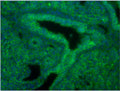
Anti-Beta-Catenin antibody
Our Anti-Beta Catenin chicken polyclonal primary antibody from Aves Labs is produced in-house. It detects human, mouse, and rat Beta Catenin, and is affinity-purified IgY. Works in IHC, ICC, WB.
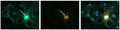
BCAT1-3 1782 × 452px Staining of COS7 cells overexpressing FLAG-tagged beta-catenin with: chicken anti-beta catenin antibody BCAT (left panel in green) showing both endogenous staining of beta catenin in COS7 cells and staining of overexpressed nuclear beta-catenin (white arrow), anti-FLAG staining of overexpressed nuclear beta-catenin (middle panel in red), and overlay (right panel) with DAPI staining of nuclei to show all cells.
Click on image to zoom
SKU: BCAT-0100
Ships: 1-2 business days
Product Details
Beta Catenin
Beta-catenin (CTNNB1) is an adherens junction protein critical for the establishment and maintenance of epithelial layers while at the same time is also a transcription factor and key downstream component of the canonical Wnt signaling pathway which regulates cell fate during development and also contributes to malignant transformation in various cancers.
Affinity Purified IgY
0.2 mg/mL
Polyclonal
IgY
ICC, IHC, WB
Chicken
CTNNB1
90 kDa
KLH-conjugated peptide encoding sequence near C-terminus of protein
Human
Human, Mouse, Rat
AB_2924439
Store at 4°C in the dark. Under these conditions, the antibodies should have a shelf life of at least twelve months, provided they remain sterile. For longer term storage, aliquot and freeze to avoid freeze-thaw of the antibody.
Liquid
Eggs from hens hyperimmunized with target were used to prepare an IgY fraction which was then subjected to antigen-specific affinity purification.
Phosphate-buffered saline (10 mM) isotonic (0.9%, w/v) saline (“PBS," pH 7.2) with sodium azide (0.02%, w/v) added as a preservative.
WB: 1:500-1:1000
IHC: 1:100-1:500
ICC: 1:100-1:500
IHC: 1:100-1:500
ICC: 1:100-1:500
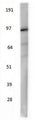
Each new lot of this antibody is tested to confirm that it recognizes a single immunoreactive band of expected molecular weight when used in Western blot on lysate from cells expressing endogenous beta catenin.
These antibodies are to be used as research laboratory reagents and are not for use as diagnostic or therapeutic reagents in humans.
United States
12 months from receipt of product
b-catenin; Beta catenin; Beta-catenin; Cadherin associated protein; Catenin (cadherin associated protein; beta 1; 88kDa; Catenin beta 1; Catenin beta-1; CATNB; CHBCAT; CTNB1_HUMAN; CTNNB; CTNNB1; DKFZp686D02253; FLJ25606; FLJ37923; OTTHUMP00000162082; OTTHUMP00000165222; OTTHUMP00000165223; OTTHUMP00000209288; OTTHUMP00000209289
P35222
UniProt Summary: Key downstream component of the canonical Wnt signaling pathway. In the absence of Wnt, forms a complex with AXIN1, AXIN2, APC, CSNK1A1 and GSK3B that promotes phosphorylation on N-terminal Ser and Thr residues and ubiquitination of CTNNB1 via BTRC and its subsequent degradation by the proteasome. In the presence of Wnt ligand, CTNNB1 is not ubiquitinated and accumulates in the nucleus, where it acts as a coactivator for transcription factors of the TCF/LEF family, leading to activate Wnt responsive genes. Also acts as a coactivator for other transcription factors, such as NR5A2. Promotes epithelial to mesenchymal transition/mesenchymal to epithelial transition (EMT/MET) via driving transcription of CTNNB1/TCF-target genes. Involved in the regulation of cell adhesion, as component of an E-cadherin:catenin adhesion complex. Acts as a negative regulator of centrosome cohesion. Involved in the CDK2/PTPN6/CTNNB1/CEACAM1 pathway of insulin internalization. Blocks anoikis of malignant kidney and intestinal epithelial cells and promotes their anchorage-independent growth by down-regulating DAPK2. Disrupts PML function and PML-NB formation by inhibiting RANBP2-mediated sumoylation of PML. Promotes neurogenesis by maintaining sympathetic neuroblasts within the cell cycle. Involved in chondrocyte differentiation via interaction with SOX9: SOX9-binding competes with the binding sites of TCF/LEF within CTNNB1, thereby inhibiting the Wnt signaling. Acts as a positive regulator of odontoblast differentiation during mesenchymal tooth germ formation, via promoting the transcription of differentiation factors such as LEF1, BMP2 and BMP4. Activity is repressed in a MSX1-mediated manner at the bell stage of mesenchymal tooth germ formation which prevents premature differentiation of odontoblasts.
1499
Ice packs