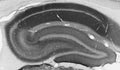
Anti-Bassoon Antibody (L124/59)
Our mouse Bassoon monoclonal antibody from NeuroMab is produced in-house from clone L124/59. It detects mouse and rat Bassoon and is purified by Protein A chromatography. Works in WB, IHC, ICC, ELISA, AT.
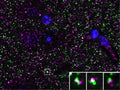
Array tomography immunofluorescence of an LRWhite-embedded 70 nm section from adult mouse cortex with L124/59 (magenta), rabbit mAb PSD-95 (Cell Signaling 3450, green) and Hoechst nuclear stain (blue). The insert shows three consecutive sections through the synapse that is marked with a white box.
Click on image to zoom
Mouse, Rat
AT, ELISA, ICC, IHC, WB
Mouse
SKU: 75-491
Ships: 1-2 business days
Product Details
Bassoon
Bassoon is a large (420-kDa) scaffolding protein specifically localized at the active zone of presynaptic nerve terminals. Bassoon is involved in the development of presynaptic terminals and in the regulation of neurotransmitter release at both excitatory and inhibitory brain synapses (Richter K. et al., 1999).
Purified by Protein A chromatography
1 mg/mL
Monoclonal
L124/59
IgG2b
AT, ELISA, ICC, IHC, WB
Mouse
Bsn
400 kDa for full-length protein, many smaller bands possible depending on sample used
Fusion protein amino acids 157-517 (zinc finger domains) of rat Bassoon (accession number O88778) produced recombinantly in E. Coli
Rat
Mouse, Rat
AB_2744564
Aliquot and store at ≤ -20°C for long term storage. For short term storage, store at 2-8°C. For maximum recovery of product, centrifuge the vial prior to removing the cap.
Liquid
Produced by in vitro bioreactor culture of hybridoma line followed by Protein A affinity chromatography. Purified mAbs are >90% specific antibody.
10 mM Tris, 50 mM Sodium Chloride, 0.065% Sodium Azide pH 7.125
IHC: 1:500
ICC: 1:500
ICC: 1:500
Unconjugated
No cross-reactivity reported
Each new lot of antibody is quality control tested by IHC on either rat or mouse brain and confirmed to give the expected staining pattern.
These antibodies are to be used as research laboratory reagents and are not for use as diagnostic or therapeutic reagents in humans.
United States
24 months from date of receipt
ZNF231; Protein bassoon; neuronal double zinc finger protein; zinc finger protein 231
O88778
UniProt Summary: Scaffold protein of the presynaptic cytomatrix at the active zone (CAZ) which is the place in the synapse where neurotransmitter is released. After synthesis, participates in the formation of Golgi-derived membranous organelles termed Piccolo-Bassoon transport vesicles (PTVs) that are transported along axons to sites of nascent synaptic contacts. At the presynaptic active zone, regulates the spatial organization of synaptic vesicle cluster, the protein complexes that execute membrane fusion and compensatory endocytosis. Also functions in processes other than assembly such as the regulation of specific presynaptic protein ubiquitination by interacting with SIAH1 or the regulation of presynaptic autophagy by associating with ATG5. Also mediates synapse to nucleus communication leading to reconfiguration of gene expression by associating with the transcriptional corepressor CTBP1 and by subsequently reducing the size of its pool available for nuclear import. Inhibits the activity of the proportion of DAO enzyme that localizes to the presynaptic active zone, which may modulate synaptic transmission.
8927
Shipped on ice packs