
Anti-NR2A Glutamate Receptor Antibody (N327A/38)
Our mouse NR2A glutamate receptor monoclonal antibody from NeuroMab is produced in-house from clone N327A/38. It detects human, mouse, and rat NR2A glutamate receptor and is TC supernatant. Works in WB, IHC, ELISA.
Human, Mouse, Rat
ELISA, IHC, WB
Mouse
SKU: 73-303
Ships: 1-2 business days
Product Details
NR2A glutamate receptor
Glutamate receptor NMDA2A or GluN2A/NR2A glutamate receptor is a member of the glutamate-gated ion channel family. NR2A is a subunit of the ligand-gated ion channel with high calcium permeability and voltage-dependent sensitivity to magnesium. NR2A is expressed throughout the brain, including striatum, forbrain, cerebellum (at protein level) brain cortex, piriform cortex, hippocampus, caudate-putamen, dentate gyrus and granule cell layer. It is found at the postsynaptic cell membrane, dendritic spine, synapse, and cytoplasmic vesicle membrane. A variety of neurological diseases, including epilepsy, intellectual disability, autism spectrum disorders, developmental delay, and schizophrenia are associated with mutations in the NR2A gene.
TC Supernatant
Lot dependent
Monoclonal
N327A/38
IgG2b
ELISA, IHC, WB
Mouse
Grin2a
170 kDa
Fusion protein amino acids 75-325 (extracellular N-terminus) of rat NR2A (accession number Q00959) produced recombinantly in E. Coli
Rat
Human, Mouse, Rat
AB_2315843
Aliquot and store at ≤ -20°C for long term storage. For short term storage, store at 2-8°C. For maximum recovery of product, centrifuge the vial prior to removing the cap.
Liquid
Supernatant is harvested from hybridoma cells grown under standard cell culture conditions
Supernatant is provided in cell culture medium with 0.1% sodium azide as anti-microbial
Unconjugated
Does not cross-react with NR2B
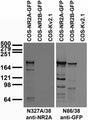
Each new lot of antibody is quality control tested on cells overexpressing target protein and confirmed to give the expected staining pattern.
These antibodies are to be used as research laboratory reagents and are not for use as diagnostic or therapeutic reagents in humans.
United States
24 months from date of receipt
EPND; Glutamate receptor ionotropic; FESD; GluN2A; GluN2A; Glutamate [NMDA receptor subunit epsilon-1; Glutamate [NMDA receptor subunit epsilon-1; N-methyl D-aspartate receptor subtype 2A; Glutamate receptor; NMDAR2A; Glutamate receptor ionotropic N methyl D aspartate 2A; NR2A; GRIN 2A; GRIN2A; hNR2A; LKS; N methyl D aspartate receptor channel subunit epsilon 1; N Methyl D Aspartate Receptor Subtype 2A; N methyl D aspartate receptor subunit 2A; N-methyl D-aspartate receptor subtype 2A; NMDA receptor subtype 2A; NMDAR 2A; NMDAR2A; NMDE1_HUMAN; NR2A; OTTHUMP00000160135; OTTHUMP00000174531; NMDA 2A
Q00959
UniProt Summary: Component of N-methyl-D-aspartate (NMDA) receptors (NMDARs) that function as heterotetrameric, ligand-gated cation channels with high calcium permeability and voltage-dependent block by Mg(2+) (Probable). NMDARs participate in synaptic plasticity for learning and memory formation by contributing to the slow phase of excitatory postsynaptic current, long-term synaptic potentiation, and learning. Channel activation requires binding of the neurotransmitter L-glutamate to the GluN2 subunit, glycine or D-serine binding to the GluN1 subunit, plus membrane depolarization to eliminate channel inhibition by Mg(2+). NMDARs mediate simultaneously the potassium efflux and the influx of calcium and sodium. Each GluN2 subunit confers differential attributes to channel properties, including activation, deactivation and desensitization kinetics, pH sensitivity, Ca2(+) permeability, and binding to allosteric modulators. Participates in the synaptic plasticity regulation through activation by the L-glutamate releaseed by BEST1, into the synaptic cleft, upon F2R/PAR-1 activation in astrocyte.
24409
Shipped on ice packs

