
Anti-Stat1 (Tyr-701), Phosphospecific Antibody (M135)
Our Stat1 (Tyr-701) mouse monoclonal phosphospecific primary antibody from PhosphoSolutions is produced in-house. It detects human, mouse, and rat Stat1 (Tyr-701) and is Protein A purified. It is great for use in WB.
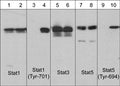
Western blot analysis of A431 cells untreated (lanes 1, 3, 5, 7, & 9) or treated with EGF (100 nM) for 60 min (lanes 2, 4, 6, 8, & 10). The blots were probed with anti-Stat1 (lanes 1 & 2), anti-Stat1 (Tyr-701) (lanes 3 & 4), anti-Stat3 (lanes 5 & 6), anti-Stat5 (lanes 7 & 8), and anti-Stat5 (Tyr-694) (lanes 9 & 10).
Click on image to zoom

SKU: SM1351
Ships: 1-2 business days
Product Details
Stat1 (Tyr-701)
The stat proteins function both as cytoplasmic signal transducers and as activators of transcription. Stat1 is expressed as two variants of 84 and 91 kDa. Stat1 proteins contain SH2 and SH3 domains, and are components of the interferon-stimulated gene factor 3 (ISGF3) complex. This complex is the primary transcription activator induced by the binding of interferon to its receptors. In response to activation by various cytokines and growth factors, stat1 subunits become phosphorylated at tyrosine 701. This leads to translocation of stat1 to the nucleus, resulting in formation of an active ISGF3 complex. Active ISGF3 modulates the transcription of the interferon-stimulated genes. Thus, phosphorylation of Tyr-701 is critical for gene expression mediated by various cytokines and growth factors.
Protein A Purified
Monoclonal
M135
IgG1
ELISA, WB
Mouse
STAT1
84/91
Clone (M135) was generated from a synthetic peptide (coupled to KLH) corresponding to amino acid residues around tyrosine 701 of human Stat1. This peptide sequence has high homology to the conserved tyrosine site in rat and mouse stat1.
Human
Human, Mouse, Rat
Storage at -20°C is recommended, as aliquots may be taken without freeze/thawing due to presence of 50% glycerol. Stable for at least 1 year at -20°C.
Liquid
PBS + 1 mg/ml BSA, 0.05% NaN3 and 50% glycerol
WB: 1:1000
Unconjugated
The antibody detects 84 and 91 kDa* stat1 variants on SDS-PAGE immunoblots of human A431 treated with EGF, as well as Jurkat and A431 cells treated with pervanadate. The antibody does not detect these variants in control cells.
Phosphorylated
Tyr-701
Western blots performed on each lot.
For research use only. Not intended for therapeutic or diagnostic use. Use of all products is subject to our terms and conditions, which can be viewed on our website.
United States
After date of receipt, stable for at least 1 year at -20°C.
CANDF7; Stat1a; IMD31B; IMD31C; ISGF-3; STAT91; transcription factor ISGF-3 components p91/p84; Stat1b; ISGF3; Stat1alpha; Stat1beta
P42224
UniProt Summary: Signal transducer and transcription activator that mediates cellular responses to interferons (IFNs), cytokine KITLG/SCF and other cytokines and other growth factors. Following type I IFN (IFN-alpha and IFN-beta) binding to cell surface receptors, signaling via protein kinases leads to activation of Jak kinases (TYK2 and JAK1) and to tyrosine phosphorylation of STAT1 and STAT2. The phosphorylated STATs dimerize and associate with ISGF3G/IRF-9 to form a complex termed ISGF3 transcription factor, that enters the nucleus. ISGF3 binds to the IFN stimulated response element (ISRE) to activate the transcription of IFN-stimulated genes (ISG), which drive the cell in an antiviral state. In response to type II IFN (IFN-gamma), STAT1 is tyrosine- and serine-phosphorylated. It then forms a homodimer termed IFN-gamma-activated factor (GAF), migrates into the nucleus and binds to the IFN gamma activated sequence (GAS) to drive the expression of the target genes, inducing a cellular antiviral state. Becomes activated in response to KITLG/SCF and KIT signaling. May mediate cellular responses to activated FGFR1, FGFR2, FGFR3 and FGFR4. Following bacterial lipopolysaccharide (LPS)-induced TLR4 endocytosis, phosphorylated at Thr-749 by IKBKB which promotes binding of STAT1 to the 5'-TTTGAGGC-3' sequence in the ARID5A promoter, resulting in transcriptional activation of ARID5A and subsequent ARID5A-mediated stabilization of IL6. Phosphorylation at Thr-749 also promotes binding of STAT1 to the 5'-TTTGAGTC-3' sequence in the IL12B promoter and activation of IL12B transcription. Involved in food tolerance in small intestine: associates with the Gasdermin-D, p13 cleavage product (13 kDa GSDMD) and promotes transcription of CIITA, inducing type 1 regulatory T (Tr1) cells in upper small intestine.
6772
Blue Ice

