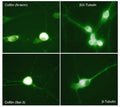
Anti-Cofilin 1 (N-terminus) Antibody
Our Cofilin 1 (N-terminus) rabbit polyclonal primary antibody from PhosphoSolutions is produced in-house. It detects chicken, human, mouse, and rat Cofilin 1 (N-terminus) and is antigen affinity purified. It is great for use in WB, ICC.
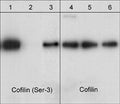
Western blot of cofilin in jurkat cells. The blots were untreated (lanes 1 & 4) or treated (lanes 2, 3, 5 & 6) with lambda phosphatase. In lanes 3 & 6, the phosphatase was inhibited with phospho-Cofilin 1 (Ser-3) peptide. The blots were probed with anti-Cofilin 1 (Ser-3) phospho-specific (lanes 1-3) or anti-Cofilin 1 (N-terminus) (lanes 4-6).
Click on image to zoom

SKU: CP1131
Ships: 1-2 business days
Product Details
Cofilin 1 (N-terminus)
Members of the ADF/cofilin (AC) family are actin-severing proteins that regulate actin remodeling during cellular events such as cell migration, cytokinesis, phagocytosis, endocytosis, axon development, and immune cell activation. In mammals, there are three members of the AC family, muscle-specific cofilin (cofilin 2), non-muscle cofilin (cofilin 1), and ADF. In humans, cofilin 1 and ADF have 72% identity, with the major amino acid differences found in the C-terminal region. Regulation of cofilin activity can occur through serine phosphorylation. Activation of cofilin kinases, LIMK1 or LIMK2, leads to phosphorylation of cofilin at serine 3. This phosphorylation disrupts cofilin binding to actin in vitro and in vivo. Multiple phosphatases, PP1, PP2A, PP2B, slingshot, and chronophin can dephosphorylate Ser-3 and activate actin binding. Thus, Ser-3 phosphorylation is a major site for the regulation of cofilin activity.
Antigen Affinity Purified
Polyclonal
IgG
ELISA, ICC, WB
Rabbit
CFL1
19
A synthetic peptide (coupled to KLH) corresponding to amino acid residues at the N-terminus of human Cofilin 1. This sequence has 100% homology with similar regions of rat and mouse Cofilin 1, and has 3 amino acid differences from human Cofilin 2.
Human
Chicken, Human, Mouse, Rat
Storage at -20°C is recommended, as aliquots may be taken without freeze/thawing due to presence of 50% glycerol. Stable for at least 1 year at -20°C.
Liquid
PBS + 1 mg/ml BSA, 0.05% NaN3 and 50% glycerol
WB: 1:1000
ICC: 1:50
ICC: 1:50
Unconjugated
The antibody detects a 19 kDa* protein corresponding to the molecular mass of Cofilin 1 on SDS-PAGE immunoblots of Jurkat cells.
Western blots performed on each lot.
For research use only. Not intended for therapeutic or diagnostic use. Use of all products is subject to our terms and conditions, which can be viewed on our website.
United States
After date of receipt, stable for at least 1 year at -20°C.
CFL; ADF; cofilin; cofilin-1; 18 kDa phosphoprotein; cofilin 1 (non-muscle; non-muscle isoform; epididymis secretory protein Li 15; p18
P23528
UniProt Summary: Binds to F-actin and exhibits pH-sensitive F-actin depolymerizing activity. In conjunction with the subcortical maternal complex (SCMC), plays an essential role for zygotes to progress beyond the first embryonic cell divisions via regulation of actin dynamics. Required for the centralization of the mitotic spindle and symmetric division of zygotes. Plays a role in the regulation of cell morphology and cytoskeletal organization in epithelial cells. Required for the up-regulation of atypical chemokine receptor ACKR2 from endosomal compartment to cell membrane, increasing its efficiency in chemokine uptake and degradation. Required for neural tube morphogenesis and neural crest cell migration.
1072
Blue Ice