Anti-Proto-oncogene tyrosine-protein kinase receptor Ret (RET) Antibody
Our Anti-Proto-oncogene tyrosine-protein kinase receptor Ret (RET) chicken polyclonal primary antibody detects human Proto-oncogene tyrosine-protein kinase receptor Ret (RET), and is purified. It is validated for use in ICC, WB.
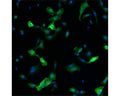
Immunofluorescence detection of human RET expressed in U2OS cells. RET was visualized using Chicken polyclonal antibody to human RET (dilution 1:500) and Goat anti-chicken IgY - H&L DyLight 550 (dilution 1:200) as secondary antibody. For nuclear staining DAPI was used. Composite picture was generated using pseudocolors green for RET specific signal and blue for nuclei.
Click on image to zoom
SKU: C-1663-100
Ships: 1-2 business days
Product Details
Proto-oncogene tyrosine-protein kinase receptor Ret (RET)
The RET proto-oncogene is a receptor tyrosine kinase for members of the glial cell line-derived neurotrophic factor family of extracellular signalling molecules
Purified
Polyclonal
IgY
ICC, WB
Chicken
Recombinant His-tagged extracellular fragment of human RET protein produced using CHO cell line. The extracellular fragment of hRET was expressed and secreted to the cell culture supernatant. Protein was purified by Ni-affinity chromatography following gel-filtration from cell culture supernatant.
Human
Human
Store antibody stock solution at +4°C upon receipt. DO NOT FREEZE. This product is an (NH4)2SO4 precipitate. To use, mix well by pipetting or vortexing gently prior use, then withdraw the desired amount of antibody stock solution and dilute into your antibody dilution buffer and use normally.Alternatively, material can be centrifuged at 10K x g for 5 minutes and the liquid sulfate solution carefully removed. Then precipitated antibody can be resuspended in 0.1M P, 250 mM NaCL, pH 7.4 solution. The solution should then be divided into working aliquots and stored at -80°C until used. Prevent multiple freeze thaw cycles of aliquots for best product life. Store at 2-8°C upon receipt; DO NOT FREEZE. As product is (NH4)2SO4 (ammonium sulfate) precipitate, mix well by pipetting or vortexing prior to use. See reconstitution instructions for more information.
Liquid
Concentrated ammonium sulphate in PBS pH 7.4
WB: 1:5000-1:10000
ICC: 1:250-1:500
ICC: 1:250-1:500
Unconjugated
Human RET.
For research use only.
United States
12 months after date of receipt (unopened vial).
CDHF12; Cadherin family member 12; HSCR1; Ret; MEN2A; MEN2B; MTC1; PTC; RET-ELE1; RET receptor tyrosine kinase; cadherin-related family member 16; proto-oncogene c-Ret; rearranged during transfection
P07949
UniProt Summary: Receptor tyrosine-protein kinase involved in numerous cellular mechanisms including cell proliferation, neuronal navigation, cell migration, and cell differentiation in response to glia cell line-derived growth family factors (GDNF, NRTN, ARTN, PSPN and GDF15). In contrast to most receptor tyrosine kinases, RET requires not only its cognate ligands but also coreceptors, for activation. GDNF ligands (GDNF, NRTN, ARTN, PSPN and GDF15) first bind their corresponding GDNFR coreceptors (GFRA1, GFRA2, GFRA3, GFRA4 and GFRAL, respectively), triggering RET autophosphorylation and activation, leading to activation of downstream signaling pathways, including the MAPK- and AKT-signaling pathways. Acts as a dependence receptor via the GDNF-GFRA1 signaling: in the presence of the ligand GDNF in somatotrophs within pituitary, promotes survival and down regulates growth hormone (GH) production, but triggers apoptosis in absence of GDNF. Required for the molecular mechanisms orchestration during intestine organogenesis via the ARTN-GFRA3 signaling: involved in the development of enteric nervous system and renal organogenesis during embryonic life, and promotes the formation of Peyer's patch-like structures, a major component of the gut-associated lymphoid tissue. Mediates, through interaction with GDF15-receptor GFRAL, GDF15-induced cell-signaling in the brainstem which triggers an aversive response, characterized by nausea, vomiting, and/or loss of appetite in response to various stresses. Modulates cell adhesion via its cleavage by caspase in sympathetic neurons and mediates cell migration in an integrin (e.g. ITGB1 and ITGB3)-dependent manner. Also active in the absence of ligand, triggering apoptosis through a mechanism that requires receptor intracellular caspase cleavage. Triggers the differentiation of rapidly adapting (RA) mechanoreceptors. Involved in the development of the neural crest. Regulates nociceptor survival and size. Phosphorylates PTK2/FAK1.

5979
2-8°C (on cold packs)