
Anti-Presenilin 1 loop region Antibody
Our Anti-Presenilin 1 loop region rabbit polyclonal primary antibody detects human and mouse Presenilin 1 loop region, and is IgG. It is validated for use in WB.
SKU: R-1680-500
Ships: 1-2 business days
Product Details
Presenilin 1 loop region
Presenilin-1 (PSEN1) is a multi-pass membrane protein and component of the gamma-secretase complex. PSEN1 is thought to play a role in intracellular signaling and gene expression or in linking chromatin to the nuclear membrane. It may also play a role in hematopoiesis. Defects in PSEN1 are a cause of Alzheimer disease type 3 (AD3), a familial early-onset form of Alzheimer disease (Ref:SWISS-Prot).
IgG
Polyclonal
IgG
WB
Rabbit
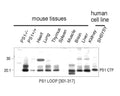
19 kDa, 45 kDa (See application details.)
A synthetic peptide (GDPEAQRRVSKNSKYNA-C) corresponding to human PS1 [301-317] in the loop region conjugated via additional C-terminal Cys to Diphtheria toxoid.
Human
Human, Mouse
Spin vial briefly before opening. Reconstitute in 500 µL sterile-filtered 1X PBS, pH 7.2-7.6. Centrifuge to remove any insoluble material. Short term storage at 2-8°C for one week. At -20°C as an undiluted liquid for up to 12 months.
Lyophilized
Protein G purified IgG
Lyophilized from PBS, pH 7.4. Contains no preservative.
WB: 1:1000
Full length presenilin 1 (467 aa) has relative MW of about 45 kDa, with this antibody most commonly detected as cleaved CTF of 19 kDa. Human or mouse brain samples commonly prepared with reducing agent (50mM DTT), urea (2.3 M), SDS (1.5%) in 62.5 mM Tris-HCL pH 6.8 sample buffer (without boiling) heating to 50 C for 15 min.
Unconjugated
Confirmed by Western blotting using transfected cells, presenilin 1 knock-out mouse cells and mouse and human brain.
For research use only.
United States
12 months after date of receipt (unopened vial).
ACNINV3; Presenilin 1; FAD; PS-1; Protein S182; PS1; PS1-CTF12; S182; PSEN1; presenilin-1; AD3; presenilin-1 isoform I-467; PSNL1
P49768
UniProt Summary: Catalytic subunit of the gamma-secretase complex, an endoprotease complex that catalyzes the intramembrane cleavage of integral membrane proteins such as Notch receptors and APP (amyloid-beta precursor protein). Requires the presence of the other members of the gamma-secretase complex for protease activity. Plays a role in Notch and Wnt signaling cascades and regulation of downstream processes via its role in processing key regulatory proteins, and by regulating cytosolic CTNNB1 levels. Stimulates cell-cell adhesion via its interaction with CDH1; this stabilizes the complexes between CDH1 (E-cadherin) and its interaction partners CTNNB1 (beta-catenin), CTNND1 and JUP (gamma-catenin). Under conditions of apoptosis or calcium influx, cleaves CDH1. This promotes the disassembly of the complexes between CDH1 and CTNND1, JUP and CTNNB1, increases the pool of cytoplasmic CTNNB1, and thereby negatively regulates Wnt signaling. Required for normal embryonic brain and skeleton development, and for normal angiogenesis. Mediates the proteolytic cleavage of EphB2/CTF1 into EphB2/CTF2. The holoprotein functions as a calcium-leak channel that allows the passive movement of calcium from endoplasmic reticulum to cytosol and is therefore involved in calcium homeostasis. Involved in the regulation of neurite outgrowth. Is a regulator of presynaptic facilitation, spike transmission and synaptic vesicles replenishment in a process that depends on gamma-secretase activity. It acts through the control of SYT7 presynaptic expression.
5663
25°C (ambient)

