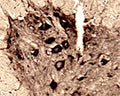
Anti-Huntingtin-associated protein 1 (HAP-1) Antibody
Our Anti-Huntingtin-associated protein 1 (HAP-1) rabbit polyclonal primary antibody detects rat Huntingtin-associated protein 1 (HAP-1), and is whole serum. It is validated for use in IHC-Frozen.
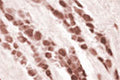
SKU: R-090-100
Ships: 1-2 business days
Product Details
Huntingtin-associated protein 1 (HAP-1)
FUNCTION: Associates specifically with huntingtin. This binding is enhanced by an expanded polyglutamine repeat. ALTERNATIVE PRODUCTS: 2 named isoforms produced by alternative splicing. TISSUE SPECIFICITY: In the brain, especially in the olfactory bulb and in the brain stem. No detectable expression in peripheral tissues such as lung, testis, spleen, and small intestine. SIMILARITY: Contains 1 HAP1 N-terminal domain.
Whole serum
Polyclonal
Mixed
IHC
Rabbit
Recombinant rat HAP-1
Rat
Rat
Spin vial briefly before opening. Reconstitute in 100 µL sterile-filtered, ultrapure water. Centrifuge to remove any insoluble material. After reconstitution keep aliquots at -20°C for a higher stability, and at 2-8°C with an appropriate antibacterial agent. Glycerol (1:1) may be added for an additional stability. Avoid repetitive freeze/thaw cycles.
Lyophilized
IHC: 1:500-1:3000
Unconjugated
Specificity for HAP-1 was confirmed by IHC. This antiserum is known to react with rat HAP-1. Other species have not yet been tested.
For research use only.
United States
12 months after date of receipt (unopened vial).
HAP1-A; Huntingtin-associated protein 1; HAP1; HAP-1
P54256
UniProt Summary: Originally identified as neuronal protein that specifically associates with HTT/huntingtin and the binding is enhanced by an expanded polyglutamine repeat within HTT possibly affecting HAP1 interaction properties. Both HTT and HAP1 are involved in intracellular trafficking and HAP1 is proposed to link HTT to motor proteins and/or transport cargos. Seems to play a role in vesicular transport within neurons and axons such as from early endosomes to late endocytic compartments and to promote neurite outgrowth. The vesicular transport function via association with microtubule-dependent transporters can be attenuated by association with mutant HTT. Involved in the axonal transport of BDNF and its activity-dependent secretion; the function seems to involve HTT, DCTN1 and a complex with SORT1. Involved in APP trafficking and seems to facilitate APP anterograde transport and membrane insertion thereby possibly reducing processing into amyloid beta. Involved in delivery of gamma-aminobutyric acid (GABA(A)) receptors to synapses; the function is dependent on kinesin motor protein KIF5 and is disrupted by HTT with expanded polyglutamine repeat. Involved in regulation of autophagosome motility by promoting efficient retrograde axonal transport. Seems to be involved in regulation of membrane receptor recycling and degradation, and respective signal transduction, including GABA(A) receptors, tyrosine kinase receptors, EGFR, IP3 receptor and androgen receptor. Among others suggested to be involved in control of feeding behavior (involving hypothalamic GABA(A) receptors), cerebellar and brainstem development (involving AHI1 and NTRK1/TrkA), postnatal neurogenesis (involving hypothalamic NTRK2/TrkB), and ITPR1/InsP3R1-mediated Ca(2+) release (involving HTT and possibly the effect of mutant HTT). Via association with DCTN1/dynactin p150-glued and HTT/huntingtin involved in cytoplasmic retention of REST in neurons. May be involved in ciliogenesis. Involved in regulation of exocytosis. Seems to be involved in formation of cytoplasmic inclusion bodies (STBs). In case of anomalous expression of TBP, can sequester a subset of TBP into STBs; sequestration is enhanced by an expanded polyglutamine repeat within TBP. HAP1-containing STBs have been proposed to play a protective role against neurodegeneration in Huntigton disease (HD) and spinocerebellar ataxia 17 (SCA17).
29430
25°C (ambient)