
Anti-Alpha-synuclein Antibody
Our Anti-Alpha-synuclein rabbit polyclonal primary antibody detects human, mouse, and rat Alpha-synuclein, and is whole serum. It is validated for use in IHC-Frozen.
SKU: R-075-100
Ships: 1-2 business days
Product Details
Alpha-synuclein
Alpha synuclein is an abundant 140 amino acid neuronal protein, expressed primarily at presynaptic terminals in the central nervous system. FUNCTION: May be involved in the regulation of dopamine release and transport. Soluble protein, normally localized primarily at the presynaptic region of axons, which can form filamentous aggregates that are the major non amyloid component of intracellular inclusions in several neurodegenerative diseases (synucleinopathies). Induces fibrillization of microtubule-associated protein tau. Reduces neuronal responsiveness to various apoptotic stimuli
Whole serum
Polyclonal
Mixed
IHC
Rabbit
A synthetic peptide (SEEGYQDYEPEA) corresponding to the C-terminal of human alpha synuclein protein (aa 129-140) conjugated to Blue Carrier Protein has been used as the immunogen. The peptide is homologous with the corresponding sequence derived from alpha synuclein protein in monkey and pig.
Human
Human, Mouse, Rat
Spin vial briefly before opening. Reconstitute in 100 µL sterile-filtered, ultrapure water. Centrifuge to remove any insoluble material. After reconstitution of lyophilized antibody, aliquot and store at -20°C for a higher stability. Glycerol (1:1) may be added for an additional stability. Reconstituted antibody can be stored at 2-8°C with an appropriate antibacterial agent. Avoid repetitive freeze/thaw cycles. Unopened, lyophilized vial may be stored for 12 months from date of receipt at 2-8°C or lower.
Lyophilized
IHC: 1:500-1:3000
Unconjugated
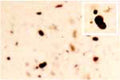
Immunohistochemical analysis of human brain indicates a high level of specificity for this antiserum. This antibody is known to react with human, mouse and rat alpha synuclein. Other species have not yet been tested.
For research use only.
United States
12 months after date of receipt (unopened vial).
Alpha synuclein; Non-A beta component of AD amyloid; Alpha-synuclein; Non-A4 component of amyloid precursor; Alpha-synuclein; NACP; isoform NACP140; SNCA; alphaSYN; PARK1; MGC105443; MGC110988; MGC127560; MGC64356; NACP; Non A beta component of AD amyloid; Non A4 component of amyloid; Non A4 component of amyloid precursor; Non-A beta component of AD amyloid; Non-A-beta component of alzheimers disease amyloid; precursor of; Non-A4 component of amyloid precursor; Non-A4 component of amyloid; OTTHUMP00000218549; OTTHUMP00000218551; OTTHUMP00000218552; OTTHUMP00000218553; OTTHUMP00000218554; PARK 1; PARK 4; PARK1; PARK4; Parkinson disease (autosomal dominant Lewy body 4; Parkinson disease familial 1; SNCA; Snca synuclein alpha (non A4 component of amyloid precursor; SYN; Synuclein alpha; Synuclein alpha 140; Synuclein alpha (non A4 component of amyloid precursor; SYUA_HUMAN
P37840
UniProt Summary: Neuronal protein that plays several roles in synaptic activity such as regulation of synaptic vesicle trafficking and subsequent neurotransmitter release. Participates as a monomer in synaptic vesicle exocytosis by enhancing vesicle priming, fusion and dilation of exocytotic fusion pores. Mechanistically, acts by increasing local Ca(2+) release from microdomains which is essential for the enhancement of ATP-induced exocytosis. Also acts as a molecular chaperone in its multimeric membrane-bound state, assisting in the folding of synaptic fusion components called SNAREs (Soluble NSF Attachment Protein REceptors) at presynaptic plasma membrane in conjunction with cysteine string protein-alpha/DNAJC5. This chaperone activity is important to sustain normal SNARE-complex assembly during aging. Also plays a role in the regulation of the dopamine neurotransmission by associating with the dopamine transporter (DAT1) and thereby modulating its activity.
6622
25°C (ambient)

