Anti-Ubiquilin 2 Antibody (6H9)
Our Anti-Ubiquilin 2 mouse monoclonal primary antibody detects human and mouse Ubiquilin 2, and is IgG. It is validated for use in ICC, WB.
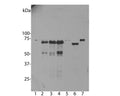
Western blot analysis of untransfected primary mouse neuron and glia cell cultures (lane 1), the same cells transduced with human ubiquilin 2 wild type (lane 2), with ubiquilin 2 P506T mutant (lane 3), with ubiquilin 2 P497S mutant (lane 4), with enchanced GFP control (lane 5), in HeLa cells (lane 6) and 3T3 cells (lane 7).
Click on image to zoom
SKU: M-1656-100
Ships: 1-2 business days
Product Details
Ubiquilin 2
Ubiquilin 2 (also known as PLIC2 and Chap1) is a member of the ubiquilin protein family, which regulate the degradation of cellular proteins through proteasome or autophage-like pathways (1, 2, 3). Humans have four ubiquilin genes, each encoding a separate protein referred to as Ubiquilin 1, 2, 3 and 4. All ubiquilins contain an N-terminal ubiquitin-like (UBL) domain and a C-terminal ubiquitin-associated (UBA) domain, while the central part of the molecules are highly variable. The UBL domains bind subunits of the proteasome, and the UBA domains binds to polyubiquitin chains that are typically conjugated onto proteins marked for proteosomal degradation (1). Ubiquilin 2 has a unique region close to the C terminus containing 12 PXX tandem collagen like repeats, where P is proline and X is most cases valine, glycine, isoleucine or threonine. Teepu Siddique and his collaborators have identified mutations in the ubiquilin 2 gene leading to protein point mutations which were important contributors to several forms of amyotrophic lateral sclerosis (ALS) and Frontotemporal lobar degeneration (FTLD). Interestingly, these mutations involved alterations in proline residues in the PXX repeat region (P497H, P497S, P506T, P509S and P525S, ref. 4). Recently, the Lee and Trojanowski group investigated C9orf72 hexanucleotide expansion and ubiquilin 2 pathology in patients with ALS and FTLD by genetic analysis and immunohistochemistry and found distinct ubiquilin 2 pathology in ALS and FTLD-TDP with C9orf72 expansion (5). C9orf72 hexonucleotide expansion is the most commmon cause to date of familial ALS and FTLD (6, 7). Ubiquilin 2 protein is of different molecular size in mouse and human, 638 and 624 amino acids respectively. As a result the mouse protein, endogenously expressed in rodent 3T3 cells, runs on SDS-PAGE and western blots slightly slower than the human protein.
IgG
Monoclonal
6H9
IgG1
ICC, WB
Mouse
~66 kDa in human Hela cells and 68 kDa in rodent 3T3 cells
Recombinant human ubiquilin 2 expressed and purified from E. coli.
Human
Human, Mouse
Spin vial briefly before opening. Reconstitute with 100 µL sterile-filtered, ultrapure water to achieve a 1 mg/mL concentration. Centrifuge to remove any insoluble material. Aliquot and store at -20°C for up to six months after date of receipt. Avoid freeze-thaw cycles.
Lyophilized
Protein G purified
Lyophilized from PBS buffer pH 7.2-7.6 with 0.1% trehalose, and sodium azide
WB: 1:1000-1:2000
ICC: 1:500-1:1000
ICC: 1:500-1:1000
Unconjugated
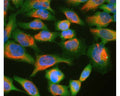
In primary mouse neuron and glia cell culture, endogenous ubiquilin 2 appears as a weak band at 68 kDa in all tranduced and non-transduced cells, indicating low endogenous expression of mouse ubiquilin 2. Strong bands are seen in cells transduced with human wild type or mutant ubiquilin 2. Small proteins which run at 50 kDa in these cells are the fragments of ubiquilin 2. Note, ubiquilin 2 runs at ~66 kDa in human Hela cells and 68 kDa in rodent 3T3 cells. The antibody has also been used successfully for immunocytochemistry.
For research use only.
United States
12 months after date of receipt (unopened vial).
ALS15; DSK2; HRIHFB2157; N4BP4; PLIC2; ubiquilin-2; Nedd4 binding protein 4; protein linking IAP with cytoskeleton 2; ubiquitin-like product Chap1/Dsk2
Q9UHD9
UniProt Summary: Plays an important role in the regulation of different protein degradation mechanisms and pathways including ubiquitin-proteasome system (UPS), autophagy and the endoplasmic reticulum-associated protein degradation (ERAD) pathway. Mediates the proteasomal targeting of misfolded or accumulated proteins for degradation by binding (via UBA domain) to their polyubiquitin chains and by interacting (via ubiquitin-like domain) with the subunits of the proteasome. Plays a role in the ERAD pathway via its interaction with ER-localized proteins FAF2/UBXD8 and HERPUD1 and may form a link between the polyubiquitinated ERAD substrates and the proteasome. Involved in the regulation of macroautophagy and autophagosome formation; required for maturation of autophagy-related protein LC3 from the cytosolic form LC3-I to the membrane-bound form LC3-II and may assist in the maturation of autophagosomes to autolysosomes by mediating autophagosome-lysosome fusion. Negatively regulates the endocytosis of GPCR receptors: AVPR2 and ADRB2, by specifically reducing the rate at which receptor-arrestin complexes concentrate in clathrin-coated pits (CCPs).
29978
25°C (ambient)