
Anti-TRPML3/Mucolipin-3 Antibody (N268/19)
Our mouse TRPML3/Mucolipin-3 monoclonal antibody from NeuroMab is produced in-house from clone N268/19. It detects human, mouse, and rat TRPML3/Mucolipin-3 and is purified by Protein A chromatography. Works in WB, ICC, ELISA.
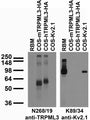
Human, Mouse, Rat
ELISA, ICC, WB
Mouse
SKU: 75-283
Ships: 1-2 business days
Product Details
TRPML3/Mucolipin-3
Mucolipin-3, Transient receptor potential cation channel, mucolipin subfamily, member 3 or TrpML3 is encoded by the gene MCOLN3. It is a member of the small family of the TRPML channels, a subgroup of the large protein family of TRP ion channels and acts as an inwardly rectifying cation channel. TrpML3 is found in the cochlea, olfactory kidney, lung and hair cells and strial cells of the inner ear. The protein localizes to the plasma membrane, endosomes, and lysosomes of cells. Mutations in this gene in mice result in auditory hair cell death and deafness
Purified by Protein A chromatography
1 mg/mL
Monoclonal
N268/19
IgG2a
ELISA, ICC, WB
Mouse
MCOLN3
64 kDa
Synthetic peptide amino acids 269-285 (CKDWHVSGSIQKNTHYM, extracellular N-terminus) of human TRPML3 (accession number Q8TDD5)
Human
Human, Mouse, Rat
AB_11000726
Aliquot and store at ≤ -20°C for long term storage. For short term storage, store at 2-8°C. For maximum recovery of product, centrifuge the vial prior to removing the cap.
Liquid
Produced by in vitro bioreactor culture of hybridoma line followed by Protein A affinity chromatography. Purified mAbs are >90% specific antibody.
10 mM Tris, 50 mM Sodium Chloride, 0.065% Sodium Azide pH 7.125
Unconjugated
No cross-reactivity reported
Each new lot of antibody is quality control tested on cells overexpressing target protein and confirmed to give the expected staining pattern.
These antibodies are to be used as research laboratory reagents and are not for use as diagnostic or therapeutic reagents in humans.
United States
24 months from date of receipt
TRP-ML3; Mucolipin-3; Transient receptor potential channel mucolipin 3; TRPML3
Q8TDD5
UniProt Summary: Nonselective cation channel probably playing a role in the regulation of membrane trafficking events. Acts as a Ca(2+)-permeable cation channel with inwardly rectifying activity. Mediates release of Ca(2+) from endosomes to the cytoplasm, contributes to endosomal acidification and is involved in the regulation of membrane trafficking and fusion in the endosomal pathway. Also permeable to Mg(2+), Na(+) and K(+). Does not seem to act as mechanosensory transduction channel in inner ear sensory hair cells. Proposed to play a critical role at the cochlear stereocilia ankle-link region during hair-bundle growth. Involved in the regulation of autophagy. Through association with GABARAPL2 may be involved in autophagosome formation possibly providing Ca(2+) for the fusion process. Through a possible and probably tissue-specific heteromerization with MCOLN1 may be at least in part involved in many lysosome-dependent cellular events. Possible heteromeric ion channel assemblies with TRPV5 show pharmacological similarity with TRPML3.
55283
Shipped on ice packs

