
Anti-Pan-Kvbeta Potassium Channel Antibody (K25/73)
Our mouse Pan-Kvbeta potassium channel monoclonal antibody from NeuroMab is produced in-house from clone K25/73. It detects human, mouse, and rat Pan-Kvbeta potassium channel and is purified by Protein A chromatography. Works in WB, IHC, ICC, ELISA.
Human, Mouse, Rat
ELISA, ICC, IHC, WB
Mouse
SKU: 75-392
Ships: 1-2 business days
Product Details
Pan-Kvbeta potassium channel
The ß subunits of voltage-gated potassium channels are members of the potassium channel, voltage-gated, shaker-related subfamily. Kvβs are cytoplasmic subunits that modulate the characteristics of the membrane spanning, channel-forming alpha-subunits. Beta subunits can promote the closure of channels or enhance channel activity depending on other channel proteins. There are three ß subunits (Kvß1, Kvß2, Kvß3) which are coded by three different genes. Additionally, there is alternative splicing of these three genes, further diversifying the functions and tissue expression of the family.
Purified by Protein A chromatography
1 mg/mL
Monoclonal
K25/73
IgG1
ELISA, ICC, IHC, WB
Mouse
Kcnab1 Kvb1 Kcnab3 Ckbeta3 Kcnab2 Ckbeta2 Kcnb3
40 kDa
Synthetic peptide amino acids 350-367 (EIDSILGNKPYSKKDYRS, C-terminus) of human Kvbeta2 (accession number Q13303)
Human
Human, Mouse, Rat
AB_2491089
Aliquot and store at ≤ -20°C for long term storage. For short term storage, store at 2-8°C. For maximum recovery of product, centrifuge the vial prior to removing the cap.
Liquid
Produced by in vitro bioreactor culture of hybridoma line followed by Protein A affinity chromatography. Purified mAbs are >90% specific antibody.
10 mM Tris, 50 mM Sodium Chloride, 0.065% Sodium Azide pH 7.125
Unconjugated
Reacts with Kvbeta1
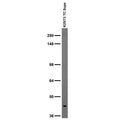
Each new lot of antibody is quality control tested by western blot on rat whole brain lysate and confirmed to stain the expected molecular weight band.
These antibodies are to be used as research laboratory reagents and are not for use as diagnostic or therapeutic reagents in humans.
United States
24 months from date of receipt
AKR6A5; Voltage-gated potassium channel subunit beta-1; HKvbeta2.1; EC 1.1.1.-; HKvbeta2.2; K(+ channel subunit beta-1; KCNA2B; Kv-beta-1 Voltage-gated potassium channel subunit beta-3; K(+ channel subunit beta-2; K(+ channel subunit beta-3; KV-BETA-2; Kv-beta-3; voltage-gated potassium channel subunit beta-2; RCK beta3 Voltage-gated potassium channel subunit beta-2
Q13303
UniProt Summary: Regulatory subunit of the voltage-gated potassium (Kv) Shaker channels composed of pore-forming and potassium-conducting alpha subunits and of regulatory beta subunits. The beta-2/KCNAB2 cytoplasmic subunit promotes potassium channel closure via a mechanism that does not involve physical obstruction of the channel pore. Promotes the inactivation of Kv1.4/KCNA4 and Kv1.5/KCNA5 alpha subunit-containing channels. Displays nicotinamide adenine dinucleotide phosphate (NADPH)-dependent aldoketoreductase activity by catalyzing the NADPH-dependent reduction of a wide range of aldehyde and ketone substrates. Substrate specificity includes methylglyoxal, 9,10-phenanthrenequinone, prostaglandin J2, 4-nitrobenzaldehyde, 4-nitroacetophenone and 4-oxo-trans-2-nonenal (in vitro, no physiological substrate identified yet). The binding of oxidized and reduced nucleotide alters Kv channel gating and may contribute to dynamic fine tuning of cell excitability. Contributes to the regulation of nerve signaling, and prevents neuronal hyperexcitability.
8514
Shipped on ice packs

