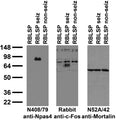
Anti-Npas4 Antibody (N408/79)
Our mouse Npas4 monoclonal antibody from NeuroMab is produced in-house from clone N408/79. It detects mouse and rat Npas4 and is purified by Protein A chromatography. Works in WB, IHC, ICC, ELISA.
Mouse, Rat
ELISA, ICC, IHC, WB
Mouse
SKU: 75-396
Ships: 1-2 business days
Product Details
Npas4
Neuronal PAS Domain Protein 4 is encoded by the gene NPAS4. NPAS4 is a transcription factor that is involved in a wide range of physiologic and developmental events. NPAS4 is specifically expressed in neurons. No diseases were found to be associated with NPAS4
Purified by Protein A chromatography
1 mg/mL
Monoclonal
N408/79
IgG1
ELISA, ICC, IHC, WB
Mouse
Npas4 Nxf
90 kDa
Fusion protein amino acids 597-802 (C-terminus) of rat Npas4 (accession number Q8CJH6) produced recombinantly in E. Coli
Rat
Mouse, Rat
AB_2491085
Aliquot and store at ≤ -20°C for long term storage. For short term storage, store at 2-8°C. For maximum recovery of product, centrifuge the vial prior to removing the cap.
Liquid
Produced by in vitro bioreactor culture of hybridoma line followed by Protein A affinity chromatography. Purified mAbs are >90% specific antibody.
10 mM Tris, 50 mM Sodium Chloride, 0.065% Sodium Azide pH 7.125
Unconjugated
No cross-reactivity reported
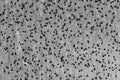
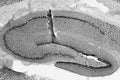
Each new lot of antibody is quality control tested by IHC on either rat or mouse brain and confirmed to give the expected staining pattern.
These antibodies are to be used as research laboratory reagents and are not for use as diagnostic or therapeutic reagents in humans.
United States
24 months from date of receipt
Nxf; Neuronal PAS domain-containing protein 4; HLH-PAS transcription factor NXF; Neuronal PAS4; bHLH-PAS type transcription factor NXF
Q8CJH6
UniProt Summary: Transcription factor expressed in neurons of the brain that regulates the excitatory-inhibitory balance within neural circuits and is required for contextual memory in the hippocampus. Plays a key role in the structural and functional plasticity of neurons. Acts as an early-response transcription factor in both excitatory and inhibitory neurons, where it induces distinct but overlapping sets of late-response genes in these two types of neurons, allowing the synapses that form on inhibitory and excitatory neurons to be modified by neuronal activity in a manner specific to their function within a circuit, thereby facilitating appropriate circuit responses to sensory experience. In excitatory neurons, activates transcription of BDNF, which in turn controls the number of GABA-releasing synapses that form on excitatory neurons, thereby promoting an increased number of inhibitory synapses on excitatory neurons. In inhibitory neurons, regulates a distinct set of target genes that serve to increase excitatory input onto somatostatin neurons, probably resulting in enhanced feedback inhibition within cortical circuits. The excitatory and inhibitory balance in neurons affects a number of processes, such as short-term and long-term memory, acquisition of experience, fear memory, response to stress and social behavior. Acts as a regulator of dendritic spine development in olfactory bulb granule cells in a sensory-experience-dependent manner by regulating expression of MDM2. Efficient DNA binding requires dimerization with another bHLH protein, such as ARNT, ARNT2 or BMAL1. Can activate the CME (CNS midline enhancer) element.
266734
Shipped on ice packs