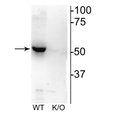
Anti-Nicotinic Acetylcholine Receptor (nAChR) β2 Antibody
Our Anti-Nicotinic Acetylcholine Receptor (nAChR) β2 primary antibody from PhosphoSolutions is rabbit polyclonal. It detects mouse and rat Nicotinic Acetylcholine Receptor (nAChR) β2 and is antigen affinity purified from pooled serum. It is great for use in WB.
SKU: 1470-nACB2
Ships: 1-2 business days
Product Details
Nicotinic Acetylcholine Receptor (nAChR) β2
Nicotinic acetylcholine receptors (nAChRs) are ionotropic, cholinergic receptors that are divided into 2 types; muscle type and neuronal type. Neuronal nAChRs are pentameric ion channels consisting of 5 identical (homopentamers) or different (heteropentamers) subunits. Heteropentameric neuronal nAChRs mediate fast synaptic transmission in the autonomic nervous system. The predominant hetero-oligomeric nAChR in the CNS contain the subunits α4β2, whereas α3β4 prevail in the PNS. However, the expression of these subunits varies not only by region but also during development (Scholze et al 2011). In the brain, β2-containing receptors greatly outnumber receptors that contain β4 (McGehee & Role, 1995; Albuquerque, et al., 2009), and in most brain regions, targeted deletion of the β2 subunit virtually abolishes [3H]-epibatidine binding and receptor autoradiography (Zoli, et al., 1998) due to the absence of a β subunit required to form functional nAChRs (Champtiaux & Changeux, 2004).
Antigen Affinity Purified from Pooled Serum
Polyclonal
IgG
ELISA, WB
Rabbit
Chrnb2
52 kDa
Fusion protein from the cytoplasmic loop of the β2 subunit of mouse nAChR.
Mouse
Mouse, Rat
AB_2619712
Storage at -20°C is recommended, as aliquots may be taken without freeze/thawing due to presence of 50% glycerol. Stable for at least 1 year at -20°C.
Liquid
Prepared from pooled rabbit serum by affinity purification using a column to which the fusion protein antigen was coupled.
10 mM HEPES (pH 7.5), 150 mM NaCl, 100 µg per ml BSA and 50% glycerol.
WB: 1:1000
WB Brain: 1:1000
WB Brain: 1:1000
Unconjugated
Specific for endogenous levels of the ~52 kDa nAChRβ2 protein.
Western blots performed on each lot.
For research use only. Not intended for therapeutic or diagnostic use. Use of all products is subject to our terms and conditions, which can be viewed on our website.
After date of receipt, stable for at least 1 year at -20°C.
Acetylcholine receptor beta 2 neural; ACHB2_HUMAN; neuronal; ACHN; AChR; Acrb 2; Acrb2; b2 nAchR; Cholinergic receptor nicotinic beta 2; Cholinergic receptor nicotinic beta polypeptide 2; Cholinergic receptor nicotinic beta polypeptide 2 neuronal; cholinergic receptor nicotinic beta 2 (neuronal; Chrnb2; EFNL 3; EFNL3; nAChRB2; Neuronal acetylcholine receptor protein beta 2 chain precursor; Neuronal acetylcholine receptor protein subunit beta 2; Neuronal acetylcholine receptor subunit beta-2; Neuronal nicotinic acetylcholine receptor beta 2; cholinergic receptor nicotinic beta 2
Q9ERK7
UniProt Summary: Component of neuronal acetylcholine receptors (nAChRs) that function as pentameric, ligand-gated cation channels with high calcium permeability among other activities. nAChRs are excitatory neurotrasnmitter receptors formed by a collection of nAChR subunits known to mediate synaptic transmission in the nervous system and the neuromuscular junction. Each nAchR subunit confers differential attributes to channel properties, including activation, deactivation and desensitization kinetics, pH sensitivity, cation permeability, and binding to allosteric modulators (PubMed:22361591, PubMed:27698419, PubMed:29720657, PubMed:38454578). CHRNB2 forms heteropentameric neuronal acetylcholine receptors with CHRNA2, CHRNA3, CHRNA4 and CHRNA6, as well as CHRNA5 and CHRNB3 as accesory subunits (PubMed:16835356, PubMed:20881005, PubMed:22361591, PubMed:27698419, PubMed:29720657, PubMed:38454578, PubMed:8663494). Found in two major stoichiometric forms,(CHRNA4)3:(CHRNB2)2 and (CHRNA4)2:(CHRNB2)3, the two stoichiometric forms differ in their unitary conductance, calcium permeability, ACh sensitivity and potentiation by divalent cation (PubMed:27698419, PubMed:29720657, PubMed:38454578). Heteropentameric channels with CHRNA6 and CHRNA4 exhibit high sensitivity to ACh and nicotine and are predominantly expressed in only a few brain areas, including dopaminergic neurons, norepirephrine neurons and cells of the visual system. nAChrs containing CHRNA6 subunits mediate endogenous cholinergic modulation of dopamine and gamma-aminobutyric acid (GABA) release in response to nicotine at nerve terminals (By similarity). Also forms functional nAChRs with other subunits such as CHRNA7:CHRNB2, mainly expressed in basal forebrain cholinergic neurons (PubMed:33239400, PubMed:38161283). {ECO:0000250|UniProtKB:P12390, ECO:0000269|PubMed:16835356, ECO:0000269|PubMed:20881005, ECO:0000269|PubMed:22361591, ECO:0000269|PubMed:27698419, ECO:0000269|PubMed:29720657, ECO:0000269|PubMed:33239400, ECO:0000269|PubMed:38161283, ECO:0000269|PubMed:38454578, ECO:0000269|PubMed:8663494}.

11444
Blue Ice
- Western Blot Protocol: Download
General References
- Scholze, P., Ciuraszkiewicz, A., Groessl, F., Orr‐Urtreger, A., McIntosh, J.M. and Huck, S., 2011. α4β2 nicotinic acetylcholine receptors in the early postnatal mouse superior cervical ganglion. Developmental Neurobiology, 71(5), pp.390-399. PMID: 10814726
- McGehee, D.S. and Role, L.W., 1995. Physiological diversity of nicotinic acetylcholine receptors expressed by vertebrate neurons. Annual Review of Physiology, 57(1), pp.521-546. PMID: 10814726
- Albuquerque, E.X., Pereira, E.F., Alkondon, M. and Rogers, S.W., 2009. Mammalian nicotinic acetylcholine receptors: from structure to function. Physiological Reviews, 89(1), pp.73-120. PMID: 10814726
- Zoli, M., Léna, C., Picciotto, M.R. and Changeux, J.P., 1998. Identification of four classes of brain nicotinic receptors using β2 mutant mice. Journal of Neuroscience, 18(12), pp.4461-4472. PMID: 10814726
- Champtiaux, N. and Changeux, J.P., 2004. Knockout and knockin mice to investigate the role of nicotinic receptors in the central nervous system. Progress in Brain Research, 145, pp.233-251. PMID: 10814726