Anti-Myelin Basic Protein (MBP) Antibody
An antipeptide antibody was generated in chickens against a sequence shared between the mouse (NP_034907) and human (NP_002376) gene products. Antibodies were affinity-purified and the concentration adjusted to 100 µg/mL.
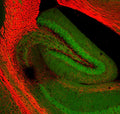
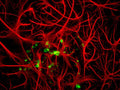
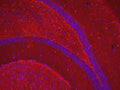
Immunohistochemical staining of MBP (RED) in the hippocampal region of a transgenic adult mouse brain. This particular transgenic mouse expresses low levels of GFP autofluorescence under control of an actin promoter region. The anti-MBP antibody (Aves Labs) was used at a 1:1000 dilution. Dr. Felix Eckenstein, University of Vermont.
Click on image to zoom
Human, Mouse, Rabbit, Rat, Sheep
ICC, IHC, WB
Chicken
SKU: MBP
Ships: 1-2 business days
Product Details
Myelin Basic Protein (MBP)
Human Myelin Basic Protein (MBP) is a 20,115 dalton protein (186 amino acids) found in myelin of the CNS and PNS. Expressed as an intracellular protein by oligodendrocytes and Schwann cells, MBP aids in the compaction and stability of myelin.
Affinity-Purified IgY
100 µg/mL
Polyclonal
IgY
ICC, IHC, WB
Chicken
MBP
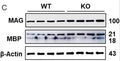
Can recognize multiple bands between 14-22 kDa, corresponding to different MBP isoforms
Synthetic peptide
Human
Human, Mouse, Rabbit, Rat, Sheep
AB_2313550
Store at 4°C in the dark. Under these conditions, the antibodies should have a shelf life of at least twelve months, provided they remain sterile. For longer term storage, aliquot and freeze to avoid freeze-thaw of the antibody.
Liquid
Chickens were immunized with a synthetic peptide / keyhole limpet hemocyanin (KLH) conjugate. The peptide corresponded to a region of the MBP gene product shared between the human (NP_002376, NCBI) and mouse (NP_034907, NCBI) sequences. After repeated injections, immune eggs were collected, the IgY fractions were purified from the yolks, and then affinity-purified using a peptide column. The concentrations of the eluates were then adjusted to 100 µg/mL, and the preparation was filter-sterilized.
Phosphate-buffered (10 mM) isotonic (0.9%, w/v) saline (“PBS," pH 7.2) with sodium azide (0.02%, w/v) added as a preservative.
WB: 1:1000-1:2000
IHC: 1:1000-1:2000
ICC: 1:1000-1:2000
IHC: 1:1000-1:2000
ICC: 1:1000-1:2000
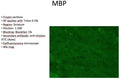
Quality assurance analysis was performed using immunohistochemistry (at a dilution of 1:2000) using fluorescein-labeled goat anti-chicken IgY (1:500 dilution, Aves Labs Cat.# F-1005) as the secondary reagent.
These antibodies are to be used as research laboratory reagents and are not for use as diagnostic or therapeutic reagents in humans.
United States
12 months from receipt of product
GDB; Myelin basic protein; Golli MBP; Golli MBP myelin basic protein; Hemopoietic MBP; HMBPR; HUGO; MBP; MBP_CAVPO; MBP_HUMAN; MGC99675; MLD; Myelin A1 protein; Myelin A1 Protein basic; Myelin basic protein; Myelin Deficient; Myelin membrane encephalitogenic protein; OTTHUMP00000163776 m; OTTHUMP00000174387; OTTHUMP00000174388; SHI; Shiverer; SP; MBP; Myelin A1 protein; Myelin membrane encephalitogenic protein
P02686
UniProt Summary: The classic group of MBP isoforms (isoform 4-isoform 14) are with PLP the most abundant protein components of the myelin membrane in the CNS. They have a role in both its formation and stabilization. The smaller isoforms might have an important role in remyelination of denuded axons in multiple sclerosis. The non-classic group of MBP isoforms (isoform 1-isoform 3/Golli-MBPs) may preferentially have a role in the early developing brain long before myelination, maybe as components of transcriptional complexes, and may also be involved in signaling pathways in T-cells and neural cells. Differential splicing events combined with optional post-translational modifications give a wide spectrum of isomers, with each of them potentially having a specialized function. Induces T-cell proliferation.
4155
Ice packs