
Anti-MARCKS (Ser152,156) Antibody
Our Anti-MARCKS (Ser152,156) rabbit polyclonal phosphospecific primary antibody from PhosphoSolutions is produced in-house. It detects mouse and rat MARCKS (Ser152,156) and is antigen affinity purified from pooled serum. It is great for use in WB.
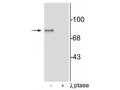
Western blot of rat brain lysate showing specific immunolabeling of the ~87 kDa MARCKS protein phosphorylated at Ser152,156, in the first lane (-). Phosphospecificity is shown in the second lane (+) where immunolabeling is completely eliminated by blot treatment with lambda phosphatase (λ-Ptase, 1200 units for 30 min).
Click on image to zoom

SKU: p1185-1526
Ships: 1-2 business days
Product Details
MARCKS (Ser152,156)
Myristoylated Alanine-Rich C Kinase Substrate (MARCKS) is a major substrate for phosphorylation by protein kinase C (PKC) (Ouimet et al., 1990). The phosphorylation of Ser-152/156 can be used as a measure of PKC activation although these sites are also phosphorylated by PRK1 (Palmer et al., 1996) MARCKS is a member of a family of calmodulin binding proteins and phosphorylation of Ser-152/156 modulates the binding of MARCKS to calmodulin (Verghese et al., 1994)
Antigen Affinity Purified from Pooled Serum
Polyclonal
IgG
ELISA, WB
Rabbit
MARCKS
87 kDa
Synthetic phospho-peptide corresponding to amino acid residues surrounding Ser152/156 of rat MARCKS, conjugated to keyhole limpet hemocyanin (KLH).
Rat
Mouse, Rat
Bovine, Chicken, Human, Xenopus, Zebrafish
AB_2492143
Storage at -20°C is recommended, as aliquots may be taken without freeze/thawing due to presence of 50% glycerol. Stable for at least 1 year at -20°C.
Liquid
Prepared from pooled rabbit serum by affinity purification via sequential chromatography on phospho and non-phosphopeptide affinity columns.
10 mM HEPES (pH 7.5), 150 mM NaCl, 100 µg per ml BSA and 50% glycerol.
WB: 1:1000
Unconjugated
Specific for endogenous levels of the ~87 kDa MARCKS protein phosphorylated at Ser152 and Ser156. Immunolabeling is completely eliminated by treatment with λ-phosphatase.
Phosphorylated
Ser152,156
Western blots performed on each lot.
For research use only. Not intended for therapeutic or diagnostic use. Use of all products is subject to our terms and conditions, which can be viewed on our website.
After date of receipt, stable for at least 1 year at -20°C.
80 kDa protein; 80K L; MARCKS; 80K L protein; 80K-L protein; 80KL ,81 kDa protein; light chain; MACS; MARCKS; MARCS; MARCS_HUMAN; MGC52672; myristoylated alanine rich C kinase substrate; Myristoylated alanine rich protein kinase C substrate (MARCKS; Myristoylated alanine rich protein kinase C substrate; Myristoylated alanine-rich C-kinase substrate; Phosphomyristin; PKCSL; PRKCSL; protein kinase C substrate 80 kDa protein light chain; Protein kinase C substrate; Myristoylated alanine rich protein kinase C substrate
P30009
UniProt Summary: Membrane-associated protein that plays a role in the structural modulation of the actin cytoskeleton, chemotaxis, motility, cell adhesion, phagocytosis, and exocytosis through lipid sequestering and/or protein docking to membranes (PubMed:23704996, PubMed:36009319). Thus, exerts an influence on a plethora of physiological processes, such as embryonic development, tissue regeneration, neuronal plasticity, and inflammation. Sequesters phosphatidylinositol 4,5-bisphosphate (PIP2) at lipid rafts in the plasma membrane of quiescent cells, an action reversed by protein kinase C, ultimately inhibiting exocytosis (PubMed:23704996). During inflammation, promotes the migration and adhesion of inflammatory cells and the secretion of cytokines such as tumor necrosis factor (TNF), particularly in macrophages (PubMed:37949888). Plays an essential role in bacteria-induced intracellular reactive oxygen species (ROS) formation in the monocytic cell type. Participates in the regulation of neurite initiation and outgrowth by interacting with components of cellular machinery including CDC42 that regulates cell shape and process extension through modulation of the cytoskeleton (By similarity). Plays also a role in axon development by mediating docking and fusion of RAB10-positive vesicles with the plasma membrane (By similarity). {ECO:0000250|UniProtKB:P26645, ECO:0000250|UniProtKB:P30009, ECO:0000269|PubMed:23704996, ECO:0000269|PubMed:36009319, ECO:0000269|PubMed:37949888}.
4082
Blue Ice
- Western Blot Protocol: Download

