Anti-Lamin A/C Antibody (4C4)
Our Anti-Lamin A/C primary antibody from PhosphoSolutions is mouse monoclonal. It detects human Lamin A/C and is Protein G purified. It is great for use in WB, IHC, ICC.
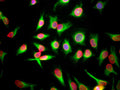
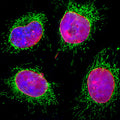
Immunostaining of HeLa cells showing strong nuclear lamina staining with anti-Lamin A/C (Cat. 1027-LAM, red, 1:1000) and anti-Vimentin (Cat. 2105-VIM, green, 1:500).
Click on image to zoom
SKU: 1027-LAM
Ships: 1-2 business days
Product Details
Lamin A/C
Lamins A and C are nuclear structural proteins that are part of the intermediate filament family and coded for by the same gene (LMNA). Lamins A and C are nearly identical except for their carboxy termini (McKeon et al., 1986). Mutations in the gene encoding lamins A/C have been shown to cause a variety of diseases including autosomal dominant Emery-Dreifuss muscular dystrophy (Bonne et al., 1995), autosomal dominant limbgirdle muscular dystrophy (Muchir et al., 2000) and Charcot-Marie-Tooth disorder type 2 (De Sandre-Giavonnoli et al., 2002).
Protein G Purified
Monoclonal
4C4
IgG1
ELISA, ICC, IHC, WB
Mouse
LMNA
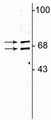
64, 74 kDa
Recombinant full length human lamin C expressed in and purified from E. Coli.
Human
Human
AB_2492139
Recommended that the undiluted antibody be aliquoted into smaller working volumes (10-30 uL/vial depending on usage) upon arrival and stored long term at -20° C or -80° C, while keeping a working aliquot stored at 4° C for short term. Avoid freeze/thaw cycles. Stable for at least 1 year.
Liquid
Protein G purified culture supernatant
PBS + 10 mM NaN3.
WB: 1:5000
IHC: 1:1000
ICC: 1:1000
IHC: 1:1000
ICC: 1:1000
Unconjugated
Specific for endogenous levels of the ~64 kDa and ~74 kDa lamin A and C proteins.
Western blots performed on each lot.
For research use only. Not intended for therapeutic or diagnostic use. Use of all products is subject to our terms and conditions, which can be viewed on our website.
After date of receipt, stable for at least 1 year at -20°C.
70 kDa lamin; Cardiomyopathy dilated 1A (autosomal dominant; autosomal dominant; CDCD1; CDDC; CMD1A; CMT2B1; EMD2; FPL; FPLD; FPLD2; HGPS; IDC; Lamin A; Lamin A/C; Lamin A/C like 1; Lamin; Lamin C; Lamin-A/C; LDP1; LFP; LGMD1B; Limb girdle muscular dystrophy 1B (autosomal dominant; LMN 1; LMN A; LMN C; LMN1; LMNA; LMNA_HUMAN; LMNC; LMNL1; Prelamin A/C; PRO1; Renal carcinoma antigen NY REN 32; Renal carcinoma antigen NY-REN-32; Renal carcinoma antigen NYREN32; Cardiomyopathy dilated 1A; Limb girdle muscular dystrophy 1B
P02545
UniProt Summary: [Lamin-A/C]: Lamins are intermediate filament proteins that assemble into a filamentous meshwork, and which constitute the major components of the nuclear lamina, a fibrous layer on the nucleoplasmic side of the inner nuclear membrane (PubMed:10080180, PubMed:10580070, PubMed:10587585, PubMed:10814726, PubMed:11799477, PubMed:12075506, PubMed:12927431, PubMed:15317753, PubMed:18551513, PubMed:18611980, PubMed:2188730, PubMed:22431096, PubMed:2344612, PubMed:23666920, PubMed:24741066, PubMed:31434876, PubMed:31548606, PubMed:37788673, PubMed:37832547). Lamins provide a framework for the nuclear envelope, bridging the nuclear envelope and chromatin, thereby playing an important role in nuclear assembly, chromatin organization, nuclear membrane and telomere dynamics (PubMed:10080180, PubMed:10580070, PubMed:10587585, PubMed:10814726, PubMed:11799477, PubMed:12075506, PubMed:12927431, PubMed:15317753, PubMed:18551513, PubMed:18611980, PubMed:22431096, PubMed:23666920, PubMed:24741066, PubMed:31548606, PubMed:37788673, PubMed:37832547). Lamin A and C also regulate matrix stiffness by conferring nuclear mechanical properties (PubMed:23990565, PubMed:25127216). The structural integrity of the lamina is strictly controlled by the cell cycle, as seen by the disintegration and formation of the nuclear envelope in prophase and telophase, respectively (PubMed:2188730, PubMed:2344612). Lamin A and C are present in equal amounts in the lamina of mammals (PubMed:10080180, PubMed:10580070, PubMed:10587585, PubMed:10814726, PubMed:11799477, PubMed:12075506, PubMed:12927431, PubMed:15317753, PubMed:18551513, PubMed:18611980, PubMed:22431096, PubMed:23666920, PubMed:31548606). Also involved in DNA repair: recruited by DNA repair proteins XRCC4 and IFFO1 to the DNA double-strand breaks (DSBs) to prevent chromosome translocation by immobilizing broken DNA ends (PubMed:31548606). Required for normal development of peripheral nervous system and skeletal muscle and for muscle satellite cell proliferation (PubMed:10080180, PubMed:10814726, PubMed:11799477, PubMed:18551513, PubMed:22431096). Required for osteoblastogenesis and bone formation (PubMed:12075506, PubMed:15317753, PubMed:18611980). Also prevents fat infiltration of muscle and bone marrow, helping to maintain the volume and strength of skeletal muscle and bone (PubMed:10587585). Required for cardiac homeostasis (PubMed:10580070, PubMed:12927431, PubMed:18611980, PubMed:23666920). {ECO:0000269|PubMed:10080180, ECO:0000269|PubMed:10580070, ECO:0000269|PubMed:10587585, ECO:0000269|PubMed:10814726, ECO:0000269|PubMed:11799477, ECO:0000269|PubMed:12075506, ECO:0000269|PubMed:12927431, ECO:0000269|PubMed:15317753, ECO:0000269|PubMed:18551513, ECO:0000269|PubMed:18611980, ECO:0000269|PubMed:2188730, ECO:0000269|PubMed:22431096, ECO:0000269|PubMed:2344612, ECO:0000269|PubMed:23666920, ECO:0000269|PubMed:23990565, ECO:0000269|PubMed:24741066, ECO:0000269|PubMed:25127216, ECO:0000269|PubMed:31434876, ECO:0000269|PubMed:31548606, ECO:0000269|PubMed:37788673, ECO:0000269|PubMed:37832547}.; [Prelamin-A/C]: Prelamin-A/C can accelerate smooth muscle cell senescence (PubMed:20458013). It acts to disrupt mitosis and induce DNA damage in vascular smooth muscle cells (VSMCs), leading to mitotic failure, genomic instability, and premature senescence (PubMed:20458013). {ECO:0000269|PubMed:20458013}.

4000
Blue Ice
- Western Blot Protocol: Download
General References
- Bonne, G., Di Barletta, M.R., Varnous, S., Bécane, H.M., Hammouda, E.H., Merlini, L., Muntoni, F., Greenberg, C.R., Gary, F., Urtizberea, J.A. and Duboc, D., 1999. Mutations in the gene encoding lamin A/C cause autosomal dominant Emery-Dreifuss muscular dystrophy. Nature Genetics, 21(3), p.285-288. PMID: 10080180
- De Sandre‐Giovannoli, A., Chaouch, M., Kozlov, S., Vallat, J.M., Tazir, M., Kassouri, N., Szepetowski, P., Hammadouche, T., Vandenberghe, A., Stewart, C.L. and Grid, D., 2002. Homozygous defects in LMNA, encoding lamin A/C nuclear‐envelope proteins, cause autosomal recessive axonal neuropathy in human (Charcot‐Marie‐Tooth disorder type 2) and mouse. Journal of the Peripheral Nervous System, 7(3), pp.205-205. PMID: 11799477
- McKeon, F.D., Kirschner, M.W. and Caput, D., 1986. Homologies in both primary and secondary structure between nuclear envelope and intermediate filament proteins. Nature, 319(6053), pp.463-468. PMID: 3453101
- Muchir, A., Bonne, G., van der Kooi, A.J., van Meegen, M., Baas, F., Bolhuis, P.A., de Visser, M. and Schwartz, K., 2000. Identification of mutations in the gene encoding lamins A/C in autosomal dominant limb girdle muscular dystrophy with atrioventricular conduction disturbances (LGMD1B). Human Molecular Genetics, 9(9), pp.1453-1459. PMID: 10814726