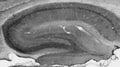
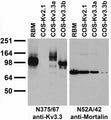
Anti-Kv3.3 Potassium Channel Antibody (N375/67)
Our mouse Kv3.3 potassium channel monoclonal antibody from NeuroMab is produced in-house from clone N375/67. It detects human, mouse, and rat Kv3.3 potassium channel and is purified by Protein A chromatography. Works in WB, IHC, ICC, ELISA.
Human, Mouse, Rat
ELISA, ICC, IHC, WB
Mouse
SKU: 75-354
Ships: 1-2 business days
Product Details
Kv3.3 potassium channel
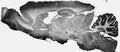
Potassium voltage-gated channel subfamily C member 3 or Kv3.3 potassium channel, is a member of the potassium channel, voltage-gated, shaker-related subfamily and the Shaw subfamily (the family includes 4 members Kv3.1-Kv3.4). Note that this protein has several splice variants and that antibody N375/67 recognizes both Kv3.3b and Kv3.3a. Kv3.3 is primarily expressed in brain. Kv3.3 is highly expressed in purkinje cells and deep cerebellar nuclei in the cerebellum. Kv3.3a is also expressed in brain, but not found in the cerebellum. Kv3.3 is a membrane protein that mediates the voltage-dependent potassium ion permeability of excitable membranes. Diseases associated with the gene for this protein (Kcnc3) include Spinocerebellar Ataxia 13 and Autosomal recessive ataxic cerebral palsy.
Purified by Protein A chromatography
1 mg/mL
Monoclonal
N375/67
IgG1
ELISA, ICC, IHC, WB
Mouse
Kcnc3
80-100 kDa (depending on isoform)
Fusion protein amino acids 628-728 (cytoplasmic C-terminus) of mouse Kv3.3b (accession number Q63959) produced recombinantly in E. Coli
Mouse
Human, Mouse, Rat
AB_2315872
Aliquot and store at ≤ -20°C for long term storage. For short term storage, store at 2-8°C. For maximum recovery of product, centrifuge the vial prior to removing the cap.
Liquid
Produced by in vitro bioreactor culture of hybridoma line followed by Protein A affinity chromatography. Purified mAbs are >90% specific antibody.
10 mM Tris, 50 mM Sodium Chloride, 0.065% Sodium Azide pH 7.125
Unconjugated
Does not cross-react with Kv3.4 or Kv3.2
Each new lot of antibody is quality control tested by western blot on rat whole brain lysate and confirmed to stain the expected molecular weight band.
These antibodies are to be used as research laboratory reagents and are not for use as diagnostic or therapeutic reagents in humans.
United States
24 months from date of receipt
KShIIID; Potassium voltage-gated channel subfamily C member 3; Kv3.3; voltage-gated potassium channel subunit Kv3.3
Q63959
UniProt Summary: Voltage-gated potassium channel that plays an important role in the rapid repolarization of fast-firing brain neurons. The channel opens in response to the voltage difference across the membrane, forming a potassium-selective channel through which potassium ions pass in accordance with their electrochemical gradient. The channel displays rapid activation and inactivation kinetics. It plays a role in the regulation of the frequency, shape and duration of action potentials in Purkinje cells. Required for normal survival of cerebellar neurons, probably via its role in regulating the duration and frequency of action potentials that in turn regulate the activity of voltage-gated Ca(2+) channels and cellular Ca(2+) homeostasis. Required for normal motor function. Plays a role in the reorganization of the cortical actin cytoskeleton and the formation of actin veil structures in neuronal growth cones via its interaction with HAX1 and the Arp2/3 complex.
16504
Shipped on ice packs