Anti-JNK (Thr-183/Tyr-185), Phosphospecific Antibody (M268)
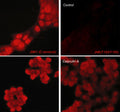
Our JNK (Thr-183/Tyr-185) phosphospecific primary antibody from PhosphoSolutions is mouse monoclonal. It detects human, mouse, and rat JNK (Thr-183/Tyr-185) and is Protein A purified. It is great for use in WB, ICC.
SKU: JM2681
Ships: 1-2 business days
Product Details
JNK (Thr-183/Tyr-185)
The stress-activated protein kinases (SAPK) or Jun-amino-terminal kinases (JNK) are potently activated by stressors such as UV and gamma radiation. Similar to other MAP Kinases, the core signaling unit is composed of a MAPKKK, usually MEKK1-4 or a mixed lineage kinase (MLK), which phosphorylate and activate MKK4-7, leading to dual phosphorylation and activation of JNK kinases. Rho-GTPases (Rac1 and cdc42) can stimulate MEKKs and MLKs, while MKKs can be activated by a GTPase-independent pathway that involves the germinal center kinase family. There are three JNK genes (JNK1, 2, 3) with further diversification resulting from alternative splicing. Active JNK dimers can translocate to the nucleus to regulate transcription through phosphorylation of c-Jun, ATF-2 and other transcription factors.
Protein A Purified
Monoclonal
M268
IgG1
ELISA, ICC, WB
Mouse
MAPK8
46/54
Clone M268 was generated from a dual phosphorylated peptide corresponding to amino acid residues surrounding Thr-183 and Tyr-185 in human JNK1. This sequence has high homology to the conserved site in rat and mouse JNK1 and JNK2.
Human
Human, Mouse, Rat
Storage at -20°C is recommended, as aliquots may be taken without freeze/thawing due to presence of 50% glycerol. Stable for at least 1 year at -20°C.
Liquid
PBS + 1 mg/ml BSA, 0.05% NaN3 and 50% glycerol
WB: 1:1000
ICC: 1:100
ICC: 1:100
Unconjugated
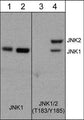
This antibody detects 46 and 54 kDa* proteins corresponding to the apparent molecular mass of JNK1 and JNK2 on SDS-PAGE immunoblots of human A431 and HeLa cells, as well as rat PC12 cells treated with calyculin A.
Phosphorylated
Western blots performed on each lot.
For research use only. Not intended for therapeutic or diagnostic use. Use of all products is subject to our terms and conditions, which can be viewed on our website.
United States
After date of receipt, stable for at least 1 year at -20°C.
JNK; SAPK1; JNK1; SAPK1c; JNK1A2; JNK21B1/2; PRKM8; mitogen-activated protein kinase 8; JUN N-terminal kinase; MAP kinase 8; c-Jun N-terminal kinase 1; stress-activated protein kinase 1; stress-activated protein kinase 1c; p49MAPK; JNK46; MAPK; Stress-activated protein kinase JNK1
P45983
UniProt Summary: Serine/threonine-protein kinase involved in various processes such as cell proliferation, differentiation, migration, transformation and programmed cell death. Extracellular stimuli such as pro-inflammatory cytokines or physical stress stimulate the stress-activated protein kinase/c-Jun N-terminal kinase (SAP/JNK) signaling pathway. In this cascade, two dual specificity kinases MAP2K4/MKK4 and MAP2K7/MKK7 phosphorylate and activate MAPK8/JNK1. In turn, MAPK8/JNK1 phosphorylates a number of transcription factors, primarily components of AP-1 such as JUN, JDP2 and ATF2 and thus regulates AP-1 transcriptional activity. Phosphorylates the replication licensing factor CDT1, inhibiting the interaction between CDT1 and the histone H4 acetylase HBO1 to replication origins. Loss of this interaction abrogates the acetylation required for replication initiation. Promotes stressed cell apoptosis by phosphorylating key regulatory factors including p53/TP53 and Yes-associates protein YAP1. In T-cells, MAPK8 and MAPK9 are required for polarized differentiation of T-helper cells into Th1 cells. Contributes to the survival of erythroid cells by phosphorylating the antagonist of cell death BAD upon EPO stimulation. Mediates starvation-induced BCL2 phosphorylation, BCL2 dissociation from BECN1, and thus activation of autophagy. Phosphorylates STMN2 and hence regulates microtubule dynamics, controlling neurite elongation in cortical neurons. In the developing brain, through its cytoplasmic activity on STMN2, negatively regulates the rate of exit from multipolar stage and of radial migration from the ventricular zone. Phosphorylates several other substrates including heat shock factor protein 4 (HSF4), the deacetylase SIRT1, ELK1, or the E3 ligase ITCH. Phosphorylates the CLOCK-BMAL1 heterodimer and plays a role in the regulation of the circadian clock. Phosphorylates the heat shock transcription factor HSF1, suppressing HSF1-induced transcriptional activity. Phosphorylates POU5F1, which results in the inhibition of POU5F1's transcriptional activity and enhances its proteasomal degradation. Phosphorylates JUND and this phosphorylation is inhibited in the presence of MEN1. In neurons, phosphorylates SYT4 which captures neuronal dense core vesicles at synapses. Phosphorylates EIF4ENIF1/4-ET in response to oxidative stress, promoting P-body assembly. Phosphorylates SIRT6 in response to oxidative stress, stimulating its mono-ADP-ribosyltransferase activity. Phosphorylates NLRP3, promoting assembly of the NLRP3 inflammasome. Phosphorylates ALKBH5 in response to reactive oxygen species (ROS), promoting ALKBH5 sumoylation and inactivation.
5599
Blue Ice