Anti-EphA4 (Tyr-602) [conserved site], Phosphospecific Antibody
Our EphA4 (Tyr-602)) phosphospecific primary antibody from PhosphoSolutions is rabbit polyclonal. It detects chicken, human, mouse, and rat EphA4 (Tyr-602)) and is antigen affinity purified. It is great for use in WB, IHC.
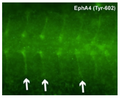
Paraformaldehyde-fixed zebrafish embryos were probed with anti-EphA4 (Tyr-602) (EP2731) then detected using Alexa Fluor 647 goat anti-rabbit. Arrows show labeling of somite boundaries and the notochord. (Image provided by Dr. Scott Holley at the Department of Molecular, Cellular and Developmental Biology, Yale University.)
Click on image to zoom

SKU: EP2731
Ships: 1-2 business days
Product Details
EphA4 (Tyr-602))
The Eph family of Receptor tyrosine kinases and their Ephrin ligands are important for cell positioning and morphogenesis during development. Eph receptors are classified into 10 EphA and 6 EphB receptors, which preferentially bind to the type A and type B ephrins, respectively. The EphA4 receptor can inhibit axon outgrowth and has roles in regulating axon projections during neural development. EphA4 signaling pathways require its kinase activity and involve binding and activation of Rho-GTPase guanine nucleotide-exchange factors (GEFs). EphA4 activation leads autophosphorylation of Tyr-596 and Tyr-602, and the conserved sites in EphA2 are required for binding to the GEFs, Vav2 and Vav3, and ephrin-induced cell migration. The Tyr-779 site in the kinase domain is also phosphorylated in vivo and may regulate kinase activity. Activated EphA4 leads to Src kinase phosphorylation of the GEF, ephexin-1, and this activates RhoA. Thus, EphA4 signaling involves complex tyrosine phosphorylation in its cytoplasmic region along with interaction with several GEFs.
Antigen Affinity Purified
Polyclonal
IgG
ELISA, IHC, WB
Rabbit
EPHA4
120
EphA4 (Tyr-602) synthetic peptide (coupled to carrier protein) corresponds to amino acids surrounding phosphorylated tyrosine 602 in human EphA4. This sequence has significant homology to the conserved site in rat and mouse EphA4, and is conserved well in most other EphA and EphB family members.
Human
Chicken, Human, Mouse, Rat
Storage at -20°C is recommended, as aliquots may be taken without freeze/thawing due to presence of 50% glycerol. Stable for at least 1 year at -20°C.
Liquid
PBS + 1 mg/ml BSA, 0.05% NaN3 and 50% glycerol
WB: 1:1000
IHC: 1:100
IHC: 1:100
Unconjugated
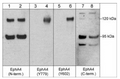
The purified antibody detects a 120 kDa* band corresponding to EphA4 in Western blots of HUVEC cells treated with pervanadate and in mouse brain tissue.
Phosphorylated
Tyr-602
Western blots performed on each lot.
For research use only. Not intended for therapeutic or diagnostic use. Use of all products is subject to our terms and conditions, which can be viewed on our website.
United States
After date of receipt, stable for at least 1 year at -20°C.
HEK8; SEK; TYRO1; ephrin type-A receptor 4; EK8; EPH-like kinase 8; TYRO1 protein tyrosine kinase; receptor protein-tyrosine kinase HEK8; tyrosine-protein kinase TYRO1; tyrosine-protein kinase receptor SEK; Eph
P54764
UniProt Summary: Receptor tyrosine kinase which binds membrane-bound ephrin family ligands residing on adjacent cells, leading to contact-dependent bidirectional signaling into neighboring cells. The signaling pathway downstream of the receptor is referred to as forward signaling while the signaling pathway downstream of the ephrin ligand is referred to as reverse signaling. Highly promiscuous, it has the unique property among Eph receptors to bind and to be physiologically activated by both GPI-anchored ephrin-A and transmembrane ephrin-B ligands including EFNA1 and EFNB3. Upon activation by ephrin ligands, modulates cell morphology and integrin-dependent cell adhesion through regulation of the Rac, Rap and Rho GTPases activity. Plays an important role in the development of the nervous system controlling different steps of axonal guidance including the establishment of the corticospinal projections. May also control the segregation of motor and sensory axons during neuromuscular circuit development. In addition to its role in axonal guidance plays a role in synaptic plasticity. Activated by EFNA1 phosphorylates CDK5 at 'Tyr-15' which in turn phosphorylates NGEF regulating RHOA and dendritic spine morphogenesis. In the nervous system, also plays a role in repair after injury preventing axonal regeneration and in angiogenesis playing a role in central nervous system vascular formation. Additionally, its promiscuity makes it available to participate in a variety of cell-cell signaling regulating for instance the development of the thymic epithelium. During development of the cochlear organ of Corti, regulates pillar cell separation by forming a ternary complex with ADAM10 and CADH1 which facilitates the cleavage of CADH1 by ADAM10 and disruption of adherens junctions. Phosphorylates CAPRIN1, promoting CAPRIN1-dependent formation of a membraneless compartment.
2043
Blue Ice