Anti-CamKII subunit alpha, Thr253 Antibody
Our Anti-Phospho-calcium/calmodulin-dependent protein kinase type II subunit alpha, Thr253 (alpha-CaMKII, Thr253) rabbit polyclonal primary antibody detects rat Phospho-calcium/calmodulin-dependent protein kinase type II subunit alpha, Thr253 (alpha-CaMKII, Thr253), and is whole serum. It is validated for use in WB.
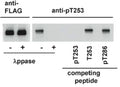
Western blot analysis of recombinant FLAG-alpha-CaMKII purified from transfected COS cells. Blots of wild-type CaMKII phosphorylated at Thr253 were treated with lambda phosphatase prior to probing with anti-pT253 or anti-FLAG antibody. The pT253 antibody was incubated with phospho-Thr253 (pT253, 50 nM), non-phospho-Thr253 (T253, 500 nM) or phospho-Thr286 (pT286, 50 nM) peptides prior to probing the western blots. Reference: Migues PV et al (2006) J Neurochem 98 (1), 289-299.
Click on image to zoom
SKU: R-1706-100
Ships: 1-2 business days
Product Details
Phospho-calcium/calmodulin-dependent protein kinase type II subunit alpha, Thr253 (alpha-CaMKII, Thr253)
Calcium/calmodulin-stimulated protein kinase II (CaMKII) is composed of four different chains (alpha, beta, gamma, and delta) and is abundantly expressed in neurons. CaMKII is involved in regulating many aspects of neuronal function, including neurotransmitter synthesis and release, modulation of ion channel activity and cellular transport. The enzymatic function of CaMKII is regulated by its multiple phosphorylation sites and targeting to sub-cellular locations through interactions with protein binding partners. Phosphorylation of Thr253 has been identified in vivo and found to alter the interaction of CaMKII with binding partners, but not change its enzymatic activity. Thus, phosphorylation of Thr253 is suggested to modulate functional responses based on its binding partner and subsequently its sub-cellular localization.
Whole serum
Polyclonal
Mixed
WB
Rabbit
A synthetic peptide (NKmLpTINPSC) corresponding to the sequence around Thr253 (AA 249-257) in alpha-CaMKII was synthesized, purified to 95% purity by HPLC, analyzed by mass spectroscopy and coupled to diphtheria toxoid.
Rat
Rat
Spin vial briefly before opening. Reconstitute in 100 uL sterile-filtered, ultrapure water. Centrifuge to remove any insoluble material. Centrifuge to remove any insoluble material. After reconstitution of lyophilized antibody, aliquot and store at -20°C for a higher stability. Avoid freeze-thaw cycles.
Lyophilized
WB: 1:200-1:1000
Unconjugated
Rat. Predicted from gene analysis to react with human and mouse alpha-CaMKII.
For research use only.
United States
12 months after date of receipt (unopened vial).
Calcium/calmodulin dependent protein kinase II alpha; Calcium/calmodulin dependent protein kinase II beta; Calcium/calmodulin dependent protein kinase II delta; Calcium/calmodulin dependent protein kinase II gamma; Calcium/calmodulin-dependent protein kinase type II subunit alpha; CaM kinase II alpha; CaM kinase II; CaM kinase II beta; CaM kinase II delta; CaM kinase II gamma; CaM kinase II subunit alpha; CaMK-II subunit alpha; CAMK2; Camk2a; CAMK2B; CAMK2D; CAMK2G; CAMKA; KCC2A_HUMAN
P11275
UniProt Summary: Calcium/calmodulin-dependent protein kinase that functions autonomously after Ca(2+)/calmodulin-binding and autophosphorylation, and is involved in various processes, such as synaptic plasticity, neurotransmitter release and long-term potentiation. Member of the NMDAR signaling complex in excitatory synapses, it regulates NMDAR-dependent potentiation of the AMPAR and therefore excitatory synaptic transmission. Regulates dendritic spine development. Also regulates the migration of developing neurons. Phosphorylates the transcription factor FOXO3 to activate its transcriptional activity. Phosphorylates the transcription factor ETS1 in response to calcium signaling, thereby decreasing ETS1 affinity for DNA. In response to interferon-gamma (IFN-gamma) stimulation, catalyzes phosphorylation of STAT1, stimulating the JAK-STAT signaling pathway. In response to interferon-beta (IFN-beta) stimulation, stimulates the JAK-STAT signaling pathway. In response to interferon-gamma (IFN-gamma) stimulation, catalyzes phosphorylation of PSAT1, inhibiting ferroptosis by promoting GPX4 hydroxylation and stability. Acts as a negative regulator of 2-arachidonoylglycerol (2-AG)-mediated synaptic signaling via modulation of DAGLA activity.
25400
25°C (ambient)