
Anti-Atrial Natriuretic Peptide Antibody
Our Anti-Atrial Natriuretic Peptide rabbit polyclonal primary antibody detects bovine (predicted), cat (predicted), dog (predicted), horse (predicted), human, mouse, pig (predicted), and rat Atrial Natriuretic Peptide, and is affinity-purified. It is validated for use in ICC, IHC-Frozen, IHC-Paraffin-embedded.
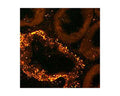
Immunohistochemical staining in convoluted tubules in rat kidney. 4% paraformaldehyde fixed rat kidney crystostat sections (10 µm) were incubated overnight at 4°C with Rabbit polyclonal antibody to rat Atrial Natriuretic Peptide (10 µg/mL) followed by incubation with donkey anti-rabbit Rhodamine Red conjugated secondary antibody (1:200).
Click on image to zoom
Bovine, Canine, Feline, Horse, Human, Mouse, Pig, Rat
ICC, IHC
Rabbit
SKU: R-1500-50
Ships: 5-7 business days
Product Details
Atrial Natriuretic Peptide
The hormone Atrial natriuretic peptide (ANP) is produced by cardiomyocites and is secreted into the bloodstream. ANP acts on convoluted tubules in kidney reducing sodium absorption which results in reducing the blood pressure.
Affinity-purified
Polyclonal
IgG
ICC, IHC
Rabbit
Synthetic rat Atrial natriuretic peptide (123-150 aa) conjugated to BSA.
Rat
Bovine, Canine, Feline, Horse, Human, Mouse, Pig, Rat
Spin vial briefly before opening. Reconstitute in 0.05 mL of sterile-filtered PBS (pH 7.4). Centrifuge to remove any insoluble material. At least 12 months after purchase at 2 - 8°C (lyophilized formulations). After reconstitution, aliquot and store at -20°C for up to 6 months for a higher stability and at 2-8°C with an appropriate antibacterial agent for up to 2 weeks.Avoid freeze-thaw cycles
Lyophilized
Lyophilized with BSA.
IHC: 5-15 µg/mL
ICC: 5-15 µg/mL
ICC: 5-15 µg/mL
Unconjugated
Human; mouse; rat. Highly conserved and expected to interact with feline, canine, porcine, bovine, and equine ANP.
For research use only.
United States
12 months after date of receipt (unopened vial).
ANF; Atrial natriuretic factor; Pnd; RATANF; Prepronatriodilatin; natriuretic peptides A; atrial natriuretic peptide; natriuretic peptide precursor type A
P01161
UniProt Summary: [Atrial natriuretic peptide]: Hormone that plays a key role in mediating cardio-renal homeostasis, and is involved in vascular remodeling and regulating energy metabolism. Acts by specifically binding and stimulating NPR1 to produce cGMP, which in turn activates effector proteins, such as PRKG1, that drive various biological responses. Regulates vasodilation, natriuresis, diuresis and aldosterone synthesis and is therefore essential for regulating blood pressure, controlling the extracellular fluid volume and maintaining the fluid-electrolyte balance. Also involved in inhibiting cardiac remodeling and cardiac hypertrophy by inducing cardiomyocyte apoptosis and attenuating the growth of cardiomyocytes and fibroblasts. Plays a role in female pregnancy by promoting trophoblast invasion and spiral artery remodeling in uterus, and thus prevents pregnancy-induced hypertension. In adipose tissue, acts in various cGMP- and PKG-dependent pathways to regulate lipid metabolism and energy homeostasis. This includes up-regulating lipid metabolism and mitochondrial oxygen utilization by activating the AMP-activated protein kinase (AMPK), and increasing energy expenditure by acting via MAPK11 to promote the UCP1-dependent thermogenesis of brown adipose tissue. Binds the clearance receptor NPR3 which removes the hormone from circulation.
24602
25°C (ambient)

