Anti-Amyloid Precursor Protein (APP), Peptide #3 Antibody
This antibody recognizes the peptide sequence QHF QEK VES LEQ EAA NER AA, which corresponds to residues #433-452 of the human APP gene product. This peptide sequence is 100% conserved between human, mouse and rat homologs of APP, and the antibodies against this sequence cross-react with all three species. The antibody preparation is at a concentration of 100 µg/mL (based on absorbance at 280 nm).
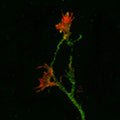
Mouse cortical neurons in culture. The green staining is APP-immunoreactivity, using fluorescein-labeled goat anti-chicken IgY (Product No. F-1005, Aves Labs) and rhodamine-labeled phalloidin as a counterstain. Note the APP-staining of the neurites and growth cones, and the phalloidin-staining limited to the distal growth cones and filapodia. Photomicrograph courtesy of Dr. Philip Copenhaver (OHSU).
Amyloid Precursor Protein (APP, UniProt Accession Number P05067) is a 770 amino acid, single-pass transmembrane protein whose beta-amyloid proteolytic fragment can form neurotoxic extracellular accumulations in human cerebral cortex, and is widely believed to be the cause of Alzheimer's dementia. However, the normal function of APP itself is still obscure, as are potential functions of various proteolytic fragments that have been observed in human brain [Muller, U.C., Deller, T., Korte, M. (2017) Nature Reviews Neuroscience 18: 281-298)]. To better understand these functions, we have made a set of five anti-peptide antibody reagents against APP. One of the peptide sequences used is within the beta-amyloid fragment and recognizes the extracellular amyloid plaques observed in Alzheimer patients' brains (see Cat.# ABN). Three other peptide sequences used, however, are within the extracellular domain of APP outside of this domain, and are useful for identifying the APP protein itself, and various proteolytic fragments, rather than the beta-amyloid peptide and plaques.
Affinity-Purified IgY
100 µg/mL
Polyclonal
IgY
ICC, IHC
Chicken
APP A4 AD1
87 kDa
Synthetic peptide (QHF QEK VES LEQ EAA NER AA, residues #433-452) from the human APP gene product
Human
Human, Mouse, Rat
AB_2797314
Store at 4°C in the dark. Under these conditions, the antibodies should have a shelf life of at least twelve months, provided they remain sterile. For longer term storage, aliquot and freeze to avoid freeze-thaw of the antibody.
Liquid
Chickens were immunized with a keyhole limpet hemocyanin (KLH) conjugate of the synthetic peptide QHF QEK VES LEQ EAA NER QQ, which corresponds to residues #433-452 of the human gene product (NP_000475.1). This sequence is also conserved in the mouse and rat APP gene products, as well. After repeated injections, immune eggs were collected from the hens, and the IgY fractions were purified from the yolks. These IgY fractions were then affinity-purified against the cognate peptide using an agarose column, the concentration of the eluates adjusted to 100 µg/mL, and the preparation was filter-sterilized.
Phosphate-buffered (10 mM) isotonic (0.9%, w/v) saline (“PBS," pH 7.2) with sodium azide (0.02%, w/v) added as a preservative.
IHC: 1:500-1:1000
ICC: 1:500-1:1000
This anti-peptide antibody mixture was analyzed by immunohistochemistry (at a dilution of 1:1000) using fluorescein-labeled goat anti-chicken IgY (1:500 dilution, Aves Labs Cat.# F-1005) as the secondary reagent.
These antibodies are to be used as research laboratory reagents and are not for use as diagnostic or therapeutic reagents in humans.
P05067
UniProt Summary: Functions as a cell surface receptor and performs physiological functions on the surface of neurons relevant to neurite growth, neuronal adhesion and axonogenesis. Interaction between APP molecules on neighboring cells promotes synaptogenesis. Involved in cell mobility and transcription regulation through protein-protein interactions. Can promote transcription activation through binding to APBB1-KAT5 and inhibits Notch signaling through interaction with Numb. Couples to apoptosis-inducing pathways such as those mediated by G(o) and JIP. Inhibits G(o) alpha ATPase activity. Acts as a kinesin I membrane receptor, mediating the axonal transport of beta-secretase and presenilin 1. By acting as a kinesin I membrane receptor, plays a role in axonal anterograde transport of cargo towards synapses in axons. Involved in copper homeostasis/oxidative stress through copper ion reduction. In vitro, copper-metallated APP induces neuronal death directly or is potentiated through Cu(2+)-mediated low-density lipoprotein oxidation. Can regulate neurite outgrowth through binding to components of the extracellular matrix such as heparin and collagen I and IV. The splice isoforms that contain the BPTI domain possess protease inhibitor activity. Induces a AGER-dependent pathway that involves activation of p38 MAPK, resulting in internalization of amyloid-beta peptide and leading to mitochondrial dysfunction in cultured cortical neurons. Provides Cu(2+) ions for GPC1 which are required for release of nitric oxide (NO) and subsequent degradation of the heparan sulfate chains on GPC1.
351
Ice packs
Bulk Order Anti-Amyloid Precursor Protein (APP), Peptide #3 Antibody
Related Products
Recently Viewed
Your research is our top priority
Highly-validated antibodies and reagents from our family of brands.