Detect endogenous levels of alpha-synuclein (SNCA), also known as PARK1, NACP, PARK4, by Western Blot, immunohistochemistry, and immunofluorescence using this highly-validated chicken anti-alpha-synuclein antibody.
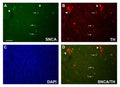
Chicken anti-SNCA (green) and TH (red) double immunostaining in Parkinson's Disease patient’s substantia nigra section. Arrows indicate SNCA positive, degenerating dopamine neurons. Arrowheads indicate SNCA negative, healthy dopamine neurons. Bar = 50 um for A-D. (Image courtesy of Dr. Curt Freed’s lab, University of Colorado Anschutz Medical Campus.)
Alpha-synuclein (SNCA), also known as PARK1, NACP, PARK4, is a member of the synuclein family, which also includes beta- and gamma-synuclein. Alpha-synuclein is a highly-conserved protein known to be abundant in neurons and especially presynaptic terminals where it serves multiple roles including regulation of synaptic vesicle trafficking and subsequent neurotransmitter release. Functionally, alpha synuclein has been implicated in synaptic plasticity (Liu 2004) and the assembly of snare complexes (Burre 2010) and it is known to be associated with various neuropathologies including Parkinson's Disease, Lewy Body Dementia, and Alzheimer's Disease, where it forms insoluble protein aggregates. Early studies of amyloid deposits in the brains of Alzheimer's patients revealed two previously uncharacterized peptides in addition to the amyloid beta fragment (Ueda 1993), both of which were found to correspond to alpha-synuclein (SNCA). Later studies confirmed that aggregated alpha-synuclein proteins are present in brain lesions (Lewy bodies) that are hallmarks of neurodegenerative synucleinopathies and that alpha synuclein likely plays a role in the pathogenesis of Parkinson's disease, Lewy body dementia, and Alzheimer’s disease among other neuropathologies. The SNCA antibody was raised against full-length human alpha synuclein and recognizes endogenous levels of alpha synuclein in brain by Western blot and immunohistochemistry.
IgY Fraction
10 mg/mL
Polyclonal
IgY
ICC, IF, IHC, WB
Chicken
SNCA, NACP, PARK1
14 kDa
Full-length human alpha-synuclein (UniProtKB - P37840) produced in E.Coli.
Human
Human, Mouse, Rat
AB_2827809
Store at 4°C in the dark. Under these conditions, the antibodies should have a shelf life of at least twelve months, provided they remain sterile. For longer term storage, aliquot and freeze to avoid freeze-thaw of the antibody.
Liquid
Chickens were immunized with recombinant human α-synuclein protein (expressed in bacteria). After repeated injections, immune eggs were collected, the IgY fractions were purified from the yolks, and the IgY concentration adjusted to 10 mg/ml. Finally, the antibody preparation was filter-sterilized.
Phosphate-buffered (10 mM) isotonic (0.9%, w/v) saline ("PBS,” pH 7.2) with sodium azide (0.02%, w/v) added as a preservative.
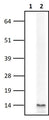
Antibodies were analyzed by western blot analysis (1:2500 dilution) on rat brain lysate and immunohistochemistry (1:200 dilution) on substantia nigra sections from a Parkinson’s Disease patient's brain. Western blots were performed using BlokHen® (Aves Labs) as the blocking reagent, and HRP-labeled goat anti-chicken IgY (1:500 dilution, Aves Labs Cat.# H-1004) as the detection reagent. Immunohistochemistry used FITC-conjugated goat anti-chicken IgY (AvesLabs Cat. # F-1005).
These antibodies are to be used as research laboratory reagents and are not for use as diagnostic or therapeutic reagents in humans.
United States
12 months from receipt of product
Alpha synuclein; Alpha-synuclein; Alpha-synuclein; isoform NACP140; alphaSYN; MGC105443; MGC110988; MGC127560; MGC64356; NACP; Non A beta component of AD amyloid; Non A4 component of amyloid; Non A4 component of amyloid precursor; Non-A beta component of AD amyloid; Non-A-beta component of alzheimers disease amyloid; precursor of; Non-A4 component of amyloid precursor; Non-A4 component of amyloid; OTTHUMP00000218549; OTTHUMP00000218551; OTTHUMP00000218552; OTTHUMP00000218553; OTTHUMP00000218554; PARK 1; PARK 4; PARK1; PARK4; Parkinson disease (autosomal dominant Lewy body 4; Parkinson disease familial 1; SNCA; Snca synuclein alpha (non A4 component of amyloid precursor; SYN; Synuclein alpha; Synuclein alpha 140; Synuclein alpha (non A4 component of amyloid precursor; SYUA_HUMAN; Non-A beta component of AD amyloid; Non-A4 component of amyloid precursor; NACP
P37840
UniProt Summary: Neuronal protein that plays several roles in synaptic activity such as regulation of synaptic vesicle trafficking and subsequent neurotransmitter release. Participates as a monomer in synaptic vesicle exocytosis by enhancing vesicle priming, fusion and dilation of exocytotic fusion pores. Mechanistically, acts by increasing local Ca2+ release from microdomains which is essential for the enhancement of ATP-induced exocytosis. Acts also as a molecular chaperone in its multimeric membrane-bound state, assisting in the folding of synaptic fusion components called SNAREs (Soluble NSF Attachment Protein REceptors) at presynaptic plasma membrane in conjunction with cysteine string protein-alpha/DNAJC5. This chaperone activity is important to sustain normal SNARE-complex assembly during aging. Plays also a role in the regulation of the dopamine neurotransmission by associating with the dopamine transporter (DAT1) and thereby modulating its activity.
Entrez Gene Summary: Alpha-synuclein is a member of the synuclein family, which also includes beta- and gamma-synuclein. Synucleins are abundantly expressed in the brain and alpha- and beta-synuclein inhibit phospholipase D2 selectively. SNCA may serve to integrate presynaptic signaling and membrane trafficking. Defects in SNCA have been implicated in the pathogenesis of Parkinson's Disease. SNCA peptides are a major component of amyloid plaques in the brains of patients with Alzheimer's Disease. Alternatively spliced transcripts encoding different isoforms have been identified for this gene.
6622
Ice packs
Bulk Order Anti-Alpha Synuclein Antibody
Related Products
Recently Viewed
Your research is our top priority
Highly-validated antibodies and reagents from our family of brands.