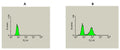
This kit is highly specific for active human and murine enzyme. The kit utilizes a rabbit affinity purified polyclonal antibody against aa 163-175 of murine caspase 3. Visualization of fixed samples is via a FITC-labeled goat anti-rabbit antibody.
Figure 1. Jurkat Cells were stimulated with staurosporine (B) or DMSO (A) for 2 hours. The cells were washed and fixed for 15 minutes. The cells were then permeabilized with saponin and stained with anti-active caspase 3 antibody for 1 hour. The samples were then stained with FITC labeled Goat anti-Rabbit antibody.
Apoptosis is an evolutionarily conserved form of cell suicide, which follows a specialized cellular process. The central component of this process is a cascade of proteolytic enzymes called caspases. These enzymes participate in a series of reactions that are triggered in response to pro-apoptotic signals and result in cleavage of protein substrates, causing the disassembly of the cell. Caspases have been identified in organisms ranging from C. elegans to humans. The mammalian caspases play distinct roles in apoptosis and inflammation. In apoptosis, caspases are responsible for proteolytic cleavages that lead to cell disassembly (effector caspases), and are involved in upstream regulatory events (initiator caspases). An active caspase consists of two large (~20 kD) and two small (~10 kD) subunits to form two heterodimers which associate in a tetramer. As is common with other proteases, caspases are synthesized as precursors that undergo proteolytic maturation, either autocatalytically or in a cascade by enzymes with similar specificity.
Caspase 3, also known as CPP-32, Apopain or Yama, is a key effector caspase in the apoptotic pathway. It is present in many different cell lineages and is responsible for the cleavage of a variety of molecules such as poly ADP-ribose polymerase (PARP), protein kinase C, actin and DNA-dependent protein kinase.
This kit utilizes a primary Rabbit affinity-purified polyclonal antibody raised against amino acid 163-175 of murine caspase 3. This neo-epitope is present on the p18 subunit of cleaved caspase 3. Cell undergoing apoptosis are fixed and permeabilized prior to the addition of the primary antibody. A secondary FITC-labeled Goat anti-Rabbit antibody is used to visualize the bound Rabbit anti-caspase 3 polyclonal antibody.
Part # 1002: Rabbit Anti Cleaved Caspase 3 Affinity Purified Polyclonal Antibody, 1 Vial (2-8°C)
Part # 2002: FITC Labeled Goat Anti Rabbit Affinity Purified Polyclonal Antibody, 1 Vial (2-8°C)
Part # 3001: 10X Fixative, 1 Vial (2-8°C)
Bulk Order Apo Active FITC - Caspase 3 Detection Kit
Refund Policy
Satisfaction Guaranteed
We stand by our products and are here to ensure that you get the most out of each experiment using our products and reagents.
We produce everything that we sell and are dedicated to creating reliable and high-quality products that further scientific research. All of our products are produced and quality control tested in-house. We will never sell a product unless we can get it to work in our hands. If a product does not perform as expected, please contact us within 12 months of product purchase and we will provide expert troubleshooting tips to support you. If we cannot resolve the issue, we will replace the product at no cost or offer a 100% refund. We are passionate about providing researchers with the highest quality products on the market, reagents you can count on to make your next discovery.