
Anti-Ubiquitin carboxyl-terminal hydrolase isozyme L1 (PGP9.5) Antibody
Our Anti-Ubiquitin carboxyl-terminal hydrolase isozyme L1 (PGP9.5) chicken polyclonal primary antibody detects bovine, human, mouse, other mammals (predicted), pig, and rat Ubiquitin carboxyl-terminal hydrolase isozyme L1 (PGP9.5), and is IgY preparation. It is validated for use in ICC, IHC-Frozen, IHC-Paraffin-embedded, WB.
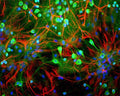
Image shows rat mixed neuron/glial cultures stained with Chicken polyclonal antibody to Ubiquitin C Terminal Hydrolase 1 C-1406-50 (green) and Rabbit polyclonal antibody to Glial Fibrillary Acidic Protein R-1374-50 (red). Blue is a DNA stain. Note that the Ubiquitin antibody stains neurons strongly and specifically and that the staining is concentrated in the cell bodies, though some does extend into the dendrites also.
Click on image to zoom
SKU: C-1406-50
Ships: 5-7 business days
Product Details
Ubiquitin carboxyl-terminal hydrolase isozyme L1 (PGP9.5)
This enzyme is a thiol protease that recognizes and hydrolyzes a peptide bond at the C-terminal glycine of ubiquitin. The enzyme also binds to free monoubiquitin and may prevent its degradation in lysosomes (ref: SWISSPROT).
IgY preparation
Polyclonal
IgY
ICC, IHC, WB
Chicken
24 kDa
Recombinant full length human Ubiquitin C Terminal Hydrolase 1 (UCHL1) purified from E. coli.
Human
Bovine, Human, Mouse, Pig, Rat
Spin vial briefly before opening. Reconstitute with 50 µL sterile-filtered, ultrapure water. Centrifuge to remove any insoluble material. After reconstitution of lyophilized antibody, aliquot and store at -20°C for a higher stability. Avoid freeze-thaw cycles.
Lyophilized
Lyophilized IgY preparation, with sodium azide.
WB: 1:5000-1:10000
ICC: 1:500-1:1000
ICC: 1:500-1:1000
Unconjugated
The specificity of this antibody has been confirmed by WB. This antibody detects ~24 kDa UCHL1 enzyme. Suitable control tissue is rat spinal cord or peripheral nerve homogenate. Hu, rat, Ms, Bov, Por. Predicted to react with other mammalian tissues due to sequence homology.
For research use only.
United States
12 months after date of receipt (unopened vial).
Epididymis luminal protein 117; Ubiquitin carboxyl-terminal hydrolase isozyme L1; Epididymis secretory protein Li 53; UCH-L1; HEL 117; Neuron cytoplasmic protein 9.5; HEL S 53; PGP 9.5; NDGOA; PGP9.5; Neuron cytoplasmic protein 9.5; Ubiquitin thioesterase L1; OTTHUMP00000218137; UCHL1; OTTHUMP00000218139; Ubiquitin C Terminal Hydrolase 1; OTTHUMP00000218140; OTTHUMP00000218141; Park 5; PARK5; PGP 9.5; PGP9.5; PGP95; Protein gene product 9.5; Ubiquitin C terminal esterase L1; Ubiquitin C terminal hydrolase; Ubiquitin C terminal hydrolase L1; Ubiquitin carboxyl terminal esterase L1; Ubiquitin carboxyl terminal hydrolase isozyme L1; Ubiquitin carboxyl-terminal hydrolase isozyme L1; Ubiquitin thioesterase L1; Ubiquitin thiolesterase; Ubiquitin thiolesterase L1; UCH-L1; UCHL1; UCHL1_HUMAN
P09936
UniProt Summary: Deubiquitinase that plays a role in the regulation of several processes such as maintenance of synaptic function, cardiac function, inflammatory response or osteoclastogenesis. Abrogates the ubiquitination of multiple proteins including WWTR1/TAZ, EGFR, HIF1A and beta-site amyloid precursor protein cleaving enzyme 1/BACE1. In addition, recognizes and hydrolyzes a peptide bond at the C-terminal glycine of ubiquitin to maintain a stable pool of monoubiquitin that is a key requirement for the ubiquitin-proteasome and the autophagy-lysosome pathways. Regulates amyloid precursor protein/APP processing by promoting BACE1 degradation resulting in decreased amyloid beta production. Plays a role in the immune response by regulating the ability of MHC I molecules to reach cross-presentation compartments competent for generating Ag-MHC I complexes. Mediates the 'Lys-48'-linked deubiquitination of the transcriptional coactivator WWTR1/TAZ leading to its stabilization and inhibition of osteoclastogenesis. Deubiquitinates and stabilizes epidermal growth factor receptor EGFR to prevent its degradation and to activate its downstream mediators. Modulates oxidative activity in skeletal muscle by regulating key mitochondrial oxidative proteins. Enhances the activity of hypoxia-inducible factor 1-alpha/HIF1A by abrogateing its VHL E3 ligase-mediated ubiquitination and consequently inhibiting its degradation.
7345
25°C (ambient)

