
Anti-TRPM7 (Ser-1493), Phosphospecific Antibody
Our TRPM7 (Ser-1493) rabbit polyclonal phosphospecific primary antibody from PhosphoSolutions is produced in-house. It detects human TRPM7 (Ser-1493) and is antigen affinity purified. It is great for use in WB.
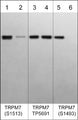
Western blot image of human autophosphorylated TRPM7 C-terminal kinase domain (lanes 1-6). The blot was treated with lambda phosphatase to dephosphorylate TRPM7 phosphosites (lanes 2, 4, & 6). The blot was probed with rabbit polyclonals anti-TRPM7 (Ser-1513), phospho-specific (lanes 1 & 2), anti-TRPM7 (a.a.1484-1497), TP5691 antibody (lanes 3 & 4), or anti-TRPM7 (Ser-1493), phospho-specific (lanes 5 & 6).
Click on image to zoom

SKU: TP5661
Ships: 1-2 business days
Product Details
TRPM7 (Ser-1493)
The transient receptor potential melastatin (TRPM) subfamily of cation-permeable TRP channels is ubiquitously expressed in mammalian tissues. This family includes TRPM1-8. In addition to acting as a calcium-permeant channel, TRPM6 and TRPM7 possess an inherent serine/threonine kinase activity. TRPM7 specifically is involved with cellular magnesium homeostasis and neurotransmitter release. Due to the magnesium inhibition, TRPM7’s ion channel activity is very low. TRPM7 has been implicated in cell proliferation and migration during cancer progression, and its expression levels correlate with prognosis in breast cancer. TRPM7 kinase activation leads to massive autophosphorylation of the C-terminal region, including phosphorylation of Ser-1493, Ser-1513, and Ser-1569. Both Ser-1513 and Ser-1569 phosphorylation is required for kinase activity, and phosphorylation of Ser-1513 may inhibit Caspase-mediated cleavage of the C-terminal tail. Thus, TRPM7 is a multifunctional transmembrane protein with roles in cell signaling, proliferation, migration, and death.
Antigen Affinity Purified
Polyclonal
IgG
ELISA, WB
Rabbit
TRPM7
220
Phospho-TRPM7 (Ser-1493) synthetic peptide (coupled to carrier) corresponding to amino acids surrounding Ser-1493 in human TRPM7. This site is conserved in rat and mouse TRPM7, but the homology surrounding the site is low. This site has no homology to other TRPM family members.
Human
Human
Storage at -20°C is recommended, as aliquots may be taken without freeze/thawing due to presence of 50% glycerol. Stable for at least 1 year at -20°C.
Liquid
PBS + 1 mg/ml BSA, 0.05% NaN3 and 50% glycerol
WB: 1:500
Unconjugated
The antibody was cross-adsorbed to unphosphorylated TRPM7 (Ser-1493) then affinity purified using phospho-TRPM7 (Ser-1493) peptide. This antibody detects a 220 kDa* protein on SDS-PAGE immunoblots of human MDA-MB-231 cells stimulated with calyculin A, and detects a 70 kDa autophosphorylated recombinant kinase domain of human TRPM7. These reactivities are not observed after lambda phosphatase treatment to dephosphorylate TRPM7.
Phosphorylated
Ser-1493
Western blots performed on each lot.
For research use only. Not intended for therapeutic or diagnostic use. Use of all products is subject to our terms and conditions, which can be viewed on our website.
United States
After date of receipt, stable for at least 1 year at -20°C.
ALSPDC; TRPM7 TrpC7; CHAK1; LTRPC7; LTrpC-7; TRP-PLIK; LTRPC ion channel family member 7; channel-kinase 1; long transient receptor potential channel 7; TRP
Q96QT4
UniProt Summary: Bifunctional protein that combines an ion channel with an intrinsic kinase domain, enabling it to modulate cellular functions either by conducting ions through the pore or by phosphorylating downstream proteins via its kinase domain. The channel is highly permeable to divalent cations, specifically calcium (Ca2+), magnesium (Mg2+) and zinc (Zn2+) and mediates their influx. Controls a wide range of biological processes such as Ca2(+), Mg(2+) and Zn(2+) homeostasis, vesicular Zn(2+) release channel and intracellular Ca(2+) signaling, embryonic development, immune responses, cell motility, proliferation and differentiation. The C-terminal alpha-kinase domain autophosphorylates cytoplasmic residues of TRPM7. In vivo, TRPM7 phosphorylates SMAD2, suggesting that TRPM7 kinase may play a role in activating SMAD signaling pathways. In vitro, TRPM7 kinase phosphorylates ANXA1 (annexin A1), myosin II isoforms and a variety of proteins with diverse cellular functions.
54822
Blue Ice

