
Anti-Trk B Antibody
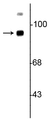
Our Anti-Trk B rabbit polyclonal primary antibody from PhosphoSolutions is produced in-house. It detects rat Trk B and is affinity purified. It is great for use in WB.
SKU: 2007-TRKB
Ships: 1-2 business days
Product Details
Trk B
Tropomyosin-receptor-kinase (TRK) receptors are members of the receptor tyrosine kinase family and include TrkA, TrkB and TrkC. Each of these receptor types has different binding affinities to the neurotrophins nerve growth factor (NGF), brain-derived neurotrophic factor (BDNF) and neurotrophin 3 (NT-3). TrkB has the highest affinity to binding BDNF which plays critical roles in the function and survival of neurons in the CNS (Soppet et al., 1991; Klein et al., 1991). Additionally, alterations in expression of TrkB have been associated with Alzheimer’s disease (Ferrer et al., 1999; Chen et al., 2008).
Affinity Purified
Polyclonal
IgG
ELISA, WB
Rabbit
Ntrk2
93 kDa
Synthetic peptide corresponding to amino acid residues from the N-terminal region of rat TrkB, conjugated to keyhole limpet hemocyanin (KLH).
Rat
Rat
AB_2492266
Storage at -20°C is recommended, as aliquots may be taken without freeze/thawing due to presence of 50% glycerol. Stable for at least 1 year at -20°C.
Liquid
Prepared from rabbit serum by affinity purification on a column made with the N-terminal peptide used as antigen.
10 mM HEPES (pH 7.5), 150 mM NaCl, 100 µg per ml BSA and 50% glycerol.
WB: 1:1000
WB Brain: 1:1000
WB Brain: 1:1000
Unconjugated
Specific for endogenous levels of the ~93 kDa TrkB protein in western blots.
Western blots performed on each lot.
For research use only. Not intended for therapeutic or diagnostic use. Use of all products is subject to our terms and conditions, which can be viewed on our website.
After date of receipt, stable for at least 1 year at -20°C.
AI848316; BDNF tropomyosine receptor kinase B; BDNF/NT 3 growth factors receptor; BDNF/NT-3 growth factors receptor; Brain derived neurotrophic factor receptor; C030027L06Rik; EC 2.7.10.1; GP145 TrkB; GP145-TrkB; GP145-TrkB/GP95-TrkB; GP95 TrkB; Neurotrophic receptor tyrosine kinase 2; Neurotrophic tyrosine kinase receptor type 2; Neurotrophin receptor tyrosine kinase type 2; NTRK 2; Ntrk2; NTRK2_HUMAN; Obesity hyperphagia and developmental delay included; RATTRKB1; Tkrb; Trk B; Trk-B; TRKB; TrkB tyrosine kinase; TRKB1; Tropomyosin related kinase B; tyrosine kinase receptor B; Tyrosine receptor kinase B
Q63604
UniProt Summary: Receptor tyrosine kinase involved in the development and the maturation of the central and the peripheral nervous systems through regulation of neuron survival, proliferation, migration, differentiation, and synapse formation and plasticity (By similarity). Receptor for BDNF/brain-derived neurotrophic factor and NTF4/neurotrophin-4. Alternatively can also bind NTF3/neurotrophin-3 which is less efficient in activating the receptor but regulates neuron survival through NTRK2 (PubMed:15494731, PubMed:7574684). Upon ligand-binding, undergoes homodimerization, autophosphorylation and activation (PubMed:15494731). Recruits, phosphorylates and/or activates several downstream effectors including SHC1, FRS2, SH2B1, SH2B2 and PLCG1 that regulate distinct overlapping signaling cascades. Through SHC1, FRS2, SH2B1, SH2B2 activates the GRB2-Ras-MAPK cascade that regulates for instance neuronal differentiation including neurite outgrowth. Through the same effectors controls the Ras-PI3 kinase-AKT1 signaling cascade that mainly regulates growth and survival. Through PLCG1 and the downstream protein kinase C-regulated pathways controls synaptic plasticity. Thereby, plays a role in learning and memory by regulating both short term synaptic function and long-term potentiation. PLCG1 also leads to NF-Kappa-B activation and the transcription of genes involved in cell survival. Hence, it is able to suppress anoikis, the apoptosis resulting from loss of cell-matrix interactions. May also play a role in neutrophin-dependent calcium signaling in glial cells and mediate communication between neurons and glia. {ECO:0000250|UniProtKB:P15209, ECO:0000269|PubMed:15494731, ECO:0000269|PubMed:7574684}.
25054
Blue Ice
- Western Blot Protocol: Download
General References
- Soppet D, Escandon E, Maragos J, Middlemas DS, Reid SW, Blair J, Burton LE, Stanton BR, Kaplan DR, Hunter T, Nikolics K, Parada LF (1991)The neurotrophic factors brain-derived neurotrophic factor and neurotrophin-3 are ligands for the trkB tyrosine kinase receptor. Cell, May 31;65(5):895-903. PMID: 1645620
- Klein R, Nanduri V, Jing SA, Lamballe F, Tapley P, Bryant S, Cordon-Cardo C, Jones KR, Reichardt LF, Barbacid M (1991)The trkB tyrosine protein kinase is a receptor for brain-derived neurotrophic factor and neurotrophin-3. Cell, Jul 26;66(2):395-403. PMID: 1649702
- Ferrer I, Marín C, Rey MJ, Ribalta T, Goutan E, Blanco R, Tolosa E, Martí E (1999) BDNF and full-length and truncated TrkB expression in Alzheimer disease. Implications in therapeutic strategies. Journal of Neuropathology and Experimental Neurology, Jul;58(7):729-39. PMID: 10411343
- Chen Z, Simmons MS, Perry RT, Wiener HW, Harrell LE, Go RC. (2008) Genetic association of neurotrophic tyrosine kinase receptor type 2 (NTRK2) With Alzheimer's disease.American Journal of Medical Genetics Part B: Neuropsychiatric Genetics, Apr 5;147(3):363-9. PMID: 17918233

