
Anti-Stat3 (N-terminal region) Antibody (M263)
Our Stat3 (N-terminal region) primary antibody from PhosphoSolutions is mouse monoclonal. It detects human, mouse, and rat Stat3 (N-terminal region) and is Protein A purified. It is great for use in WB, IP.
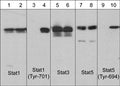
Western blot analysis of human A431 cells untreated (lanes 1, 3, 5, 7, & 9) or treated with EGF (100 nM) for 60 min (lanes 2, 4, 6, 8, & 10). The blots were probed with anti-Stat1 (lanes 1 & 2), anti-Stat1 (Tyr-701) (lanes 3 & 4), anti-Stat3 (lanes 5 & 6), anti-Stat5 (lanes 7 & 8), and anti-Stat5 (Tyr-694) (lanes 9 & 10).
Click on image to zoom

SKU: SM2631
Ships: 1-2 business days
Product Details
Stat3 (N-terminal region)
The stat proteins (Stat1-6) function both as cytoplasmic signal transducers and as activators of transcription in response to cytokines and growth factor receptors. Stat3 is expressed as two variants, Stat3α (86 kDa) and Stat3b (79 kDa) that can differ in expression and activity depending on cell type, activation pathway, and cell maturation stage. Both are activated by phosphorylation at Tyr-705, which induces dimerization, nuclear translocation and DNA binding. Stat3α (86 kDa) transcriptional activation may be regulated by phosphorylation at Ser-727 through the MAPK pathway, while Stat3β lacks this serine site.
Protein A Purified
Monoclonal
M263
IgG1
ELISA, IP, WB
Mouse
STAT3
79/86
Clone (M263) was generated from a recombinant protein that included amino acid residues in the N-terminal region of human Stat3. This sequence has high homology to the conserved regions in rat and mouse Stat3 α and β.
Human
Human, Mouse, Rat
Storage at -20°C is recommended, as aliquots may be taken without freeze/thawing due to presence of 50% glycerol. Stable for at least 1 year at -20°C.
Liquid
PBS + 1 mg/ml BSA, 0.05% NaN3 and 50% glycerol
WB: 1:1000
IP: 1:100
IP: 1:100
Unconjugated
The antibody detects 86 and 79 kDa* bands corresponding to Stat3 isoforms on SDS-PAGE immunoblots of human A431 cells.
Western blots performed on each lot.
For research use only. Not intended for therapeutic or diagnostic use. Use of all products is subject to our terms and conditions, which can be viewed on our website.
United States
After date of receipt, stable for at least 1 year at -20°C.
ADMIO; Signal transducer and activator of transcription 3; APRF; HIES; DNA-binding protein APRF; acute-phase response factor
P40763
UniProt Summary: Signal transducer and transcription activator that mediates cellular responses to interleukins, KITLG/SCF, LEP and other growth factors. Once activated, recruits coactivators, such as NCOA1 or MED1, to the promoter region of the target gene. May mediate cellular responses to activated FGFR1, FGFR2, FGFR3 and FGFR4. Upon activation of IL6ST/gp130 signaling by interleukin-6 (IL6), binds to the IL6-responsive elements identified in the promoters of various acute-phase protein genes. Activated by IL31 through IL31RA. Acts as a regulator of inflammatory response by regulating differentiation of naive CD4(+) T-cells into T-helper Th17 or regulatory T-cells (Treg): acetylation promotes its transcription activity and cell differentiation while deacetylation and oxidation of lysine residues by LOXL3 inhibits differentiation. Involved in cell cycle regulation by inducing the expression of key genes for the progression from G1 to S phase, such as CCND1. Mediates the effects of LEP on melanocortin production, body energy homeostasis and lactation. May play an apoptotic role by transctivating BIRC5 expression under LEP activation. Cytoplasmic STAT3 represses macroautophagy by inhibiting EIF2AK2/PKR activity. Plays a crucial role in basal beta cell functions, such as regulation of insulin secretion. Following JAK/STAT signaling activation and as part of a complex with NFATC3 and NFATC4, binds to the alpha-beta E4 promoter region of CRYAB and activates transcription in cardiomyocytes.
6774
Blue Ice

