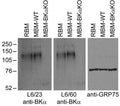
Anti-Slo1/BKAlpha Potassium Channel Antibody (L6/23)
Our mouse Slo1/BKAlpha potassium channel monoclonal antibody from NeuroMab is produced in-house from clone L6/23. It detects mouse and rat Slo1/BKAlpha potassium channel and is purified by Protein A chromatography. KO validated. Works in WB, IHC, ICC, IP, ELISA.
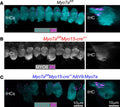
Confocal Z stack images taken from the 9–12 kHz cochlear region in noninjected control Myo7afl/fl (A), Myo7afl/fl Myo15-cre+/– (B), and Myo7afl/fl Myo15-cre+/– mice injected with AAV9-Myo7a (C) at P49–P54. AAV-Myo7a was injected between P13 and P15. Cochleae were labeled with antibodies against BK (Cat. 75-408, 1:200, magenta) and the IHC markers MYO7A (cyan) or MYO6 (gray). BK was almost complete absence in Myo7afl/fl Myo15-cre+/– mice (B). Image from publication, CC-BY-4.0. PMID: 39641274
Click on image to zoom
Mouse, Rat
ELISA, ICC, IHC, IP, WB
Mouse
SKU: 75-408
Ships: 1-2 business days
Product Details
Slo1/BKAlpha potassium channel
Calcium-activated potassium channel subunit alpha-1, Potassium Calcium-Activated Channel Subfamily M Alpha 1 or Slo1/BKalpha is encoded by the gene KCNMA1. BKalpha binds to one of 4 different beta subunits to form a channel in the calcium activated large conductance (MaxiK channel) family. This potassium channel is activated by membrane depolarization or an increase in cytosolic ca2+ and mediated the export of K+. BKalpha is involved with various cell processes including contraction of smooth muscle, regulation of transmitter release, innate immunity and regulation of membrane potential. Diseases associated with KCNMA1 include forms of Epilepsy and Developmental Delay Cerebellar Atrophy and Seizures.
Purified by Protein A chromatography
1 mg/mL
Monoclonal
L6/23
IgG1
ELISA, ICC, IHC, IP, WB
Mouse
Kcnma1 Kcnma
110-130 kDa
Fusion protein amino acids 690-1196 (cytoplasmic C-terminus) of mouse Slo1 (accession number Q08460) produced recombinantly in E. Coli
Mouse
Mouse, Rat
AB_2491105
Aliquot and store at ≤ -20°C for long term storage. For short term storage, store at 2-8°C. For maximum recovery of product, centrifuge the vial prior to removing the cap.
Liquid
Produced by in vitro bioreactor culture of hybridoma line followed by Protein A affinity chromatography. Purified mAbs are >90% specific antibody.
10 mM Tris, 50 mM Sodium Chloride, 0.065% Sodium Azide pH 7.125
IHC: 1:250
Unconjugated
No cross-reactivity reported
Each new lot of antibody is quality control tested by western blot on rat whole brain lysate and confirmed to stain the expected molecular weight band.
These antibodies are to be used as research laboratory reagents and are not for use as diagnostic or therapeutic reagents in humans.
United States
24 months from date of receipt
5730414M22Rik; Calcium-activated potassium channel subunit alpha-1; MaxiK; BK channel; Slo; BKCA alpha; Slo1; Calcium-activated potassium channel; mSlo; K(VCAalpha; mSlo1; KCa1.1; BK channel alpha subunit; Maxi K channel; Slo-alpha; slo homolog; Slowpoke homolog; subfamily M subunit alpha-1
Q08460
UniProt Summary: Potassium channel activated by both membrane depolarization or increase in cytosolic Ca(2+) that mediates export of K(+). It is also activated by the concentration of cytosolic Mg(2+). Its activation dampens the excitatory events that elevate the cytosolic Ca(2+) concentration and/or depolarize the cell membrane. It therefore contributes to repolarization of the membrane potential. Plays a key role in controlling excitability in a number of systems, such as regulation of the contraction of smooth muscle, the tuning of hair cells in the cochlea, regulation of transmitter release, and innate immunity. In smooth muscles, its activation by high level of Ca(2+), caused by ryanodine receptors in the sarcoplasmic reticulum, regulates the membrane potential. In cochlea cells, its number and kinetic properties partly determine the characteristic frequency of each hair cell and thereby helps to establish a tonotopic map. Kinetics of KCNMA1 channels are determined by alternative splicing, phosphorylation status and its combination with modulating beta subunits. Highly sensitive to both iberiotoxin (IbTx) and charybdotoxin (CTX). Possibly induces sleep when activated by melatonin and through melatonin receptor MTNR1A-dependent dissociation of G-beta and G-gamma subunits, leading to increased sensitivity to Ca(2+) and reduced synaptic transmission.
16531
Shipped on ice packs