
Anti-SHP1 (Tyr-536), Phosphospecific Antibody
Our SHP1 (Tyr-536) rabbit polyclonal phosphospecific primary antibody from PhosphoSolutions is produced in-house. It detects human, mouse, and rat SHP1 (Tyr-536) and is antigen affinity purified. It is great for use in WB.
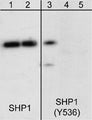
Western blot analysis of human Jurkat cells treated with pervanadate (1 mM) for 30 min. The blot was exposed to alkaline phosphatase (lanes 2 & 4) then probed with anti-SHP1 (C-terminal) antibody (lanes 1 & 2) or anti-SHP1 (Tyr-536) antibody (lanes 3-5). The SHP1 (Tyr-536) antibody was used in the presence of phospho-SHP1 (Tyr-536) peptide (lane 5).
Click on image to zoom

SKU: SP1571
Ships: 1-2 business days
Product Details
SHP1 (Tyr-536)
SHP1 (PTP1C, SH-PTP1, or HCP) is a protein-tyrosine phosphatase (PTP) involved in cell migration, cell proliferation, and immune cell function. This phosphatase contains two N-terminal SH2 domains and a C-terminal phosphatase domain. SHP1 associates with a variety of cytokine and growth factor receptors and regulates signal transduction through dephosphorylation of these receptors or their downstream effectors. Downstream of receptor activation, SHP1 regulates the transcriptional activity stimulated by JAK/Stat and MAPK pathways. SHP1 activity is regulated by both tyrosine and serine phosphorylation. Phosphorylation of Tyr-536 and Tyr-564 stimulates phosphatase activity and promotes interaction with Grb-2. Serine phosphorylation at Ser-591 is mediated by PKCα and leads to inhibition of phosphatase activity. Thus, phosphorylation at tyrosine relative to serine residues may be regulated by different cell signaling pathways to control SHP1 activity.
Antigen Affinity Purified
Polyclonal
IgG
ELISA, WB
Rabbit
PTPN6
68
Phospho-SHP1 (Tyr-536) synthetic peptide (coupled to carrier protein) corresponding to amino acids around tyrosine 536 in human SHP1. The sequence is highly conserved in rat and mouse SHP1.
Human
Human, Mouse, Rat
Storage at -20°C is recommended, as aliquots may be taken without freeze/thawing due to presence of 50% glycerol. Stable for at least 1 year at -20°C.
Liquid
PBS + 1 mg/ml BSA, 0.05% NaN3 and 50% glycerol
WB: 1:1000
Unconjugated
This antibody was cross-adsorbed to a non-specific phospho-tyrosine peptide then affinity-purified using phospho-SHP1 (Tyr-536) peptide. The antibody detects a 68 kDa* band on SDS-PAGE immunoblots of human Jurkat cells treated with pervanadate, but is not observed in control cells.
Phosphorylated
Tyr-536
Western blots performed on each lot.
For research use only. Not intended for therapeutic or diagnostic use. Use of all products is subject to our terms and conditions, which can be viewed on our website.
United States
After date of receipt, stable for at least 1 year at -20°C.
HCP; PTP1C; HPTP1C; PTP-1C; SH-PTP1; SHP-1; SHP-1L; SHP1; tyrosine-protein phosphatase non-receptor type 6; hematopoietic cell phosphatase; hematopoietic cell protein-tyrosine phosphatase; protein-tyrosine phosphatase 1C; protein-tyrosine phosphatase SHP-1; SHPTP1
P29350
UniProt Summary: Tyrosine phosphatase enzyme that plays important roles in controlling immune signaling pathways and fundamental physiological processes such as hematopoiesis. Dephosphorylates and negatively regulate several receptor tyrosine kinases (RTKs) such as EGFR, PDGFR and FGFR, thereby modulating their signaling activities. When recruited to immunoreceptor tyrosine-based inhibitory motif (ITIM)-containing receptors such as immunoglobulin-like transcript 2/LILRB1, programmed cell death protein 1/PDCD1, CD3D, CD22, CLEC12A and other receptors involved in immune regulation, initiates their dephosphorylation and subsequently inhibits downstream signaling events. Modulates the signaling of several cytokine receptors including IL-4 receptor. Additionally, targets multiple cytoplasmic signaling molecules including STING1, LCK or STAT1 among others involved in diverse cellular processes including modulation of T-cell activation or cGAS-STING signaling. Within the nucleus, negatively regulates the activity of some transcription factors such as NFAT5 via direct dephosphorylation. Also acts as a key transcriptional regulator of hepatic gluconeogenesis by controlling recruitment of RNA polymerase II to the PCK1 promoter together with STAT5A.
5777
Blue Ice

