Our Anti-Serotonin Transporter (Thr276) rabbit polyclonal phosphospecific primary antibody from PhosphoSolutions is produced in-house. It detects mouse and rat Serotonin Transporter (Thr276) and is antigen affinity purified from pooled serum. It is great for use in WB.
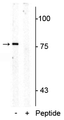
Western blot of rat mid brain membrane lysate showing specific immunolabeling of the ~76 kDa SERT protein phosphorylated at Thr276 in the first lane (-). Phosphospecificity is shown in the second lane (+) where Immunolabeling is blocked by preadsorption of the phosphopeptide used as antigen, but not by the corresponding non-phosphopeptide (not shown).
The serotonin transporter (SERT) recycles serotonin by transporting it back to the pre-synaptic cell. It is the primary target for most anti-depressant drugs and for stimulants such as methamphetamines. SERT is regulated by several processes, including a cyclic GMP signaling pathway involving nitric oxide synthase, guanylyl cyclase, and cGMP-dependent protein kinase (PKG). cGMP- and PKG-mediated SERT regulation requires phosphorylation at Thr-276 (Ramamoorthy et al., 2007). It has been suggested that although PKG is involved in the stimulation of SERT at Thr-276, it does not directly phosphorylate the residue, rather it initiates a kinase cascade that leads to SERT phosphorylation by an as yet unidentified protein kinase (Wong et al., 2012). Also of therapeutic importance, mutation at the Thr-276 residue has been shown to decrease the potency of a variety of anti-depressant drugs, (Zhang YW and Rudnick G, 2005).
Antigen Affinity Purified from Pooled Serum
Polyclonal
IgG
ELISA, WB
Rabbit
SLC6A4
76 kDa
Synthetic phospho-peptide corresponding to amino acid residues surrounding Thr276 of rat SERT, conjugated to keyhole limpet hemocyanin (KLH).
Rat
Mouse, Rat
Bovine, Human, Non-Human Primate, Sheep, Xenopus
AB_2492237
Storage at -20°C is recommended, as aliquots may be taken without freeze/thawing due to presence of 50% glycerol. Stable for at least 1 year at -20°C.
Liquid
Prepared from pooled rabbit serum by affinity purification via sequential chromatography on phospho and non-phosphopeptide affinity columns.
10 mM HEPES (pH 7.5), 150 mM NaCl, 100 µg per ml BSA and 50% glycerol.
WB: 1:1000
WB Brain: 1:1000
Unconjugated
Specific for endogenous levels of the ~76 kDa SERT protein phosphorylated at Thr276. Immunolabeling is blocked by preadsorption with the phosphopeptide used as antigen, but not by the corresponding non-phosphopeptide.
Phosphorylated
Thr276
Western blots performed on each lot.
For research use only. Not intended for therapeutic or diagnostic use. Use of all products is subject to our terms and conditions, which can be viewed on our website.
After date of receipt, stable for at least 1 year at -20°C.
5 HTT; 5 HTTLPR; serotonin transporter; 5 hydroxytryptamine (serotonin transporter; neurotransmitter transporter member 4; 5 hydroxytryptamine transporter; neurotransmitter transporter serotonin member 4; 5HT transporter; 5HTT; hSERT; HTT; Na+/Cl- dependent serotonin transporter; OCD1; SC6A4_HUMAN; Serotonin transporter 1; SERT; SERT1; Slc6a4; Sodium dependent serotonin transporter; Sodium-dependent serotonin transporter; Solute carrier family 6 (neurotransmitter transporter member 4; solute carrier family 6 (neurotransmitter transporter serotonin member 4; Solute carrier family 6 member 4; solute carrier family 6; 5 hydroxytryptamine
P31652
UniProt Summary: Serotonin transporter that cotransports serotonin with one Na(+) ion in exchange for one K(+) ion and possibly one proton in an overall electroneutral transport cycle. Transports serotonin across the plasma membrane from the extracellular compartment to the cytosol thus limiting serotonin intercellular signaling (PubMed:10407194, PubMed:12869649, PubMed:21730057, PubMed:27049939, PubMed:27756841, PubMed:34851672). Essential for serotonin homeostasis in the central nervous system. In the developing somatosensory cortex, acts in glutamatergic neurons to control serotonin uptake and its trophic functions accounting for proper spatial organization of cortical neurons and elaboration of sensory circuits. In the mature cortex, acts primarily in brainstem raphe neurons to mediate serotonin uptake from the synaptic cleft back into the pre-synaptic terminal thus terminating serotonin signaling at the synapse (By similarity). Modulates mucosal serotonin levels in the gastrointestinal tract through uptake and clearance of serotonin in enterocytes. Required for enteric neurogenesis and gastrointestinal reflexes (By similarity). Regulates blood serotonin levels by ensuring rapid high affinity uptake of serotonin from plasma to platelets, where it is further stored in dense granules via vesicular monoamine transporters and then released upon stimulation (PubMed:17506858, PubMed:18317590). Mechanistically, the transport cycle starts with an outward-open conformation having Na1(+) and Cl(-) sites occupied. The binding of a second extracellular Na2(+) ion and serotonin substrate leads to structural changes to outward-occluded to inward-occluded to inward-open, where the Na2(+) ion and serotonin are released into the cytosol. Binding of intracellular K(+) ion induces conformational transitions to inward-occluded to outward-open and completes the cycle by releasing K(+) possibly together with a proton bound to Asp-98 into the extracellular compartment. Na1(+) and Cl(-) ions remain bound throughout the transport cycle (PubMed:10407194, PubMed:12869649, PubMed:21730057, PubMed:27049939, PubMed:27756841, PubMed:34851672). Additionally, displays serotonin-induced channel-like conductance for monovalent cations, mainly Na(+) ions. The channel activity is uncoupled from the transport cycle and may contribute to the membrane resting potential or excitability (By similarity). {ECO:0000250|UniProtKB:P31652, ECO:0000250|UniProtKB:Q60857, ECO:0000269|PubMed:10407194, ECO:0000269|PubMed:12869649, ECO:0000269|PubMed:17506858, ECO:0000269|PubMed:18317590, ECO:0000269|PubMed:21730057, ECO:0000269|PubMed:27049939, ECO:0000269|PubMed:27756841, ECO:0000269|PubMed:34851672}.