
Anti-S6 Kinase 1 (Thr449) Antibody
Our Anti-S6 Kinase 1 (Thr449) rabbit polyclonal phosphospecific primary antibody from PhosphoSolutions is produced in-house. It detects arabidopsis S6 Kinase 1 (Thr449) and is antigen affinity purified from pooled serum. It is great for use in WB.
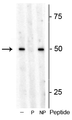
Western blot of Arabidopsis lysate showing specific immunolabeling of the ~53 kDa S6K1 phosphorylated at Thr449 in the first lane (-). Phosphospecificity is shown in the second lane (P) where immunolabeling is blocked by preadsorption with the phosphopeptide used as antigen, but not by the corresponding non-phosphopeptide in the third lane (NP).
Click on image to zoom

SKU: p1705-449
Ships: 1-2 business days
Product Details
S6 Kinase 1 (Thr449)
Ribosomal s6 kinase is a member of a family of protein kinases involved in signal transduction. The subfamily S6K has two known homologues: S6K1 and S6K2. First characterized in mammals, S6K1 is controlled by target-of-rapamycin (TOR) kinase, which plays a central regulatory role in growth signaling pathways (Dufner and Thomas 1999). Osmotic stress inhibition of S6K is mediated by the TOR kinase pathway (Mahfouz et al., 2006). The activation of mammalian S6K1 involves phosphorylation at Thr-389 (Pearson et al., 2005), however its orthologue in Arabidopsis suggests that plant S6K1 Thr-449 is its functional equivalent (Schepetilnikov et al., 2011). The phytohormone auxin triggers TOR activation, which is followed by S6K1 phosphorylation at Thr-449, which in turn is critical for translation reinitiation (Schepetilnikov et al., 2013). Rapamycin effectively inactivates S6K1 Thr-449 phosphorylation in Arabidopsis seedlings, which suppresses TOR PK activity and ultimately plant growth (Xiong Y and Sheen J, 2011).
Antigen Affinity Purified from Pooled Serum
Polyclonal
IgG
ELISA, WB
Rabbit
S6K1
53 kDa
Synthetic phospho-peptide corresponding to amino acid residues surrounding Thr449 of Arabidopsis S6K1, conjugated to keyhole limpet hemocyanin (KLH).
Arabidopsis
Arabidopsis
AB_2492235
Storage at -20°C is recommended, as aliquots may be taken without freeze/thawing due to presence of 50% glycerol. Stable for at least 1 year at -20°C.
Liquid
Prepared from pooled rabbit serum by affinity purification via sequential chromatography on phospho and non-phosphopeptide affinity columns.
10 mM HEPES (pH 7.5), 150 mM NaCl, 100 µg per ml BSA and 50% glycerol.
WB: 1:1000
Unconjugated
Specific for endogenous levels of the ~53 kDa S6K1 protein phosphorylated at Thr449. Immunolabeling is blocked by preadsorption with the phosphopeptide used as antigen, but not by the corresponding non-phosphopeptide.
Phosphorylated
Thr449
Western blots performed on each lot.
For research use only. Not intended for therapeutic or diagnostic use. Use of all products is subject to our terms and conditions, which can be viewed on our website.
After date of receipt, stable for at least 1 year at -20°C.
70 kDa ribosomal protein S6 kinase 1; KS6B1_HUMAN; p70 alpha; P70 beta 1; p70 ribosomal S6 kinase alpha; p70 ribosomal S6 kinase beta 1; p70 S6 kinase alpha; P70 S6 Kinase; p70 S6 kinase alpha 1; p70 S6 kinase alpha 2; p70 S6K; p70 S6K-alpha; p70 S6KA; p70(S6K alpha; p70(S6K-alpha; p70-alpha; p70-S6K 1; p70-S6K; P70S6K; P70S6K1; p70S6Kb; PS6K; Ribosomal protein S6 kinase 70kDa polypeptide 1; Ribosomal protein S6 kinase beta 1; Ribosomal protein S6 kinase beta-1; Ribosomal protein S6 kinase I; RPS6KB1; S6K; S6K-beta-1; S6K1; Serine/threonine kinase 14 alpha; Serine/threonine-protein kinase 14A; STK14A; p70(S6K) alpha; p70(S6K)-alpha
P42818
UniProt Summary: Downstream effector of TOR signaling pathway involved in osmotic stress response (PubMed:20683442). Could be involved in the control of plant growth and development (PubMed:20683442). Phosphorylates the ribosomal proteins P14, P16 and S6 (PubMed:20683442). Functions as a repressor of cell proliferation and required for maintenance of chromosome stability and ploidy levels through the RBR1-E2F pathway (PubMed:20683442). Mediates the phosphorylation of MRFs (e.g. MRF1) (PubMed:29084871). {ECO:0000269|PubMed:20683442, ECO:0000269|PubMed:29084871}.
820020
Blue Ice
- Western Blot Protocol: Download
General References
- Dufner, A. and Thomas, G., 1999. Ribosomal S6 kinase signaling and the control of translation. Experimental Cell Research, 253(1), pp.100-109. PMID: 10579915
- Mahfouz, M.M., Kim, S., Delauney, A.J. and Verma, D.P.S., 2006. Arabidopsis TARGET OF RAPAMYCIN interacts with RAPTOR, which regulates the activity of S6 kinase in response to osmotic stress signals. The Plant Cell, 18(2), pp.477-490. PMID: 16377756
- Pearson, R.B., Dennis, P.B., Han, J.W., Williamson, N.A., Kozma, S.C., Wettenhall, R.E. and Thomas, G., 1995. The principal target of rapamycin‐induced p70s6k inactivation is a novel phosphorylation site within a conserved hydrophobic domain. The EMBO Journal, 14(21), pp.5279-5287. PMID: 7489717
- Schepetilnikov, M., Kobayashi, K., Geldreich, A., Caranta, C., Robaglia, C., Keller, M. and Ryabova, L.A., 2011. Viral factor TAV recruits TOR/S6K1 signalling to activate reinitiation after long ORF translation. The EMBO Journal, 30(7), pp.1343-1356. PMID: 21343906
- Schepetilnikov, M., Dimitrova, M., Mancera‐Martínez, E., Geldreich, A., Keller, M. and Ryabova, L.A., 2013. TOR and S6K1 promote translation reinitiation of uORF‐containing mRNAs via phosphorylation of eIF3h. The EMBO Journal, 32(8), pp.1087-1102. PMID: 23524850
- Xiong, Y. and Sheen, J., 2012. Rapamycin and glucose-target of rapamycin (TOR) protein signaling in plants. Journal of Biological Chemistry, 287(4), pp.2836-2842. PMID: 22134914

