
Anti-Ribosomal protein S6 (Ser244) Antibody
Our Anti-Ribosomal protein S6 (Ser244) rabbit polyclonal phosphospecific primary antibody from PhosphoSolutions is produced in-house. It detects human and mouse Ribosomal protein S6 (Ser244) and is antigen affinity purified from pooled serum. It is great for use in WB.
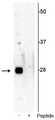
Western blot of Jurkat cell lysate showing specific immunolabeling of the ~28 kDa rpS6 phosphorylated at Ser244 in the first lane (-). Phosphospecificity is shown in the second lane (+) where immunolabeling is blocked by preadsorption of the phosphopeptide used as antigen, but not by the corresponding non-phosphopeptide (not shown).
Click on image to zoom

SKU: p1860-244
Ships: 1-2 business days
Product Details
Ribosomal protein S6 (Ser244)
Ribosomal protein S6 (rpS6) is a critical component of the 40 S ribosomal subunit that mediates translation initiation at the 5'-m7 GpppG cap of mRNA. The rpS6 protein is both cytoplasmic and nuclear localized (Chen and Dittmer 2011). In response to mitogenic stimuli, rpS6 undergoes ordered C-terminal phosphorylation by p70 S6 kinases and p90 ribosomal S6 kinases on four Ser residues (Ser-235, Ser-236, Ser-240, and Ser-244) whose modification potentiates rpS6 cap binding activity (Hutchinson et al., 2011). Additionally, rpS6 phosphorylation and function are highly regulated and have been implicated in the regulation of translational initiation and protein synthesis in response to extracellular stimuli such as TRAIL and gamma interferon (IFN-γ), as well as upon activation of the phosphatidylinositol 3-kinase (PI3K)–Akt–mTOR pathway (Chen and Dittmer 2011).
Antigen Affinity Purified from Pooled Serum
Polyclonal
IgG
ELISA, WB
Rabbit
RPS6
28 kDa
Synthetic phospho-peptide corresponding to amino acid residues surrounding Ser244 of mouse rpS6, conjugated to keyhole limpet hemocyanin (KLH).
Mouse
Human, Mouse
Chicken, Goat, Non-Human Primate, Rat, Xenopus, Zebrafish
AB_2492234
Storage at -20°C is recommended, as aliquots may be taken without freeze/thawing due to presence of 50% glycerol. Stable for at least 1 year at -20°C.
Liquid
Prepared from pooled rabbit serum by affinity purification via sequential chromatography on phospho and non-phosphopeptide affinity columns.
10 mM HEPES (pH 7.5), 150 mM NaCl, 100 µg per ml BSA and 50% glycerol.
WB: 1:500
Unconjugated
Specific for endogenous levels of the ~28 kDa rpS6 protein phosphorylated at Ser244. Immunolabeling is blocked by preadsorption with the phosphopeptide used as antigen, but not by the corresponding non-phosphopeptide.
Phosphorylated
Ser244
Western blots performed on each lot.
For research use only. Not intended for therapeutic or diagnostic use. Use of all products is subject to our terms and conditions, which can be viewed on our website.
After date of receipt, stable for at least 1 year at -20°C.
40S ribosomal protein S6; Air8; NP33; Phosphoprotein NP33; Pp30; Ribosomal protein S6; RP S6; rps6; RS6; RS6_HUMAN; S6; S6 Ribosomal Protein
P62754
UniProt Summary: Component of the 40S small ribosomal subunit (PubMed:23636399, PubMed:8706699). Plays an important role in controlling cell growth and proliferation through the selective translation of particular classes of mRNA (PubMed:17220279). Part of the small subunit (SSU) processome, first precursor of the small eukaryotic ribosomal subunit. During the assembly of the SSU processome in the nucleolus, many ribosome biogenesis factors, an RNA chaperone and ribosomal proteins associate with the nascent pre-rRNA and work in concert to generate RNA folding, modifications, rearrangements and cleavage as well as targeted degradation of pre-ribosomal RNA by the RNA exosome (PubMed:34516797). {ECO:0000269|PubMed:17220279, ECO:0000269|PubMed:23636399, ECO:0000269|PubMed:34516797, ECO:0000269|PubMed:8706699}.
20104
Blue Ice
- Western Blot Protocol: Download
General References
- Chen, W. and Dittmer, D.P., 2011. Ribosomal protein S6 interacts with the latency-associated nuclear antigen of Kaposi's sarcoma-associated herpesvirus. Journal of Virology, 85(18), pp.9495-9505. PMID: 21734034
- Fumagalli, S. and Thomas, G., 2000. 23-S6 Phosphorylation and Signal Transduction. Cold Spring Harbor Monograph Archive
- , 39, pp.695-717.Hutchinson, J.A., Shanware, N.P., Chang, H. and Tibbetts, R.S., 2011. Regulation of ribosomal protein S6 phosphorylation by casein kinase 1 and protein phosphatase 1. Journal of Biological Chemistry, 286(10), pp.8688-8696. PMID: 21233202

