
Anti-Prion Protein (Ser-43), Phosphospecific Antibody
Our Prion Protein (Ser-43) rabbit polyclonal phosphospecific primary antibody from PhosphoSolutions is produced in-house. It detects human, mouse, and rat Prion Protein (Ser-43) and is antigen affinity purified. It is great for use in WB.
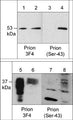
Western blot of GST recombinant human full-length prion protein that was untreated (lanes 1 and 3) or phosphorylated with Cdk5/p25 (lanes 2 & 4). Endogenous prion phosphorylation was examined in human PC3 cells untreated (lanes 5 & 7) or treated with Calyculin A (100 nM) for 30 min (lanes 6 & 8). The blots were probed with anti-Prion protein (3F4) (lanes 1, 2, 5, & 6) or anti-Prion protein (Ser-43) (lanes 3, 4, 7, & 8).
Click on image to zoom

SKU: PP3951
Ships: 1-2 business days
Product Details
Prion Protein (Ser-43)
Prion related neurodegenerative diseases, called transmissible spongiform encephalopathies, are observed in many animal species. These diseases involve conversion of normal cellular prion protein (PrPc) into a form that is insoluble and resistant to proteases (PrPSc). The protease resistant form can polymerize into fibrils which accumulate in infected tissues and cause cell death and tissue damage. PrPs have an N-terminal signal sequence and a C-terminal linkage to glycosylphosphatidylinositol anchor. The mature protein is a glycosylated protein that associates with cell membranes. Phosphorylation of PrPC at Ser-43 by Cdk5 promotes proteinase K resistance, prion aggregation, and fibril formation in vitro. In addition, Ser-43 phosphorylation is upregulated in scrapie-infected mouse brain relative to controls. Thus, phosphorylation of Ser-43 may be an important mechanism leading conversion of PrPc to PrPSc and the onset of disease.
Antigen Affinity Purified
Polyclonal
IgG
ELISA, WB
Rabbit
PRNP
27
Prion Protein (Ser-43) antibody was generated from a phospho-peptide that included amino acids surrounding Serine 43 in human prion protein. This sequence has high homology to the conserved site in rat, mouse, and bovine prion protein.
Human
Human, Mouse, Rat
Storage at -20°C is recommended, as aliquots may be taken without freeze/thawing due to presence of 50% glycerol. Stable for at least 1 year at -20°C.
Liquid
PBS + 1 mg/ml BSA, 0.05% NaN3 and 50% glycerol
WB: 1:1000
Unconjugated
The antibody detects a human recombinant Prion protein after phosphorylation by Cdk5/p25 complex. In addition, the antibody may detect aggregrated forms of prion in human PC3 cells treated with Calyculin A.
Phosphorylated
Ser-43
Western blots performed on each lot.
For research use only. Not intended for therapeutic or diagnostic use. Use of all products is subject to our terms and conditions, which can be viewed on our website.
United States
After date of receipt, stable for at least 1 year at -20°C.
ASCR; PrP; CD230; CJD; GSS; KURU; PRIP; PrP27-30; PrP33-35C; PrPc; p27-30; major prion protein; alternative prion protein; CD230 antigen; prion-related protein; PrPsc
P04156
UniProt Summary: Its primary physiological function is unclear. May play a role in neuronal development and synaptic plasticity. May be required for neuronal myelin sheath maintenance. May promote myelin homeostasis through acting as an agonist for ADGRG6 receptor. May play a role in iron uptake and iron homeostasis. Soluble oligomers are toxic to cultured neuroblastoma cells and induce apoptosis (in vitro). Association with GPC1 (via its heparan sulfate chains) targets PRNP to lipid rafts. Also provides Cu(2+) or Zn(2+) for the ascorbate-mediated GPC1 deaminase degradation of its heparan sulfate side chains.
5621
Blue Ice

