Anti-PAK-1 (Thr84) Antibody
Our Anti-PAK-1 (Thr84) rabbit polyclonal phosphospecific primary antibody from PhosphoSolutions is produced in-house. It detects human, mouse, and rat PAK-1 (Thr84) and is antigen affinity purified from pooled serum. It is great for use in WB.
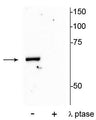
Western blot of mouse hippocampal lysate showing specific immunolabeling of the ~68 kDa PAK1 protein phosphorylated at Thr84 in the first lane (-). Phosphospecificity is shown in the second lane (+) where the immunolabeling is completely eliminated by lysate treatment with lambda phosphatase (λ-Ptase , 800 units/1mg protein for 30 minutes).
Click on image to zoom
SKU: p187-84
Ships: 1-2 business days
Product Details
PAK-1 (Thr84)
PAKs, p21 activated kinases, are a family of serine/threonine protein kinases comprised of six isoforms, PAK1-6, and they play important roles in cytoskeleton dynamics, cell survival and proliferation (Ye et al, 2012). Each of these isoforms contains a C-terminal catalytic domain and an N-terminal regulatory domain with a small G protein binding motif (Chen et al, 2004). OSR1, oxidative stress response 1, is activated only by osmotic stresses, like sorbital or NaCl (Chen et al, 2004). It has been predicted that OSR1 phosphorylates PAK1 in the regulatory domain at thr84 and inhibits activation of JNK and MAPK pathway. (Chen et al, 2004). It has also been suggested that OSR1 may have a regulating function with actin cytoskeleton because it can phosphorylate PAK1 at Thr-84 and bind to gelsolin (Chen et al, 2004).
Antigen Affinity Purified from Pooled Serum
Polyclonal
IgG
ELISA, WB
Rabbit
PAK1
68 kDa
Synthetic phospho-peptide corresponding to amino acid residues surrounding Thr84 of human PAK1, conjugated to keyhole limpet hemocyanin (KLH).
Human
Human, Mouse, Rat
Bovine, Canine, Chicken, Guinea Pig, Non-Human Primate, Sheep, Zebrafish
AB_2492199
Storage at -20°C is recommended, as aliquots may be taken without freeze/thawing due to presence of 50% glycerol. Stable for at least 1 year at -20°C.
Liquid
Prepared from pooled rabbit serum by affinity purification via sequential chromatography on phospho and non-phosphopeptide affinity columns.
10 mM HEPES (pH 7.5), 150 mM NaCl, 100 µg per ml BSA and 50% glycerol.
WB: 1:1000
WB Brain: 1:1000
WB Brain: 1:1000
Unconjugated
Specific for endogenous levels of the ~68 kDa PAK1 phosphorylated at Thr84. The immunolabeling is completely eliminated by treatment with λ-phosphatase.
Phosphorylated
Thr84
Western blots performed on each lot.
For research use only. Not intended for therapeutic or diagnostic use. Use of all products is subject to our terms and conditions, which can be viewed on our website.
After date of receipt, stable for at least 1 year at -20°C.
Alpha PAK; ADRB2; Beta PAK; Cdc42/Rac activated kinase 1; bPAK; yeast Ste20 related; CDKN1A; STE20 homolog yeast; Gamma PAK; hPAK3; MRX30; MRX47; Oligophrenin 3; OPHN3; P21 (CDKN1A activated kinase 2; P21 (CDKN1A activated kinase 3; p21 activated kinase 1; p21 activated kinase 2; p21 activated kinase 3; P21 protein (Cdc42/Rac activated kinase 1; P21 protein (Cdc42/Rac activated kinase 2; P21 protein (Cdc42/Rac activated kinase 3; P21/Cdc42/Rac1 activated kinase 1 (STE20 homolog yeast; P21/Cdc42/Rac1 activated kinase 1 (yeast Ste20 related; P58; P65 PAK; PAK 2; PAK 3; PAK1; PAK2; PAK3; PAK3beta; PAK65; PAKalpha; PAKgamma; S6/H4 kinase; Serine/threonine protein kinase PAK 1; Serine/threonine protein kinase PAK 2; Serine/threonine protein kinase PAK 3; Serine/threonine protein kinase PAK1; Serine/threonine protein kinase PAK2; Serine/threonine protein kinase PAK3; p21-activated kinase 1; p21/Cdc42/Rac1-activated kinase 1; Alpha-PAK; p21/Cdc42/Rac1 activated kinase 1; p65-PAK; MGC130000; P68-PAK; MGC130001; PAK alpha; PAK-1; p21 protein; PAK1_HUMAN; Paka; Protein kinase MUK2; Rac/p21-activated kinase; Serine/threonine-protein kinase PAK 1
Q13153
UniProt Summary: Protein kinase involved in intracellular signaling pathways downstream of integrins and receptor-type kinases that plays an important role in cytoskeleton dynamics, in cell adhesion, migration, proliferation, apoptosis, mitosis, and in vesicle-mediated transport processes (PubMed:10551809, PubMed:11896197, PubMed:12876277, PubMed:14585966, PubMed:15611088, PubMed:17726028, PubMed:17989089, PubMed:30290153, PubMed:17420447). Can directly phosphorylate BAD and protects cells against apoptosis (By similarity). Activated by interaction with CDC42 and RAC1 (PubMed:8805275, PubMed:9528787). Functions as a GTPase effector that links the Rho-related GTPases CDC42 and RAC1 to the JNK MAP kinase pathway (PubMed:8805275, PubMed:9528787). Phosphorylates and activates MAP2K1, and thereby mediates activation of downstream MAP kinases (By similarity). Involved in the reorganization of the actin cytoskeleton, actin stress fibers and of focal adhesion complexes (PubMed:9032240, PubMed:9395435). Phosphorylates the tubulin chaperone TBCB and thereby plays a role in the regulation of microtubule biogenesis and organization of the tubulin cytoskeleton (PubMed:15831477). Plays a role in the regulation of insulin secretion in response to elevated glucose levels (PubMed:22669945). Part of a ternary complex that contains PAK1, DVL1 and MUSK that is important for MUSK-dependent regulation of AChR clustering during the formation of the neuromuscular junction (NMJ) (By similarity). Activity is inhibited in cells undergoing apoptosis, potentially due to binding of CDC2L1 and CDC2L2 (PubMed:12624090). Phosphorylates MYL9/MLC2 (By similarity). Phosphorylates RAF1 at 'Ser-338' and 'Ser-339' resulting in: activation of RAF1, stimulation of RAF1 translocation to mitochondria, phosphorylation of BAD by RAF1, and RAF1 binding to BCL2 (PubMed:11733498). Phosphorylates SNAI1 at 'Ser-246' promoting its transcriptional repressor activity by increasing its accumulation in the nucleus (PubMed:15833848). In podocytes, promotes NR3C2 nuclear localization (By similarity). Required for atypical chemokine receptor ACKR2-induced phosphorylation of LIMK1 and cofilin (CFL1) and for the up-regulation of ACKR2 from endosomal compartment to cell membrane, increasing its efficiency in chemokine uptake and degradation (PubMed:23633677). In synapses, seems to mediate the regulation of F-actin cluster formation performed by SHANK3, maybe through CFL1 phosphorylation and inactivation (By similarity). Plays a role in RUFY3-mediated facilitating gastric cancer cells migration and invasion (PubMed:25766321). In response to DNA damage, phosphorylates MORC2 which activates its ATPase activity and facilitates chromatin remodeling (PubMed:23260667). In neurons, plays a crucial role in regulating GABA(A) receptor synaptic stability and hence GABAergic inhibitory synaptic transmission through its role in F-actin stabilization (By similarity). In hippocampal neurons, necessary for the formation of dendritic spines and excitatory synapses; this function is dependent on kinase activity and may be exerted by the regulation of actomyosin contractility through the phosphorylation of myosin II regulatory light chain (MLC) (By similarity). Along with GIT1, positively regulates microtubule nucleation during interphase (PubMed:27012601). Phosphorylates FXR1, promoting its localization to stress granules and activity (PubMed:20417602). Phosphorylates ILK on 'Thr-173' and 'Ser-246', promoting nuclear export of ILK (PubMed:17420447). {ECO:0000250|UniProtKB:O88643, ECO:0000250|UniProtKB:P35465, ECO:0000269|PubMed:10551809, ECO:0000269|PubMed:11733498, ECO:0000269|PubMed:11896197, ECO:0000269|PubMed:12624090, ECO:0000269|PubMed:12876277, ECO:0000269|PubMed:14585966, ECO:0000269|PubMed:15611088, ECO:0000269|PubMed:15831477, ECO:0000269|PubMed:15833848, ECO:0000269|PubMed:17420447, ECO:0000269|PubMed:17726028, ECO:0000269|PubMed:17989089, ECO:0000269|PubMed:20417602, ECO:0000269|PubMed:22669945, ECO:0000269|PubMed:23260667, ECO:0000269|PubMed:23633677, ECO:0000269|PubMed:25766321, ECO:0000269|PubMed:27012601, ECO:0000269|PubMed:30290153, ECO:0000269|PubMed:8805275, ECO:0000269|PubMed:9032240, ECO:0000269|PubMed:9395435, ECO:0000269|PubMed:9528787}.

5058
Blue Ice
- Western Blot Protocol: Download
General References
- Chen, W., Yazicioglu, M. and Cobb, M.H., 2004. Characterization of OSR1, a member of the mammalian Ste20p/germinal center kinase subfamily. Journal of Biological Chemistry, 279(12), pp.11129-11136. PMID: 14707132
- Ye, D.Z. and Field, J., 2012. PAK signaling in cancer. Cellular Logistics, 2(2), pp.105-116. PMID: 23162742