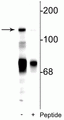
Our Anti-NMDA NR2C Subunit (Ser1244) rabbit polyclonal phosphospecific primary antibody from PhosphoSolutions is produced in-house. It detects mouse and rat NMDA NR2C Subunit (Ser1244) and is antigen affinity purified from pooled serum. It is great for use in WB.
Western blot of rat cerebellar lysate showing specific immunolabeling of the ~140 kDa NR2C subunit of the NMDA receptor phosphorylated at Ser1244 in the first lane (-). Phosphospecificity is shown in the second lane (+) where immunolabeling is blocked by preadsorption of the phosphopeptide used as the antigen, but not by the corresponding non-phosphopeptide (not shown).
The ion channels activated by glutamate that are sensitive to N-methyl-Daspartate (NMDA) are designated NMDA receptors (NMDAR). The NMDAR plays an essential role in memory, neuronal development and it has also been implicated in several disorders of the central nervous system including Alzheimer’s, epilepsy and ischemic neuronal cell death (Grosshans et al., 2002; Wenthold et al., 2003; Carroll and Zukin, 2002). The NMDA receptor is also one of the principal molecular targets for alcohol in the CNS (Lovinger et al., 1989; Alvestad et al., 2003; Snell et al., 1996). The NMDAR is also potentiated by protein phosphorylation (Lu et al., 1999). The NR2C subunit of the receptor is thought to influence the NMDAR conductance level (Ebralidze et al., 1996). Phosphorylation of Ser-1244 has been shown to regulate NMDA receptor channel function (Chen et al., 2006).
Antigen Affinity Purified from Pooled Serum
Polyclonal
IgG
ELISA, WB
Rabbit
GRIN2C
140 kDa
Synthetic phospho-peptide corresponding to amino acid residues surrounding Ser1244 of the NR2C subunit of the rat NMDA receptor, conjugated to keyhole limpet hemocyanin (KLH).
Rat
Mouse, Rat
Bovine, Canine, Human, Non-Human Primate
AB_2492186
Storage at -20°C is recommended, as aliquots may be taken without freeze/thawing due to presence of 50% glycerol. Stable for at least 1 year at -20°C.
Liquid
Prepared from pooled rabbit serum by affinity purification via sequential chromatography on phospho and non-phosphopeptide affinity columns.
10 mM HEPES (pH 7.5), 150 mM NaCl, 100 µg per ml BSA and 50% glycerol.
WB: 1:1000
WB Brain: 1:1000
Unconjugated
Specific for endogenous levels of the ~140 kDa NR2C subunit of the NMDA receptor phosphorylated at Ser1244. Immunolabeling is blocked by preadsorption with the phosphopeptide used as antigen, but not by the corresponding non-phosphopeptide.
Phosphorylated
Ser1244
Western blots performed on each lot.
For research use only. Not intended for therapeutic or diagnostic use. Use of all products is subject to our terms and conditions, which can be viewed on our website.
After date of receipt, stable for at least 1 year at -20°C.
GluN2C; Glutamate [NMDA receptor subunit epsilon-3; Glutamate Receptor Ionotropic N Methyl D Aspartate 2C; Glutamate receptor ionotropic NMDA 2C; Grin2c; Grin 2c; N Methly D Aspartate Receptor Channel Subunit Epsilon 3; N Methyl D Aspartate Receptor Subtype 2C; N methyl D aspartate receptor subunit 2C; N-methyl D-aspartate receptor subtype 2C; NMDAR2C; NMDE3_HUMAN; NR2C; OTTHUMP00000041930
Q00961
UniProt Summary: Component of N-methyl-D-aspartate (NMDA) receptors (NMDARs) that function as heterotetrameric, ligand-gated cation channels with high calcium permeability and voltage-dependent block by Mg(2+) (PubMed:26875626, PubMed:36309015). Participates in synaptic plasticity for learning and memory formation by contributing to the slow phase of excitatory postsynaptic current and long-term synaptic potentiation (By similarity). Channel activation requires binding of the neurotransmitter L-glutamate to the GluN2 subunit, glycine or D-serine binding to the GluN1 subunit, plus membrane depolarization to eliminate channel inhibition by Mg(2+) (PubMed:26875626, PubMed:36309015). NMDARs mediate simultaneously the potassium efflux and the influx of calcium and sodium (By similarity). Each GluN2 subunit confers differential attributes to channel properties, including activation, deactivation and desensitization kinetics, pH sensitivity, Ca2(+) permeability, and binding to allosteric modulators (PubMed:26875626). {ECO:0000250|UniProtKB:P35438, ECO:0000250|UniProtKB:Q01098, ECO:0000269|PubMed:26875626, ECO:0000269|PubMed:36309015}.
Carroll RC, Zukin RS (2002) NMDA-receptor trafficking and targeting: implications for synaptic transmission and plasticity. Trends Neurosci25:571-577. PMID: 12392932
Ebralidze, A.K., Rossi, D.J., Tonegawa, S. and Slater, N.T., 1996. Modification of NMDA receptor channels and synaptic transmission by targeted disruption of the NR2C gene. Journal of Neuroscience, 16(16), pp.5014-5025. PMID: 8756432
Grosshans DR, Clayton DA, Coultrap SJ, Browning MD** (2002) LTP leads to rapid surface expression of NMDA but not AMPA receptors in adult rat CA1. Nat Neurosci 5:27-33. PMID: 11740502
Lovinger DM, White G, Weight FF (1989) Ethanol inhibits NMDA-activated ion current in hippocampal neurons. Science 243:1721-1724. PMID: 2467382
Lu W-Y, Xiong Z-G, Lei S, Orser BA, Browning MD**, MacDonald JF (1999) G-protein coupled receptors act via protein kinase C and Src to regulate NMDA receptors. Nature Neurosci 2:331-338. PMID: 10204539
Snell LD, Nunley KR, Lickteig RL, Browning MD**, Tabakoff B, Hoffman PL (1996) Regional and subunit specific changes in NMDA receptor mRNA and immunoreactivity in mouse brain following chronic ethanol ingestion. Mol Brain Res 40:71-78. PMID: 8840015
Wenthold RJ, Prybylowski K, Standley S, Sans N, Petralia RS (2003) Trafficking of NMDA receptors. Annu Rev Pharmacol Toxicol 43:335-358. PMID: 12540744
Chen, B.S. and Roche, K.W., 2009. Growth factor-dependent trafficking of cerebellar NMDA receptors via protein kinase B/Akt phosphorylation of NR2C. Neuron, 62(4), pp.471-478. PMID: 19477150
**Dr. Michael Browning, a co-author of the above cited papers, is CEO and founder of PhosphoSolutions.
Bulk Order Anti-NMDA NR2C Subunit (Ser1244) Antibody
Related Products
Recently Viewed
Your research is our top priority
Highly-validated antibodies and reagents from our family of brands.