Our Anti-NF-kB p65 (Ser316) rabbit polyclonal phosphospecific primary antibody from PhosphoSolutions is produced in-house. It detects human and mouse NF-kB p65 (Ser316) and is antigen affinity purified from pooled serum. It is great for use in WB.
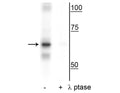
Western blot of 20’ UV treated HeLa lysate showing specific immunolabeling of the ~65 kDa NF-κB p65 phosphorylated at Ser316 in the first lane (-). Phosphospecificity is shown in the second lane (+) where immunolabeling is eliminated by blot treatment with lambda phosphatase (lambda-Ptase, 1200 units for 30 min).
p65, also known as RelA, is one of the five members of the NF-kB family. The p65 and p50 heterodimer is the predominant form of NF-kB, where p65 is the major subunit (Gilmore et al, 2006). There have been 13 identified phosphorylation sites on p65, including Ser-316 which is induced by IL-1β (Viatour et al, 2005 and Wang et al, 2015). Phosphorylation of Ser-316 is essential for NF-kB nuclear transportation, NF-kB-dependent gene regulation, cytokine/chemokine secretion, and other biological functions (Wang et al, 2015). Ser-316 has also been demonstrated to co-phosphorylate with either Ser-529 or Ser-536 to regulate the majority of NF-kB targeted genes while having its own unique regulation function (Wang et al, 2015). CKI kinase specifically targets phosphorylation at Ser-316 on p65 (Wang et al, 2015). CKI is involved in regulation of membrane transport, cell division, DNA repair, and nuclear localization by phosphorylating its target proteins (Price et al, 2006).
Antigen Affinity Purified from Pooled Serum
Polyclonal
IgG
ELISA, WB
Rabbit
RELA
62 kDa
Synthetic phospho-peptide corresponding to amino acid residues surrounding Ser316 of mouse NF-kB p65, conjugated to keyhole limpet hemocyanin (KLH).
Mouse
Human, Mouse
Bovine, Canine, Goat, Guinea Pig, Rat
AB_2756814
Storage at -20°C is recommended, as aliquots may be taken without freeze/thawing due to presence of 50% glycerol. Stable for at least 1 year at -20°C.
Liquid
Prepared from pooled rabbit serum by affinity purification via sequential chromatography on phospho and non-phosphopeptide affinity columns.
10 mM HEPES (pH 7.5), 150 mM NaCl, 100 µg per ml BSA and 50% glycerol.
WB: 1:1000
Unconjugated
Specific for endogenous levels of the ~65 kDa NF-kB p65 protein phosphorylated at Ser316. Immunolabeling is eliminated with λ-phosphatase treatment.
Phosphorylated
Ser316
Western blots performed on each lot.
For research use only. Not intended for therapeutic or diagnostic use. Use of all products is subject to our terms and conditions, which can be viewed on our website.
After date of receipt, stable for at least 1 year at -20°C.
Avian reticuloendotheliosis viral (v rel oncogene homolog A; Avian reticuloendotheliosis viral; MGC131774; v rel oncogene homolog A; NF kappa B p65delta3; nuclear factor of kappa light polypeptide gene enhancer in B cells 3; NFKB3; p65; Nuclear Factor NF Kappa B p65 Subunit; avian; Nuclear factor NF-kappa-B p65 subunit; Nuclear factor of kappa light polypeptide gene enhancer in B cells 3; Nuclear factor of kappa light polypeptide gene enhancer in B-cells 3; OTTHUMP00000233473; OTTHUMP00000233474; OTTHUMP00000233475; OTTHUMP00000233476; OTTHUMP00000233900; p65 NF kappaB; p65 NFkB; relA; TF65_HUMAN; Transcription factor p65; v rel avian reticuloendotheliosis viral oncogene homolog A (nuclear factor of kappa light polypeptide gene enhancer in B cells 3 (p65; V rel avian reticuloendotheliosis viral oncogene homolog A; v rel reticuloendotheliosis viral oncogene homolog A (avian; V rel reticuloendotheliosis viral oncogene homolog A nuclear factor of kappa light polypeptide gene enhancer in B cells 3 p65; v rel reticuloendotheliosis viral oncogene homolog A; v rel avian reticuloendotheliosis viral oncogene homolog A
Q04207
UniProt Summary: NF-kappa-B is a pleiotropic transcription factor present in almost all cell types and is the endpoint of a series of signal transduction events that are initiated by a vast array of stimuli related to many biological processes such as inflammation, immunity, differentiation, cell growth, tumorigenesis and apoptosis. NF-kappa-B is a homo- or heterodimeric complex formed by the Rel-like domain-containing proteins RELA/p65, RELB, NFKB1/p105, NFKB1/p50, REL and NFKB2/p52. The heterodimeric RELA-NFKB1 complex appears to be most abundant one. The dimers bind at kappa-B sites in the DNA of their target genes and the individual dimers have distinct preferences for different kappa-B sites that they can bind with distinguishable affinity and specificity. Different dimer combinations act as transcriptional activators or repressors, respectively. The NF-kappa-B heterodimeric RELA-NFKB1 and RELA-REL complexes, for instance, function as transcriptional activators. NF-kappa-B is controlled by various mechanisms of post-translational modification and subcellular compartmentalization as well as by interactions with other cofactors or corepressors. NF-kappa-B complexes are held in the cytoplasm in an inactive state complexed with members of the NF-kappa-B inhibitor (I-kappa-B) family. In a conventional activation pathway, I-kappa-B is phosphorylated by I-kappa-B kinases (IKKs) in response to different activators, subsequently degraded thus liberating the active NF-kappa-B complex which translocates to the nucleus. The inhibitory effect of I-kappa-B on NF-kappa-B through retention in the cytoplasm is exerted primarily through the interaction with RELA. RELA shows a weak DNA-binding site which could contribute directly to DNA binding in the NF-kappa-B complex. Besides its activity as a direct transcriptional activator, it is also able to modulate promoters accessibility to transcription factors and thereby indirectly regulate gene expression. Associates with chromatin at the NF-kappa-B promoter region via association with DDX1. Essential for cytokine gene expression in T-cells (PubMed:15790681). The NF-kappa-B homodimeric RELA-RELA complex appears to be involved in invasin-mediated activation of IL-8 expression. Key transcription factor regulating the IFN response during SARS-CoV-2 infection (PubMed:33440148). {ECO:0000269|PubMed:10928981, ECO:0000269|PubMed:12748188, ECO:0000269|PubMed:15790681, ECO:0000269|PubMed:17000776, ECO:0000269|PubMed:17620405, ECO:0000269|PubMed:19058135, ECO:0000269|PubMed:19103749, ECO:0000269|PubMed:20547752, ECO:0000269|PubMed:33440148}.
Viatour, P., Merville, M.P., Bours, V. and Chariot, A., 2005. Phosphorylation of NF-κB and IκB proteins: implications in cancer and inflammation. Trends in Biochemical Sciences, 30(1), pp.43-52. PMID: 15653325
Wang, B., Wei, H., Prabhu, L., Zhao, W., Martin, M., Hartley, A.V. and Lu, T., 2015. Role of novel serine 316 phosphorylation of the p65 subunit of NF-κB in differential gene regulation. Journal of Biological Chemistry, 290(33), pp.20336-20347. PMID: 26082493
Price, M.A., 2006. CKI, there's more than one: casein kinase I family members in Wnt and Hedgehog signaling. Genes & Development, 20(4), pp.399-410. PMID: 16481469
Bulk Order Anti-NF-kB p65 (Ser316) Antibody
Related Products
Recently Viewed
Your research is our top priority
Highly-validated antibodies and reagents from our family of brands.