Anti-IRE1 (Ser724) Antibody
Our Anti-IRE1 (Ser724) rabbit polyclonal phosphospecific primary antibody from PhosphoSolutions is produced in-house. It detects mouse Anti-IRE1 (Ser724) and is antigen affinity purified from pooled serum. It is great for use in WB.
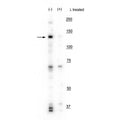
Western blot of mouse whole brain lysate showing specific labeling of the ~130 kDa IRE1 protein phosphorylated at Ser724 in the first lane (-). Phosphospecificity is shown in the second lane (+) where the immunolabeling is eliminated by blot treatment with lambda phosphatase (1200 units for 30 minutes).
Click on image to zoom
SKU: pIRE1-724
Ships: 1-2 business days
Product Details
IRE1 (Ser724)
IRE1, inositol requiring 1 protein, is an ER transmembrane sensor that activates unfolded protein response (UPR) to maintain the ER and cellular function (Chen et al, 2013). The activation of UPR involves three signaling pathways, IRE1, PERK, and ATF6, which are crucial to returning protein homoeostasis to levels of non-stressed cells (Stewart et al, 2012). Changes in ER homeostasis causing unfolded protein buildup can be due to Ca2+ depletion, hypoxia, altered glycosylation, and viral infection triggering the UPR and activation of IRE1 (Stewart et al, 2012). UPR dysfunction plays an important role in the pathogenesis of neurodegenerative diseases including Alzheimer's disease, Parkinson's disease, amyotrophic lateral sclerosis and Huntington's disease, which is characterized by the accumulation and aggregation of misfolded proteins (Xiang C et al, 2017). The phosphorylation of IRE1 at ser724 may play a significant role in understanding these diseases.
Antigen Affinity Purified from Pooled Serum
Polyclonal
ELISA, WB
Rabbit
ERN1
130 kDa
Synthetic phosphopeptide corresponding to amino acid residues surrounding the phospho-Ser724 of mouse IRE1, conjugated to keyhole limpet hemocyanin (KLH).
Mouse
Mouse
Human
AB_2895105
Storage at -20°C is recommended, as aliquots may be taken without freeze/thawing due to presence of 50% glycerol. Stable for at least 1 year at -20°C.
Liquid
Prepared from pooled rabbit serum by affinity purification via sequential chromatography on phospho and non-phosphopeptide affinity columns.
10 mM HEPES (pH 7.5), 150 mM NaCl, 100 µg per ml BSA and 50% glycerol.
WB: 1:1000
WB Brain: 1:1000
WB Brain: 1:1000
Unconjugated
Specific for endogenous levels of the ~130 kDa GluR1 protein phosphorylated at Ser724. Immunolabeling is completely eliminated by treatment with λ-phosphatase.
Phosphorylated
Ser724
Western blots performed on each lot.
For research use only. Not intended for therapeutic or diagnostic use. Use of all products is subject to our terms and conditions, which can be viewed on our website.
United States
After date of receipt, stable for at least 1 year at -20°C.
Endoplasmic reticulum (ER to nucleus signalling 1; Endoplasmic reticulum; Endoplasmic reticulum to nucleus signaling 1; ER to nucleus signalling 1; Endoplasmic reticulum-to-nucleus signaling 1; Endoribonuclease; ER to nucleus signaling 1; ERN 1; Ern1; ERN1_HUMAN; hIRE 1p; hIRE1p; Inositol requiring 1; Inositol requiring 1; S. cerevisiae; homolog of; Inositol requiring enzyme 1; Inositol requiring protein 1; inositol-requiring enzyme 1; Inositol-requiring protein 1; IRE 1; IRE 1a; IRE 1P; Ire1 alpha; Ire1-alpha; IRE1a; Ire1alpha; IRE1P; MGC163277; MGC163279; Protein kinase/endoribonuclease; RGD1559716; Serine/threonine protein kinase/endoribonuclease IRE1
Q9EQY0
UniProt Summary: Serine/threonine-protein kinase and endoribonuclease that acts as a key sensor for the endoplasmic reticulum unfolded protein response (UPR) (PubMed:11175748, PubMed:11779464, PubMed:12637535, PubMed:19328063, PubMed:21317875, PubMed:28128204, PubMed:30118681, PubMed:36739529, PubMed:9637683). In unstressed cells, the endoplasmic reticulum luminal domain is maintained in its inactive monomeric state by binding to the endoplasmic reticulum chaperone HSPA5/BiP (PubMed:21317875). Accumulation of misfolded proteins in the endoplasmic reticulum causes release of HSPA5/BiP, allowing the luminal domain to homodimerize, promoting autophosphorylation of the kinase domain and subsequent activation of the endoribonuclease activity (PubMed:21317875). The endoribonuclease activity is specific for XBP1 mRNA and excises 26 nucleotides from XBP1 mRNA (PubMed:11779464, PubMed:21317875, PubMed:24508390). The resulting spliced transcript of XBP1 encodes a transcriptional activator protein that up-regulates expression of UPR target genes (PubMed:11779464, PubMed:21317875, PubMed:24508390). Acts as an upstream signal for ER stress-induced GORASP2-mediated unconventional (ER/Golgi-independent) trafficking of CFTR to cell membrane by modulating the expression and localization of SEC16A (PubMed:21884936, PubMed:28067262). {ECO:0000269|PubMed:11175748, ECO:0000269|PubMed:11779464, ECO:0000269|PubMed:12637535, ECO:0000269|PubMed:19328063, ECO:0000269|PubMed:21317875, ECO:0000269|PubMed:21884936, ECO:0000269|PubMed:28067262, ECO:0000269|PubMed:28128204, ECO:0000269|PubMed:30118681, ECO:0000269|PubMed:36739529, ECO:0000269|PubMed:9637683, ECO:0000305|PubMed:24508390}.

78943
Blue Ice
- Western Blot Protocol: Download