Anti-HDAC2 (Ser394) Antibody
Our Anti-HDAC2 (Ser394) rabbit polyclonal phosphospecific primary antibody from PhosphoSolutions is produced in-house. It detects mouse and rat HDAC2 (Ser394) and is antigen affinity purified from pooled serum. It is great for use in WB.
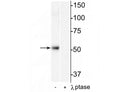
Western blot of mouse heart lysate showing specific immunolabeling of the ~55 kDa HDAC2 protein phosphorylated at Ser394 in the first lane (-). Phosphospecificity is shown in the second lane (+) where immunolabeling is completely eliminated by blot treatment with lambda phosphatase (λ-Ptase, 1200 units for 30 min).
Click on image to zoom
SKU: p1180-394
Ships: 1-2 business days
Product Details
HDAC2 (Ser394)
Histone Deacetylase 2 (HDAC2) is part of a family of histone deacetylases that are responsible for deacetylation of lysine residues in the histone core. HDAC2 is classified as a class I histone deacetylase and is ubiquitously expressed throughout the body (Kee et al, 2008). It has been shown that HDAC2 plays an important role in cardiac hypertrophy (Eom et al, 2011). Phosphorylation of Ser-394 is responsible for the hypertrophy-associated activation of HDAC2, whereas intrinsic basal activity is maintained by phosphorylation of Ser-422 and Ser-424 (EOM et al, 2011).
Antigen Affinity Purified from Pooled Serum
Polyclonal
IgG
ELISA, WB
Rabbit
HDAC2
55 kDa
Synthetic phospho-peptide corresponding to amino acid residues surrounding Ser394 of human HDAC2, conjugated to keyhole limpet hemocyanin (KLH).
Human
Mouse, Rat
Bovine, Chicken, Guinea Pig, Human, Non-Human Primate, Sheep
AB_2492136
Storage at -20°C is recommended, as aliquots may be taken without freeze/thawing due to presence of 50% glycerol. Stable for at least 1 year at -20°C.
Liquid
Prepared from pooled rabbit serum by affinity purification via sequential chromatography on phospho and non-phosphopeptide affinity columns.
10 mM HEPES (pH 7.5), 150 mM NaCl, 100 µg per ml BSA and 50% glycerol.
WB: 1:1000
Unconjugated
Specific for endogenous levels of the ~55 kDa HDAC2 protein phosphorylated at Ser394. Immunolabeling is completely eliminated by treatment with λ-phosphatase.
Phosphorylated
Ser394
Western blots performed on each lot.
For research use only. Not intended for therapeutic or diagnostic use. Use of all products is subject to our terms and conditions, which can be viewed on our website.
After date of receipt, stable for at least 1 year at -20°C.
D10Wsu179e; HD 2; HD2; HDAC 2; Hdac2; HDAC2_HUMAN; Histone deacetylase 2 (HD2; Histone deacetylase 2; OTTHUMP00000017046; OTTHUMP00000227077; OTTHUMP00000227078; RPD3; transcriptional regulator homolog RPD3; YAF1; YY1 associated factor 1; YY1 transcription factor binding protein; Yy1bp; Histone deacetylase 2
Q92769
UniProt Summary: Histone deacetylase that catalyzes the deacetylation of lysine residues on the N-terminal part of the core histones (H2A, H2B, H3 and H4) (PubMed:28497810). Histone deacetylation gives a tag for epigenetic repression and plays an important role in transcriptional regulation, cell cycle progression and developmental events (By similarity). Histone deacetylases act via the formation of large multiprotein complexes (By similarity). Forms transcriptional repressor complexes by associating with MAD, SIN3, YY1 and N-COR (PubMed:12724404). Component of a RCOR/GFI/KDM1A/HDAC complex that suppresses, via histone deacetylase (HDAC) recruitment, a number of genes implicated in multilineage blood cell development (By similarity). Acts as a component of the histone deacetylase NuRD complex which participates in the remodeling of chromatin (PubMed:16428440, PubMed:28977666). Component of the SIN3B complex that represses transcription and counteracts the histone acetyltransferase activity of EP300 through the recognition H3K27ac marks by PHF12 and the activity of the histone deacetylase HDAC2 (PubMed:37137925). Also deacetylates non-histone targets: deacetylates TSHZ3, thereby regulating its transcriptional repressor activity (PubMed:19343227). May be involved in the transcriptional repression of circadian target genes, such as PER1, mediated by CRY1 through histone deacetylation (By similarity). Involved in MTA1-mediated transcriptional corepression of TFF1 and CDKN1A (PubMed:21965678). In addition to protein deacetylase activity, also acts as a protein-lysine deacylase by recognizing other acyl groups: catalyzes removal of (2E)-butenoyl (crotonyl), lactoyl (lactyl) and 2-hydroxyisobutanoyl (2-hydroxyisobutyryl) acyl groups from lysine residues, leading to protein decrotonylation, delactylation and de-2-hydroxyisobutyrylation, respectively (PubMed:28497810, PubMed:29192674, PubMed:35044827). {ECO:0000250|UniProtKB:P70288, ECO:0000269|PubMed:12724404, ECO:0000269|PubMed:16428440, ECO:0000269|PubMed:19343227, ECO:0000269|PubMed:21965678, ECO:0000269|PubMed:28497810, ECO:0000269|PubMed:28977666, ECO:0000269|PubMed:29192674, ECO:0000269|PubMed:35044827, ECO:0000269|PubMed:37137925}.

3066
Blue Ice
- Western Blot Protocol: Download