
Anti-GSK-3α/β (Tyr-279/Tyr-216), Phosphospecific Antibody (M132)
Our GSK-3α/β (Tyr-279/Tyr-216) mouse monoclonal phosphospecific primary antibody from PhosphoSolutions is produced in-house. It detects human, mouse, and rat GSK-3α/β (Tyr-279/Tyr-216) and is Protein A purified. It is great for use in WB.
SKU: GM1321
Ships: 1-2 business days
Product Details
GSK-3α/β (Tyr-279/Tyr-216)
Glycogen synthase kinase-3 (GSK-3) has been implicated in fundamental cell processes such as cell fate determination, metabolism, transcriptional control, and oncogenesis. Two GSK-3 genes (α and β) have been cloned in mammals and these kinase homologues show strong sequence conservation within their catalytic domain. GSK-3β plays a critical role in cell survival by phosphorylating nuclear factor-κB (NF-κB) p65 subunit, leading to NF-κB transactivation in hepatocytes. Phosphorylation regulates the activity of both GSK-3 genes. MEK1/2 can phosphorylate tyrosine 216 (tyrosine 279 in GSK-3α), which stimulates GSK-3 kinase activity. Tyr-216 phosphorylation is required for GSK-mediated down-regulation of β-catenin activity. Also, TRAIL stimulation can increase Tyr-216 phosphorylation, and GSK-3β activity may suppress TRAIL-induced apoptosis. Inactiviation of GSK-3 occurs through Akt phosphorylation of serine 9 of GSK-3β (Serine 21 in GSK-3α). This phosphorylation may be involved in later phases of neuronal apoptosis.
Protein A Purified
Monoclonal
M132
IgG1
ELISA, WB
Mouse
GSK3A/B
46/50
Clone M132 was generated from a phospho-GSK-3β (Tyr-216) synthetic peptide (coupled to KLH) corresponding to amino acid residues around tyrosine 216 of human GSK-3β. This peptide sequence is also found in GSK-3α (Tyr-279) and is highly conserved in GSK-3 genes in rat and mouse.
Human
Human, Mouse, Rat
Storage at -20°C is recommended, as aliquots may be taken without freeze/thawing due to presence of 50% glycerol. Stable for at least 1 year at -20°C.
Liquid
PBS + 1 mg/ml BSA, 0.05% NaN3 and 50% glycerol
WB: 1:1000
Unconjugated
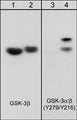
The antibody detects 46/50 kDa* proteins corresponding to the apparent molecular mass of GSK-3β and GSK-3α on SDS-PAGE immunoblots of pervanadate treated rabbit fibroblasts, as well as treated human SKN-SH and A431 cells.
Phosphorylated
Tyr-216
Western blots performed on each lot.
For research use only. Not intended for therapeutic or diagnostic use. Use of all products is subject to our terms and conditions, which can be viewed on our website.
United States
After date of receipt, stable for at least 1 year at -20°C.
glycogen synthase kinase-3 alpha; Glycogen synthase kinase beta3; serine/threonine-protein kinase GSK3A
P49840
UniProt Summary: Constitutively active protein kinase that acts as a negative regulator in the hormonal control of glucose homeostasis, Wnt signaling and regulation of transcription factors and microtubules, by phosphorylating and inactivating glycogen synthase (GYS1 or GYS2), CTNNB1/beta-catenin, APC and AXIN1. Requires primed phosphorylation of the majority of its substrates. Contributes to insulin regulation of glycogen synthesis by phosphorylating and inhibiting GYS1 activity and hence glycogen synthesis. Regulates glycogen metabolism in liver, but not in muscle. May also mediate the development of insulin resistance by regulating activation of transcription factors. In Wnt signaling, regulates the level and transcriptional activity of nuclear CTNNB1/beta-catenin. Facilitates amyloid precursor protein (APP) processing and the generation of APP-derived amyloid plaques found in Alzheimer disease. May be involved in the regulation of replication in pancreatic beta-cells. Is necessary for the establishment of neuronal polarity and axon outgrowth. Through phosphorylation of the anti-apoptotic protein MCL1, may control cell apoptosis in response to growth factors deprivation. Acts as a regulator of autophagy by mediating phosphorylation of KAT5/TIP60 under starvation conditions which activates KAT5/TIP60 acetyltransferase activity and promotes acetylation of key autophagy regulators, such as ULK1 and RUBCNL/Pacer. Negatively regulates extrinsic apoptotic signaling pathway via death domain receptors. Promotes the formation of an anti-apoptotic complex, made of DDX3X, BRIC2 and GSK3B, at death receptors, including TNFRSF10B. The anti-apoptotic function is most effective with weak apoptotic signals and can be overcome by stronger stimulation. Phosphorylates mTORC2 complex component RICTOR at 'Thr-1695' which facilitates FBXW7-mediated ubiquitination and subsequent degradation of RICTOR.
2931
Blue Ice

