Anti-Glycogen synthase kinase 3 B (GSK3B) (Ser9) Antibody
Our Anti-Glycogen synthase kinase 3 B (GSK3B) (Ser9) rabbit polyclonal phosphospecific primary antibody from PhosphoSolutions is produced in-house. It detects mouse and rat Glycogen synthase kinase 3 B (GSK3B) (Ser9) and is antigen affinity purified from pooled serum. It is great for use in WB.
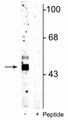
Western blot of rat cortical lysate showing specific immunolabeling of the ~46 kDa GSK3β protein phosphorylated at Ser9 in the first lane (-). Phosphospecificity is shown in the second lane (+) where immunolabeling is blocked by preadsorption of the phosphopeptide used as the antigen, but not by the corresponding non-phosphopeptide (not shown).
Click on image to zoom
SKU: p1175-9
Ships: 1-2 business days
Product Details
Glycogen synthase kinase 3 B (GSK3B) (Ser9)
Glycogen synthase kinase 3 (GSK3) is a serine/threonine kinase that is involved in the regulation of many signaling pathways. To date, 2 isoforms have been identified: GSK3α and GSK3β. Specifically, GSK3β has been shown to play a key inhibitory role in both the insulin and Wnt signaling pathways (Papkoff and Aikawa 1998). It has been suggested that Ser-9 phosphorylation underlies the inhibition of GSK3β by insulin (Sutherland et al., 1993).
Antigen Affinity Purified from Pooled Serum
Polyclonal
IgG
ELISA, WB
Rabbit
GSK3B
46 kDa
Synthetic phospho-peptide corresponding to amino acid residues surrounding Ser9 of rat GSK3β, conjugated to keyhole limpet hemocyanin (KLH).
Rat
Mouse, Rat
Bovine, Canine, Chicken, Human, Non-Human Primate, Xenopus, Zebrafish
AB_2492134
Storage at -20°C is recommended, as aliquots may be taken without freeze/thawing due to presence of 50% glycerol. Stable for at least 1 year at -20°C.
Liquid
Prepared from pooled rabbit serum by affinity purification via sequential chromatography on phospho and non-phosphopeptide affinity columns.
10 mM HEPES (pH 7.5), 150 mM NaCl, 100 µg per ml BSA and 50% glycerol.
WB: 1:1000
WB Brain: 1:1000
WB Brain: 1:1000
Unconjugated
Specific for the ~46 kDa GSK3β protein phosphorylated at Ser9. Also weakly labels the ~51 kDa GSK3β band due to the high degree of homology between the 2 subunits. Immunolabeling is blocked by the phosphopeptide used as antigen but not by the corresponding dephosphopeptide.
Phosphorylated
Ser9
Western blots performed on each lot.
For research use only. Not intended for therapeutic or diagnostic use. Use of all products is subject to our terms and conditions, which can be viewed on our website.
After date of receipt, stable for at least 1 year at -20°C.
Glycogen Synthase Kinase 3 Beta; Glycogen synthase kinase-3 beta; GSK 3 beta; GSK-3 beta; GSK3B; GSK3B_HUMAN; GSK3beta isoform; Serine/threonine-protein kinase GSK3B
P18266
UniProt Summary: Constitutively active protein kinase that acts as a negative regulator in the hormonal control of glucose homeostasis, Wnt signaling and regulation of transcription factors and microtubules, by phosphorylating and inactivating glycogen synthase (GYS1 or GYS2), EIF2B, CTNNB1/beta-catenin, APC, AXIN1, DPYSL2/CRMP2, JUN, NFATC1/NFATC, MAPT/TAU and MACF1 (PubMed:11430833, PubMed:12554650, PubMed:14690523, PubMed:16484495, PubMed:1846781, PubMed:20937854, PubMed:9072970). Requires primed phosphorylation of the majority of its substrates (PubMed:11430833, PubMed:16484495). In skeletal muscle, contributes to insulin regulation of glycogen synthesis by phosphorylating and inhibiting GYS1 activity and hence glycogen synthesis (PubMed:8397507). May also mediate the development of insulin resistance by regulating activation of transcription factors (PubMed:8397507). Regulates protein synthesis by controlling the activity of initiation factor 2B (EIF2BE/EIF2B5) in the same manner as glycogen synthase (PubMed:8397507). In Wnt signaling, GSK3B forms a multimeric complex with APC, AXIN1 and CTNNB1/beta-catenin and phosphorylates the N-terminus of CTNNB1 leading to its degradation mediated by ubiquitin/proteasomes (PubMed:12554650). Phosphorylates JUN at sites proximal to its DNA-binding domain, thereby reducing its affinity for DNA (PubMed:1846781). Phosphorylates NFATC1/NFATC on conserved serine residues promoting NFATC1/NFATC nuclear export, shutting off NFATC1/NFATC gene regulation, and thereby opposing the action of calcineurin (PubMed:9072970). Phosphorylates MAPT/TAU on 'Thr-548', decreasing significantly MAPT/TAU ability to bind and stabilize microtubules (PubMed:14690523). MAPT/TAU is the principal component of neurofibrillary tangles in Alzheimer disease (PubMed:14690523). Plays an important role in ERBB2-dependent stabilization of microtubules at the cell cortex (PubMed:20937854). Phosphorylates MACF1, inhibiting its binding to microtubules which is critical for its role in bulge stem cell migration and skin wound repair (By similarity). Probably regulates NF-kappa-B (NFKB1) at the transcriptional level and is required for the NF-kappa-B-mediated anti-apoptotic response to TNF (TNF/TNFA) (By similarity). Negatively regulates replication in pancreatic beta-cells, resulting in apoptosis, loss of beta-cells and diabetes (By similarity). Through phosphorylation of the anti-apoptotic protein MCL1, may control cell apoptosis in response to growth factors deprivation (By similarity). Phosphorylates MUC1 in breast cancer cells, decreasing the interaction of MUC1 with CTNNB1/beta-catenin (PubMed:9819408). Is necessary for the establishment of neuronal polarity and axon outgrowth (PubMed:20067585). Phosphorylates MARK2, leading to inhibition of its activity (By similarity). Phosphorylates SIK1 at 'Thr-182', leading to sustainment of its activity (PubMed:18348280). Phosphorylates ZC3HAV1 which enhances its antiviral activity (PubMed:22514281). Phosphorylates SNAI1, leading to its ubiquitination and proteasomal degradation (PubMed:15448698, PubMed:15647282, PubMed:25827072, PubMed:29059170). Phosphorylates SFPQ at 'Thr-687' upon T-cell activation (PubMed:20932480). Phosphorylates NR1D1 st 'Ser-55' and 'Ser-59' and stabilizes it by protecting it from proteasomal degradation. Regulates the circadian clock via phosphorylation of the major clock components including BMAL1, CLOCK and PER2 (PubMed:19946213, PubMed:28903391). Phosphorylates FBXL2 at 'Thr-404' and primes it for ubiquitination by the SCF(FBXO3) complex and proteasomal degradation (By similarity). Phosphorylates CLOCK AT 'Ser-427' and targets it for proteasomal degradation (PubMed:19946213). Phosphorylates BMAL1 at 'Ser-17' and 'Ser-21' and primes it for ubiquitination and proteasomal degradation (PubMed:28903391). Phosphorylates OGT at 'Ser-3' or 'Ser-4' which positively regulates its activity. Phosphorylates MYCN in neuroblastoma cells which may promote its degradation (PubMed:24391509). Regulates the circadian rhythmicity of hippocampal long-term potentiation and BMAL1 and PER2 expression (By similarity). Acts as a regulator of autophagy by mediating phosphorylation of KAT5/TIP60 under starvation conditions, activating KAT5/TIP60 acetyltransferase activity and promoting acetylation of key autophagy regulators, such as ULK1 and RUBCNL/Pacer (PubMed:30704899). Negatively regulates extrinsic apoptotic signaling pathway via death domain receptors. Promotes the formation of an anti-apoptotic complex, made of DDX3X, BRIC2 and GSK3B, at death receptors, including TNFRSF10B. The anti-apoptotic function is most effective with weak apoptotic signals and can be overcome by stronger stimulation (PubMed:18846110). Phosphorylates E2F1, promoting the interaction between E2F1 and USP11, stabilizing E2F1 and promoting its activity (PubMed:17050006, PubMed:28992046). Phosphorylates mTORC2 complex component RICTOR at 'Ser-1235' in response to endoplasmic stress, inhibiting mTORC2 (PubMed:21343617). Phosphorylates mTORC2 complex component RICTOR at 'Thr-1695' which facilitates FBXW7-mediated ubiquitination and subsequent degradation of RICTOR (PubMed:25897075). Phosphorylates FXR1, promoting FXR1 ubiquitination by the SCF(FBXO4) complex and FXR1 degradation by the proteasome (By similarity). Phosphorylates interleukin-22 receptor subunit IL22RA1, preventing its proteasomal degradation (By similarity). Phosphorylates and inhibits the CTP synthase and protein-asparagine deamidase activities of CTPS1 (PubMed:17681942). Phosphorylates DSP at multiple sequential serine residues in the C-terminus tail, promoting its recruitment to developing desmosome cell-cell junctions (PubMed:25733715). {ECO:0000250|UniProtKB:P18266, ECO:0000250|UniProtKB:Q9WV60, ECO:0000269|PubMed:11430833, ECO:0000269|PubMed:12554650, ECO:0000269|PubMed:14690523, ECO:0000269|PubMed:15448698, ECO:0000269|PubMed:15647282, ECO:0000269|PubMed:16484495, ECO:0000269|PubMed:17050006, ECO:0000269|PubMed:17681942, ECO:0000269|PubMed:18348280, ECO:0000269|PubMed:1846781, ECO:0000269|PubMed:18846110, ECO:0000269|PubMed:19946213, ECO:0000269|PubMed:20067585, ECO:0000269|PubMed:20932480, ECO:0000269|PubMed:20937854, ECO:0000269|PubMed:21343617, ECO:0000269|PubMed:22514281, ECO:0000269|PubMed:24391509, ECO:0000269|PubMed:25733715, ECO:0000269|PubMed:25827072, ECO:0000269|PubMed:25897075, ECO:0000269|PubMed:28903391, ECO:0000269|PubMed:28992046, ECO:0000269|PubMed:29059170, ECO:0000269|PubMed:30704899, ECO:0000269|PubMed:8397507, ECO:0000269|PubMed:9072970, ECO:0000269|PubMed:9819408}.

84027
Blue Ice
- Western Blot Protocol: Download
General References
- Sutherland C, Leighton IA, Cohen P (1993) Inactivation of glycogen synthase kinase 3 beta by phosphorylation: new kinase connections in insulin and growth factor signaling. Biochem J. Nov 15;296 (Pt. 1):15-9. PMID: 8250835
- Papkoff J, Aikawa M (1998)WNT-1 and HGF regulate GSK3b activity and beta catenin signaling in mammary epithelial cells. Biochem Biophys Res Commun. Jun 29;247(3):851-8. PMID: 9647782