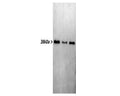
Anti-Glyceraldehyde 3-Phosphate Dehydrogenase (GAPDH) Antibody (1D4)
Our Anti-Glyceraldehyde 3-Phosphate Dehydrogenase (GAPDH) mouse monoclonal primary antibody detects bovine, chicken, human, mouse, pig, and rat Glyceraldehyde 3-Phosphate Dehydrogenase (GAPDH), and is purified. It is validated for use in ICC, IHC-Frozen, WB.
SKU: M-1376-250
Ships: 5-7 business days
Product Details
Glyceraldehyde 3-Phosphate Dehydrogenase (GAPDH)
Glyceraldehyde 3-Phosphate Dehydrogenase (GAPDH) is a metabolic enzyme responsible for catalyzing one step in the glycolytic pathway, the reversible oxidative phosphorylation of glyceraldehyde 3-phosphate. GAPDH may have other roles in the activation of transcription and in the regulation of apoptosis as well as Alzheimer's disease and Huntington's disease. The immunogen used to raise this particular antibody was extensively purified pig GAPDH. This antibody can be used as a loading control for western blotting experiments, allowing comparison between the level of this protein and others in a cell or tissue.
Purified
Monoclonal
1D4
IgM
ICC, IHC, WB
Mouse
36 kDa
Purified pig GAPDH
Pig
Bovine, Chicken, Human, Mouse, Pig, Rat
Spin vial briefly before opening. Reconstitute with 250 µL sterile-filtered, ultrapure water to achieve a 1 mg/mL concentration. Centrifuge to remove any insoluble material. After reconstitution of lyophilized antibody, aliquot and store at -20°C for a higher stability. Avoid freeze-thaw cycles.
Lyophilized
Protein L purified
Lyophilized from PBS buffer pH 7.2-7.6 with 0.1% trehalose, and sodium azide
WB: 1:1000
ICC: 1:100
ICC: 1:100
Unconjugated
The specificity of this antibody has been confirmed by WB. Human, rat, mouse, bovine, Porcine, Chicken.
For research use only.
United States
12 months after date of receipt (unopened vial).
38 kDa BFA-dependent ADP-ribosylation substrate; Glyceraldehyde-3-phosphate dehydrogenase; aging associated gene 9 protein; GAPDH; Aging-associated gene 9 protein; GAPD; BARS-38; G3PDH; cb609; GPDH; EC 1.2.1.12; Epididymis secretory sperm binding protein Li 162eP; G3P_HUMAN; G3PD; G3PDH; GAPD; GAPDH; Glyceraldehyde 3 phosphate dehydrogenase; Glyceraldehyde-3-phosphate dehydrogenase; HEL-S-162eP; KNC-NDS6; MGC102544; MGC102546; MGC103190; MGC103191; MGC105239; MGC127711; MGC88685; OCAS; p38 component; OCT1 coactivator in S phase; 38-KD component; peptidyl cysteine S nitrosylase GAPDH; Peptidyl-cysteine S-nitrosylase GAPDH; wu:fb33a10
P00355
UniProt Summary: Catalyzes the conversion of D-glyceraldehyde 3-phosphate (G3P) into 3-phospho-D-glyceroyl phosphate in glycolysis and the reverse reaction in gluconeogenesis. Also shows nitrosylase activity, thereby playing a role in nuclear functions. Modulates the organization and assembly of the cytoskeleton. Facilitates the CHP1-dependent microtubule and membrane associations through its ability to stimulate the binding of CHP1 to microtubules. Component of the GAIT (gamma interferon-activated inhibitor of translation) complex which mediates interferon-gamma-induced transcript-selective translation inhibition in inflammation processes. Upon interferon-gamma treatment assembles into the GAIT complex which binds to stem loop-containing GAIT elements in the 3'-UTR of diverse inflammatory mRNAs (such as ceruplasmin) and suppresses their translation. Also plays a role in innate immunity by promoting TNF-induced NF-kappa-B activation and type I interferon production, via interaction with TRAF2 and TRAF3, respectively. Participates in nuclear events including transcription, RNA transport, DNA replication and apoptosis. Nuclear functions are probably due to the nitrosylase activity that mediates cysteine S-nitrosylation of nuclear target proteins such as SIRT1, HDAC2 and PRKDC.
396823
25°C (ambient)