
Anti-GluR2/3 Antibody
Our Anti-GluR2/3 rabbit polyclonal primary antibody from PhosphoSolutions is produced in-house. It detects rat GluR2/3 and is antigen affinity purified from pooled serum. It is great for use in WB.
SKU: 905-GluR2/3
Ships: 1-2 business days
Product Details
GluR2/3
The ion channels activated by glutamate are typically divided into two classes. Those that are sensitive to N-methyl-D-aspartate (NMDA) are designated NMDA receptors (NMDAR) while those activated by α-amino-3-hydroxy-5-methyl-4-isoxalone propionic acid (AMPA) are known as AMPA receptors (AMPAR). The AMPAR are comprised of four distinct glutamate receptor subunits designated (GluR1-4) and they play key roles in virtually all excitatory neurotransmission in the brain (Keinänen et al., 1990;Hollmann and Heinemann, 1994). The GluR2 subunit is widely expressed throughout the nervous system where it is thought to play key roles in synaptic plasticity and learning and memory (Duprat et al., 2003;Seidenman et al., 2003;Chung et al., 2003;Yan et al., 2002).
Antigen Affinity Purified from Pooled Serum
Polyclonal
IgG
ELISA, WB
Rabbit
GRIA2/3
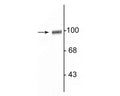
100 kDa
Synthetic peptide corresponding to amino acid residues from the C-terminal region of rat GluR2/3, conjugated to keyhole limpet hemocyanin (KLH).
Rat
Rat
Chicken, Human, Mouse, Zebrafish
AB_2492130
Storage at -20°C is recommended, as aliquots may be taken without freeze/thawing due to presence of 50% glycerol. Stable for at least 1 year at -20°C.
Liquid
Prepared from rabbit serum by affinity purification using a column to which the peptide immunogen was coupled.
10 mM HEPES (pH 7.5), 150 mM NaCl, 100 µg per ml BSA and 50% glycerol.
WB: 1:1000
WB Brain: 1:1000
WB Brain: 1:1000
Unconjugated
Specific for endogenous levels of the ~100 kDa GluR2/3 protein.
Western blots performed on each lot.
For research use only. Not intended for therapeutic or diagnostic use. Use of all products is subject to our terms and conditions, which can be viewed on our website.
After date of receipt, stable for at least 1 year at -20°C.
AMPA 2; AMPA selective glutamate receptor 2; AMPA-selective glutamate receptor 2; AMPA2; GluA2; GLUR 2; GLUR B; GluR K2; GluR-2; GluR-B; GluR-K2; GLUR2; GLURB; Glutamate receptor 2; Glutamate receptor ionotropic AMPA 2; Glutamate receptor ionotropic; Gria2; GRIA2_HUMAN; HBGR2; AMPA selective glutamate receptor 3; GluR K3; GLURC; GLUTAMATE RECEPTOR 3; Glutamate receptor ionotropic AMPA 3; GRIA3
P19491
UniProt Summary: Ionotropic glutamate receptor that functions as a ligand-gated cation channel, gated by L-glutamate and glutamatergic agonists such as alpha-amino-3-hydroxy-5-methyl-4-isoxazolepropionic acid (AMPA), quisqualic acid, and kainic acid (PubMed:20614889, PubMed:31300657, PubMed:8003671). L-glutamate acts as an excitatory neurotransmitter at many synapses in the central nervous system and plays an important role in fast excitatory synaptic transmission (PubMed:14687553). Binding of the excitatory neurotransmitter L-glutamate induces a conformation change, leading to the opening of the cation channel, and thereby converts the chemical signal to an electrical impulse upon entry of monovalent and divalent cations such as sodium and calcium (PubMed:20614889, PubMed:8003671). The receptor then desensitizes rapidly and enters in a transient inactive state, characterized by the presence of bound agonist (By similarity). In the presence of CACNG4 or CACNG7 or CACNG8, shows resensitization which is characterized by a delayed accumulation of current flux upon continued application of L-glutamate (By similarity). Through complex formation with NSG1, GRIP1 and STX12 controls the intracellular fate of AMPAR and the endosomal sorting of the GRIA2 subunit toward recycling and membrane targeting (By similarity). {ECO:0000250|UniProtKB:P19491, ECO:0000269|PubMed:14687553, ECO:0000269|PubMed:20614889, ECO:0000269|PubMed:31300657, ECO:0000269|PubMed:8003671}.
29627
Blue Ice
- Western Blot Protocol: Download
General References
- Chung HJ, Steinberg JP, Huganir RL, Linden DJ (2003) Requirement of AMPA receptor GluR2 phosphorylation for cerebellar long-term depression. Science 300:1751-1755. PMID: 12805550
- Duprat F, Daw M, Lim W, Collingridge G, Isaac J (2003) GluR2 protein-protein interactions and the regulation of AMPA receptors during synaptic plasticity. Philos Trans R Soc Lond B Biol Sci 358:715-720. PMID: 12740117
- Hollmann M, Heinemann S (1994) Cloned glutamate receptors. Annu Rev Neurosci 17:31-108. PMID: 8210177
- Keinänen K, Wisden W, Sommer B, Werner P, Herb A, Verdoorn TA, Sakmann B, Seeburg PH (1990) A family of AMPA-selective glutamate receptors. Science 249:556-560. PMID: 2166337
- Seidenman KJ, Steinberg JP, Huganir R, Malinow R (2003) Glutamate receptor subunit 2 serine 880 phosphorylation modulates synaptic transmission and mediates plasticity in CA1 pyramidal cells. J Neurosci 23:9220-9228. PMID: 14534256
- Yan, J., Zhang, Y., Jia, Z., Taverna, F.A., McDonald, R.J., Muller, R.U. and Roder, J.C., 2002. Place-cell impairment in glutamate receptor 2 mutant mice. Journal of Neuroscience, 22(3), pp.RC204-RC204. PMID: 11826150

